

Exchange rate breaks through 1,480 won… Over 1,530 won when buying
Summary
- The won·dollar exchange rate broke through 1,480 won intraday for the first time in eight months, continuing an upward trend despite responses from foreign exchange authorities.
- The governor of the Bank of Korea said the current exchange rate level is not a financial crisis, but he expressed concern about its impact on prices and social polarization.
- The Bank of Korea said that if the current won·dollar exchange rate persists through next year, the inflation rate could be higher than previously projected.
Won·dollar, highest in 8 months
Rising trend despite foreign exchange authorities' response
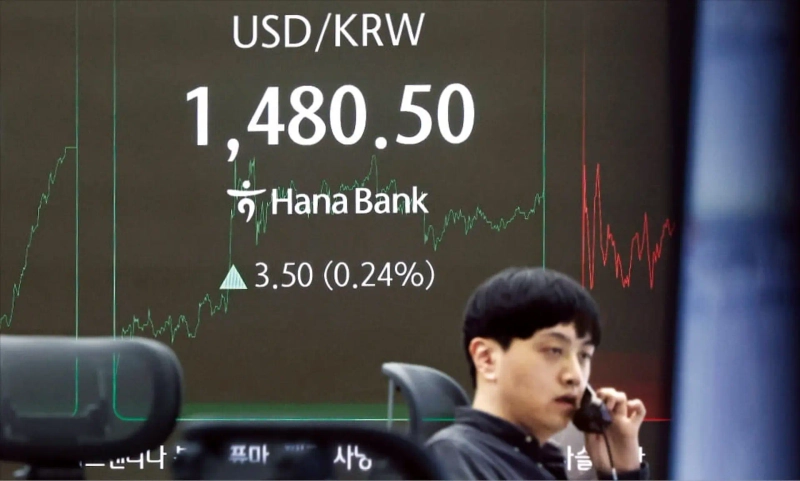
The won·dollar exchange rate surged into the 1,480-won range intraday on the 17th, the highest in eight months. The National Pension Service recently restarted strategic currency hedging using a foreign exchange swap agreement with the Bank of Korea, but it appears unable to stop the exchange rate's rise. The Bank of Korea and the National Pension Service extended by one year the swap agreement, sized at $65 billion annually, on the 15th.
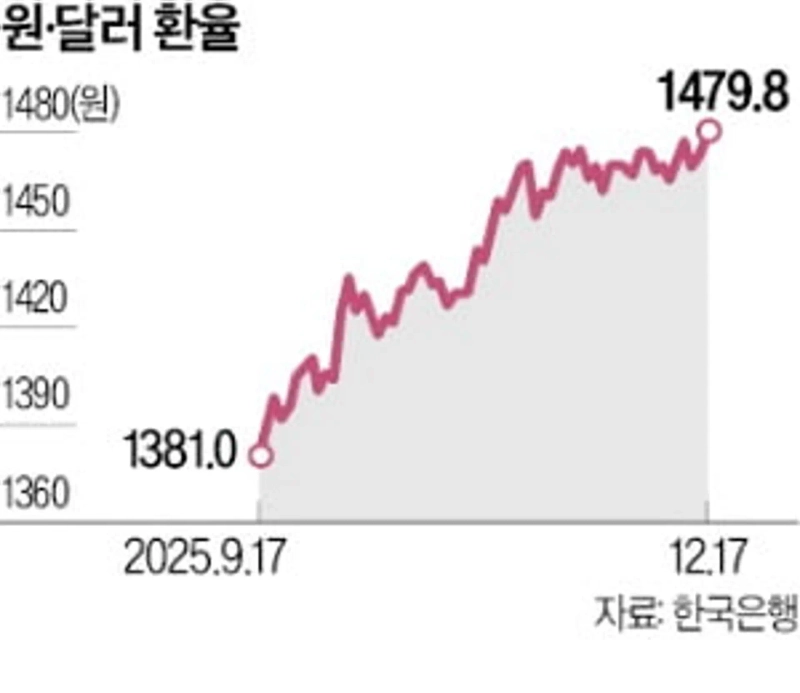
On that day in the Seoul foreign exchange market, the won·dollar exchange rate (as of 3:30 p.m.) closed trading at 1,479.80 won, up 2.80 won from the previous day. The rate opened at 1,474.50 won, down 2.50 won, but soon turned upward, rising to 1,482.30 won around 11:08 a.m. It was the first intraday breach of 1,480 won since April 9 (1,487.60 won) eight months ago. The exchange rate applied to consumers when exchanging at airports or bank counters rose into the 1,530-won range.
The day's rise in the exchange rate is attributed to the dollar's strength, such as an increase in the dollar index (the dollar's value against six major currencies), and the effect of foreigners' net-selling of 28.9 billion won worth on the stock market. Recently the exchange rate has steadily risen, repeatedly following a pattern of starting down after government measures are announced and then turning upward.
Foreign exchange authorities expressed caution. Lee Chang-yong, governor of the Bank of Korea, said at a price stability target briefing that "we take seriously the possibility that a high exchange rate could raise consumer prices," and "coordination is needed not only on volatility but also on the level of the exchange rate." His remarks that day were interpreted as verbal intervention.
"Exchange rate 1,480 won, an unnecessarily high level
Not a financial crisis but a crisis for prices and polarization"
Market attention focused on Governor Lee Chang-yong's comment on the intraday breach of 1,480 won, that "an unnecessarily high level can be adjusted (responded to)." It was unusual for the head of foreign exchange authorities to assess not only volatility but the level of the exchange rate and express willingness to intervene.
At the price stability briefing, the governor sent a worrying message about the exchange rate level. He said of the current exchange rate level, "Since our country has been a net external creditor since 2014, many benefit when the won depreciates," and "this is not a financial crisis where financial firms collapse and the country faces default risk." However, he added, "the impact of the exchange rate on prices is large, and internally there is a stark divide between those who benefit and those who lose," and "it could be a crisis in terms of growth, prices, and polarization, so I am very concerned."
He said, "In a high exchange rate situation, the separation between groups that benefit and those that lose could make social cohesion difficult," and "if a high exchange rate causes consumer prices to rise further, the burden on the public could increase, and we recognize that seriously."
According to the Bank of Korea's inflation model, when the exchange rate rises 10% it typically raises the consumer price inflation rate by 0.3 percentage point. The Bank of Korea estimates that if the current won·dollar exchange rate in the 1,470-won range continues through next year, the inflation rate would be around 2.3%, higher than the previous projection of 2.1%.
The governor pointed out that the recent rise in the exchange rate is partly because the National Pension Service's hedging strategy has effectively become public. He said, "Decision criteria such as the timing to hedge and the timing to stop are too well known to foreign exchange market participants, so the exchange rate is forming a box range," and "this perception needs to be corrected." He meant that when the exchange rate falls, speculative funds flow in until the exchange rate rises again to the level at which the National Pension Service would activate hedging.
He gave a positive assessment of recent changes at the National Pension Service. He said, "Deciding hedge timing flexibly considering macro effects is a big step forward," and "if the new policy works, supply-demand conditions should improve."
Regarding criticism that explaining individual investors' overseas investment as a factor in the exchange rate rise turned into blaming the "study abroad ants" (Korean retail investors investing overseas), he emphasized, "I am not blaming a specific group." The governor said, "I know the problem is that there is a large growth rate gap between Korea and the U.S., a large interest rate gap, and a Korea discount in the stock market," and "fixing this will take considerable time, so we need to adjust short-term supply-demand factors first."
On the claim that an annual $20 billion cap on U.S. investments is acting as a factor in the exchange rate rise, he said, "We will not make U.S. investments that threaten the foreign exchange market." The governor stressed, "According to the memorandum of understanding (MOU), when the Bank of Korea supplies funds from interest and dividend income on foreign exchange reserves, it must do so within a range that does not affect the market."
Kang Jin-kyu reporter josep@hankyung.com

Korea Economic Daily
hankyung@bloomingbit.ioThe Korea Economic Daily Global is a digital media where latest news on Korean companies, industries, and financial markets.