

U.S. inflation rate 2.7% 'surprisingly' stable…won·dollar exchange rate 'swings'
Summary
- The U.S. November consumer price index (CPI) was announced at 2.7%, below market expectations, and the won·dollar exchange rate fell sharply in the foreign exchange market.
- The low CPI figure stimulated expectations of U.S. interest rate cuts, but experts raised doubts about the statistic's reliability due to factors such as the government shutdown.
- With questions over possible distortion in November's CPI, if December's figure rebounds, U.S. interest rate cut expectations and the won·dollar exchange rate decline could be reversed.
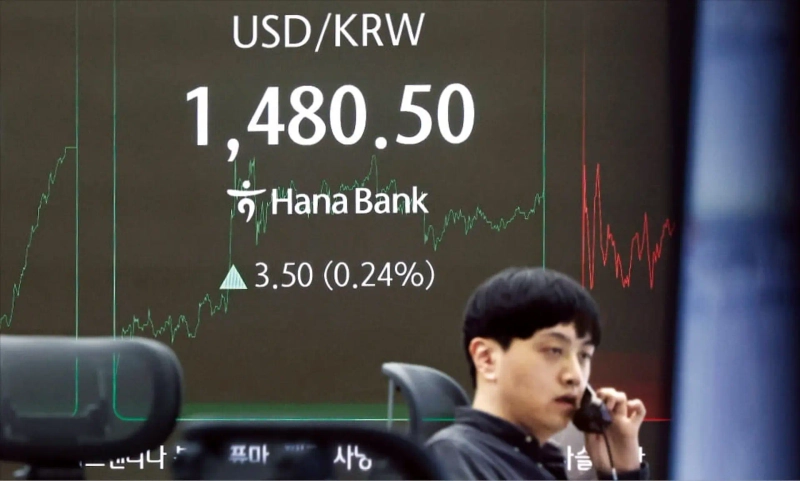
A report that last month's U.S. consumer price index (CPI) rose by only 2.7% caused the won·dollar exchange rate to fall sharply in the overnight session. The CPI significantly undershot market expectations, which is seen as having weakened the dollar by spreading expectations of U.S. interest rate cuts. However, experts also raised the view that this inflation rate may not be reliable due to the U.S. government shutdown that lasted until mid-last month.
The U.S. Department of Labor's Bureau of Labor Statistics (BLS) said on the 18th (local time) that the U.S. consumer price index (CPI) for November this year rose 2.7% compared with the same month last year. This is a figure below experts' expectations. AP reported that it had forecast November's CPI to be the same as September's (3.0%). According to The New York Times, economists had expected the November CPI increase to be 3.1%.
Core CPI, which excludes volatile energy and food, rose 2.6% year on year, a lower rate than September (3.0%). This release came eight days later than scheduled due to the 43-day federal government shutdown that continued from October 1 to November 12. The BLS said that October's CPI was not separately compiled because data could not be collected due to the suspension of related budget preparation.
Immediately after the U.S. CPI was released, the won·dollar exchange rate fell sharply in the foreign exchange market. Around 10:30 p.m., the rate, which had been trading at a level similar to the weekly trading closing price (1478 won 30 jeon), began to fall right after the announcement and dropped about 6 won to 1472 won 30 jeon around 11 p.m. Analysts interpreted this as reflecting that the low CPI had stimulated expectations of U.S. rate cuts.
However, the possibility that this inflation statistic was distorted was raised as a variable. The White House praised the low inflation rate as the result of economic policy, but experts expressed skepticism. According to The New York Times, Paul Ashworth, chief North America economist at Oxford Economics, pointed to the minimal rise in housing costs. He said, "It may reflect an actual decline in inflationary pressures, but a sudden drop in more persistent service sectors like rent or housing rent would be unusual unless it was due to a recession."
Based on this CPI alone, some suggested that the U.S. central bank (Fed) could implement additional rate cuts in January. But Kay Heag, Goldman Sachs's global head, said, "The data is very messy and is unlikely to cause a major change at the Fed."
Since price surveys were conducted after mid-November, many item prices were surveyed during the U.S. Black Friday sale period, which was also cited as a basis for possible distortion. Some said that if the November figure was distorted, the December figure could rebound significantly.
If such views are reflected, expectations of U.S. rate cuts could be reversed and the won·dollar exchange rate's decline could also be reversed. As of 11:30, the won·dollar exchange rate was 1474 won 20 jeon.
Reporter Kang Jin-kyu josep@hankyung.com

Korea Economic Daily
hankyung@bloomingbit.ioThe Korea Economic Daily Global is a digital media where latest news on Korean companies, industries, and financial markets.