

Will KOSDAQ hit 1,000…"Stock market attractiveness expands on hopes of benefiting from government policies" [Weekly Outlook]
Summary
- NH Investment & Securities presented an expected KOSPI fluctuation range for this week of a low of 3850 and a high of 4200.
- It evaluated that the market's valuation attractiveness may expand due to government policies such as the National Growth Fund and KOSDAQ revitalization.
- It reported that earnings forecasts for sectors such as IT, semiconductors, and automobiles are being revised upward, and related policy expectations are notable.
NH Investment & Securities "This week KOSPI low 3850, high 4200"
KOSDAQ·National Growth Fund…hopes of benefiting from government policies
Pay attention to sectors such as semiconductors and automobiles
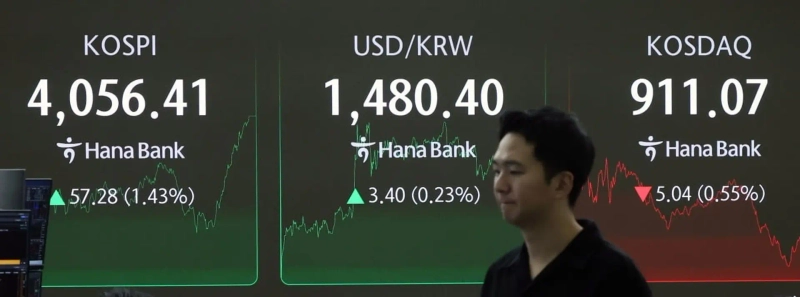
Last week, the KOSPI showed a volatile market as renewed AI bubble concerns again shook supply and demand, but it recovered the 4000 level. Securities firms evaluated that this week (December 22–26) is a period in which the stock market's valuation attractiveness may expand in light of major government policies such as the National Growth Fund and KOSDAQ revitalization.
On the 20th, NH Investment & Securities' Research Center presented an expected KOSPI fluctuation range for this week of a low of 3850 and a high of 4200.
Last week, amid controversy over AI investments, AI-related stocks, centered on Oracle, fell, and the domestic market also weakened, centered on semiconductor stocks. KOSPI briefly fell below 4000 during the week, but recaptured 4000 on the previous trading day, the 19th, influenced by Micron Technology's earnings. Over the past week, individuals and institutions net bought stocks worth KRW 2.5964 trillion and KRW 377.6 billion, respectively, while foreigners net sold KRW 3.1166 trillion.
Securities firms paid more attention to positive factors. It is due to policy expectations.
On the 19th, the Financial Services Commission announced the "Measures to Enhance KOSDAQ Market Trust and Innovation." The plan is to transform the KOSDAQ market, which had high volatility centered on individual investors, into a growth-oriented capital market accompanied by institutional funds. The main points are improving pension fund evaluation standards to create entry conditions for institutional investors and promoting tax benefits for citizen-participation National Growth Fund and KOSDAQ venture funds. This is why expectations for "KOSDAQ 1000" are growing in parts of the market.
On the same day, the government disclosed the investment destinations of the first mega project of the KRW 150 trillion National Growth Fund. They include K-NVIDIA development, the national AI computing center, Jeonnam offshore wind power, a solid-state battery material plant in Ulsan, a power semiconductor plant in Chungbuk, a foundry in Pyeongtaek, and energy infrastructure for the Yongin semiconductor cluster, among others.
Na Jeong-hwan, a researcher at NH Investment & Securities, said, "Expectations of policy benefits for KOSDAQ and AI, pharmaceutical and bio, and other advanced industries have expanded," and "the National Growth Fund is scheduled to be executed at KRW 30 trillion per year for the next five years, and some of these funds are expected to be directly injected into companies in the form of equity investments."
Regarding AI bubble concerns, he said, "The market still has controversy over verifying profitability, and this seems to be a factor that suppresses an AI bubble collapse," and "short-term doubts about AI may persist, but if AI investment project announcements expand from next year, expectations are likely to re-spread."
The researcher recommended a strategy of increasing weight in the IT sector. He said, "Considering that KOSPI's price-to-earnings ratio (PER) is located in the 10–11x range, it is difficult to say that valuation burden is high at the current level," and "rather, given that corporate earnings forecasts are being revised upward, pay attention to the possibility that valuation attractiveness may expand going forward."
He added, "Besides semiconductors, there are sectors where earnings forecasts are being revised upward. Although their stock performance was relatively weak this year, attention should be paid to sectors whose net profit forecasts for next year have been gradually improving since October," and "in particular, the automobile sector is notable as earnings expectations have increased after tariff risk eased, and there is also physical AI anticipation."
Shin Min-kyung, Hankyung.com reporter radio@hankyung.com

Korea Economic Daily
hankyung@bloomingbit.ioThe Korea Economic Daily Global is a digital media where latest news on Korean companies, industries, and financial markets.