What if high-growth-era regulation were applied to the digital-asset market? [Hankyung Koala]
Summary
- It said that Korea’s virtual-asset exchange regulation and the blocking of corporate virtual-asset trading have triggered capital outflows worth tens of billions of dollars and made the Kimchi premium a constant.
- It said that with institutional investors absent and the top 10% of retail investors accounting for more than 90% of trading volume, market volatility has increased and the goal of market stability has instead been undermined.
- It said that routinely applying an unstated-in-law separation of banking and commerce principle to the virtual-asset industry is weakening the competitiveness of Korean companies and pushing users toward overseas exchanges.
Forecast Trend Report by Period


Kim Min-seung’s ₿-ficial
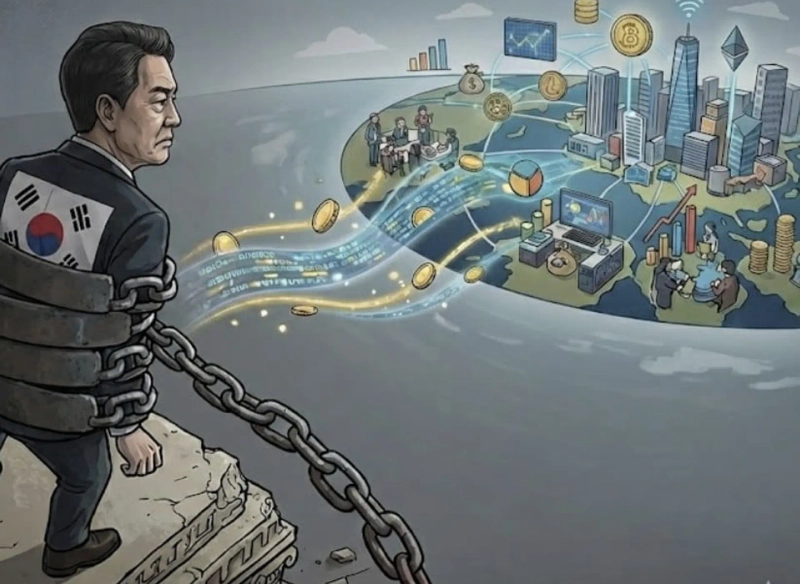
The shadow of the high-growth era: Is “status-based regulation” still valid?
What is regulation? Its original purpose is to establish order and promote the sustainable development of markets and society. If so, have the various “status-based regulations” deeply rooted in Korean society actually achieved that purpose?
From bans on marriage between people of the same surname and ancestral origin, to blocking imports of Japanese popular culture, and to today’s regulation of virtual-asset exchanges, Korea has long restricted certain rights not on the basis of an individual’s or a company’s actions or capabilities, but on the basis of inherent attributes. Blood ties, nationality, company size, and the nature of an industry become the criteria for regulation.
Status-based regulation is an approach that treats individuals or companies discriminatorily on the grounds of characteristics they cannot choose. Historically, such regulation has mainly appeared under authoritarian regimes. South Africa’s apartheid, the United States’ Jim Crow laws, and Nazi Germany’s Nuremberg Laws are representative examples. Advanced democracies have already abolished most of these regulations. Yet Korea, even after passing through its high-growth era and entering a low-growth phase, is still actively operating status-based regulation.
Failures in history
The ban on marriage between people of the same surname and ancestral origin was introduced in 1960 and remained in place for 45 years, until the Constitutional Court ruled it unconstitutional in 1997 and the law was abolished in 2005. The justification was to prevent genetic defects, but in reality it was closer to a remnant of the caste system and a product of Confucian patriarchal order. China had already abolished the system in 1931, and North Korea in 1948—yet only Korea clung to it.
The outcome was paradoxical. People could simply cohabit without registering their marriage, and the issue disappeared if they held a wedding abroad. It was prohibited legally, but relationships persisted underground. The regulation did not create order; it only deepened distrust in the system.
The ban on Japanese popular culture was similar. Lasting 53 years from 1945 to 1998, it was a long-running blockade policy difficult to find parallels for globally. Japanese comics and records were illegally copied and circulated on the black market, and in the Busan area it was possible to watch NHK at home. Whether this regulation protected national sentiment or laid the groundwork for growth in the cultural industry remains unclear.
Virtual-asset regulation: repeating the vicious cycle
A similar pattern is repeating in today’s virtual-asset market. Since the enforcement of the Act on Reporting and Using Specified Financial Transaction Information in March 2021, corporate virtual-asset trading in Korea has been fundamentally blocked. Korea is the only country in the world to selectively exclude only corporations. Domestic exchanges also do not allow trading in derivatives such as futures and margin.
The results are clear. Capital capable of deploying institutional-grade liquidity and diverse trading strategies has moved to overseas exchanges, leading to capital outflows on the scale of tens of billions of dollars. A distorted structure has become entrenched in which the top 10% of retail investors account for more than 90% of total trading volume. In a market without institutional investors, instability in supply and demand is inevitable. The entire market is shaken by the moves of a small number of large retail investors, and large-scale arbitrage with overseas markets is impossible, making the “Kimchi premium” a constant. Regulation aimed at market stability has instead increased market volatility.
Regulatory expansion, industrial contraction
Recently, proposals have even been floated to cap the stake of major shareholders of virtual-asset exchanges at no more than 15%. After dozens of exchanges were forced out and only five major exchanges survived following the implementation of the Specified Financial Transaction Information Act, even the remaining players are now becoming targets of additional regulation.
The justification is the separation of banking and commerce. But Korea’s version of this principle and its regulation of conglomerates are already difficult to find parallels for globally. The United States introduced separation through the Glass–Steagall Act in 1933 but repealed it in 1999. The EU effectively has no such separation regulation, and Japan also allowed banks to enter non-financial businesses in 2021.
Even so, Korea maintains the strongest separation regulation among OECD countries. Furthermore, it applies multi-layered, cumulative regulations to business groups with assets of 5 trillion won or more, including limits on total investment, debt-ratio regulation, and bans on cross-shareholding. Korea is effectively the only country that imposes such multi-step regulation based on company size.
In the high-growth era, it may have served to restrain the reckless expansion of chaebol. But in Korea’s economy in 2026, having entered a low-growth phase, amid intensifying global competition around strategic industries such as semiconductors and batteries, it needs to be reconsidered whether this regulation still plays a positive role.
Regulation for what purpose?
The ban on same-surname-and-origin marriage was eventually abolished, and the ban on Japanese culture was opened up step by step. These regulations lost legitimacy over time and disappeared through social consensus. Will virtual-asset regulation follow the same path?
Bitcoin has already become a portfolio asset for global institutional investors, and stablecoins are establishing themselves as new infrastructure for international remittances. It is difficult to block this flow with regulation bounded by national borders.
Companies are like living organisms. They continuously evolve with changes in technology, capital markets, and investor sentiment. Regulation that cannot accommodate these changes distorts markets or kills off the industry itself. Applying, as a matter of practice, a separation-of-banking-and-commerce principle not stipulated in law to the virtual-asset industry is structurally weakening the competitiveness of Korean players and driving users into overseas markets.
Regulation needs a clear objective. Only when it is clear whether the goal is curbing speculation, stabilizing markets, or ensuring financial safety can the means be justified. But the current regulation is vague in both goals and tools. It merely repeats past regulatory approaches out of inertia.
Isn’t it time to step out of the shadow of the high-growth era?
Kim Min-seung, head of the Korbit Research Center, ...
He is a founding member and research fellow of the Korbit Research Center. He works to explain complex events and concepts in the blockchain and virtual-asset ecosystem in an accessible way and to help people with different perspectives understand one another. He has experience in blockchain project strategy planning and software development, among other areas.
※This article is an external contributor’s column introduced to provide diverse perspectives to cryptocurrency investment newsletter subscribers and does not represent the position of The Korea Economic Daily.

Korea Economic Daily
hankyung@bloomingbit.ioThe Korea Economic Daily Global is a digital media where latest news on Korean companies, industries, and financial markets.