K Bank makes its third IPO attempt… “Equipped with a market-friendly offering structure”
Summary
- K Bank is making its third IPO, its third initial public offering (IPO) attempt, saying it will adopt a market-friendly offering structure, lower its valuation, and reduce the number of offered shares.
- K Bank presented an indicative offering price range of 8,300–9,500 won per share and an expected market capitalization of 3.3672–3.8541 trillion won, saying it adjusted the number of shares offered, the tradable float, and the lock-up period.
- K Bank said it posted 2024 net income of 128.1 billion won and recorded high loan growth and deposit growth, and that it will raise capital through a KOSPI listing while its reliance on Upbit funds has declined.
Forecast Trend Report by Period


IPO press briefing
Lower valuation, increased lock-up shares
“Upbit’s impact on performance is not significant”
Listing on the KOSPI scheduled for March 5
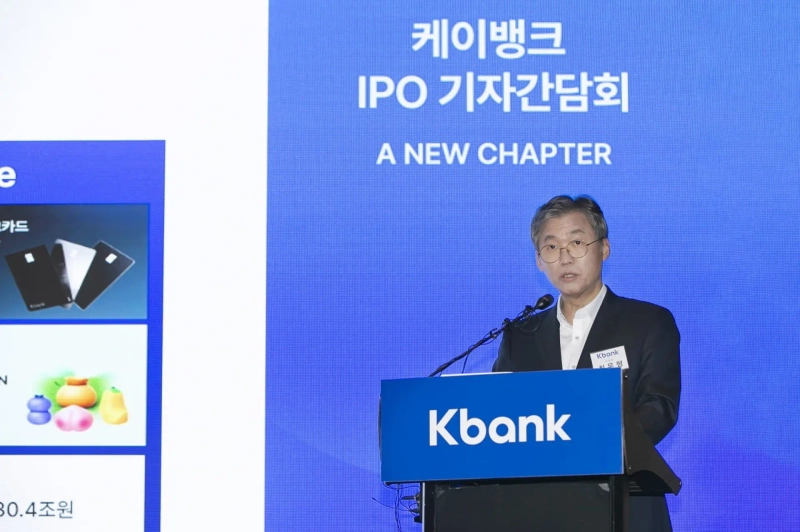
K Bank, South Korea’s first internet-only bank, has launched its third attempt at an initial public offering (IPO). Facing what is effectively a “last chance,” K Bank signaled its intention to go the distance by lowering its valuation and reducing the number of shares offered. The stock market’s unprecedented rally in recent months is also seen as a tailwind.
On the 5th, K Bank held an IPO press briefing at the Conrad Seoul in Yeouido, Yeongdeungpo-gu, Seoul, and unveiled its post-listing blueprint. K Bank also went through listing procedures in 2022 and 2024, but came up short due to weak demand in the bookbuilding process. As it embarks on its third attempt, K Bank stressed that it has put in place a market-friendly offering structure.
Choi Woo-hyung, CEO of K Bank, said, “Reflecting the market’s expectations, we have put in place a shareholder-friendly offering structure by lowering the offering price compared with before and adjusting the tradable float on the listing date,” adding, “On the back of the capital strength we have secured, we will enhance our capabilities and become an innovative financial company trusted by both customers and shareholders.”
K Bank set an indicative offering price range of 8,300–9,500 won per share. Based on the price-to-book ratio (PBR), the range implies 1.38–1.56x, about 20% lower than at the previous offering. The deal size is 60 million shares. Compared with the 2024 IPO attempt, the indicative price range (9,500–12,000 won) has been lowered and the number of shares offered (82 million) has been reduced.
The expected market capitalization after listing is 3.3672 trillion to 3.8541 trillion won. That is roughly 1 trillion won below the 5 trillion won target set during the previous listing push. The tradable float on the listing date was also slightly lowered to 36.35% from 37.32%. The tradable float six months after listing was adjusted to 65.81% from 96.06%. The move is seen as a strategy to boost the chances of a successful bookbuilding by lowering the price and reducing supply.
Na Min-wook, an analyst at DB Financial Investment, said, “K Bank reduced the offering size by more than 20% in consideration of supply-and-demand overhang,” adding, “The mandatory holding period for key shareholders has also been extended. The lock-up period for BC Card, the largest shareholder, is one year, and about half of the shares held by major financial investors (FIs) have a six-month lock-up, reducing overhang risk.”
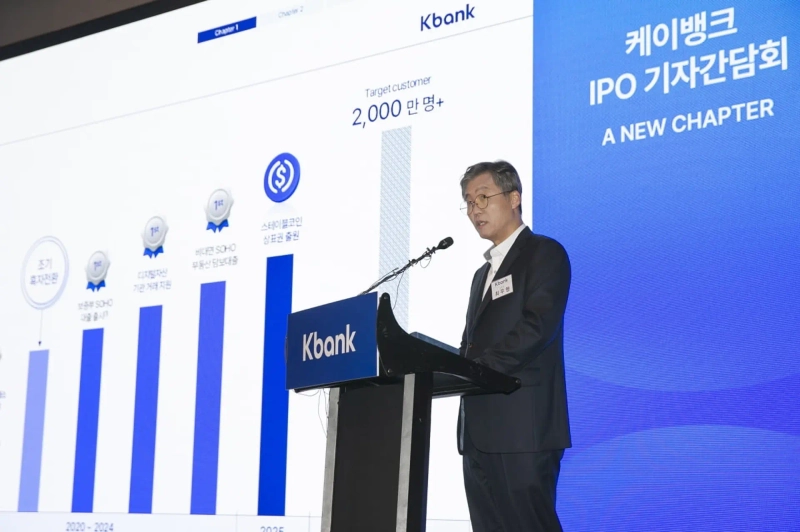
K Bank’s measures are interpreted as aimed at completing the listing process. During a capital increase in 2021, K Bank included a drag-along clause with FIs, conditional on completing an IPO by July 2026. If the listing is not completed within the deadline, FIs can exercise drag-along rights or put options by October. This is a last opportunity to ease the financial burden on BC Card, the controlling shareholder.
K Bank also emphasized that it has growth prospects in addition to a market-friendly offering structure. Having turned profitable in 2021, K Bank posted net income of 128.1 billion won in 2024. Over the most recent three years from 2022 through the third quarter of last year, K Bank’s compound annual growth rate averaged 23% for loans and 40% for deposits. Loan balances rose 66.2% from 10.77 trillion won at the end of December 2022 to 17.9 trillion won in the third quarter of last year. Over the same period, deposit balances increased 107.79% from 14.63 trillion won to 30.4 trillion won.
K Bank plans to use capital raised through its KOSPI listing to expand its lineup of loan and deposit products. It aims to gradually broaden its portfolio from household lending toward corporate lending, targeting a 50-50 mix between households and small and medium-sized enterprises (SMEs) by 2030.
There are also concerns about the high share of deposits linked to Upbit. K Bank is the only bank that provides real-name verification services to Upbit, South Korea’s largest crypto exchange. The contract between K Bank and Upbit expires in October.
In response, Choi said, “K Bank’s underlying deposit base has been growing steadily, and Upbit deposits move between 2 trillion and 8 trillion won depending on market conditions,” adding, “With solid deposit fundamentals, the impact of Upbit funds on performance is not significant.” He also said Upbit deposits are not used as funding for loans and are managed only in highly liquid assets such as money market funds (MMFs).
Choi added, “Four to five years ago, there were concerns because the share of Upbit deposits was relatively large, but that is not the case at all now.” According to the securities registration statement, the proportion of virtual-asset-related deposits out of total deposits fell from the 50% range at the end of 2021 to the 20% range last year.
K Bank will finalize the offering price on the 12th after completing institutional bookbuilding through the 10th. The retail subscription will be held over two days, on the 20th and 23rd. Subscriptions will be available through NH Investment & Securities, Samsung Securities, and Shinhan Securities. The planned listing date on the Korea Exchange’s main board is March 5.
Jin Young-gi, Hankyung.com reporter young71@hankyung.com

Korea Economic Daily
hankyung@bloomingbit.ioThe Korea Economic Daily Global is a digital media where latest news on Korean companies, industries, and financial markets.