"Protracted Iran crisis hinges on the patience of neighbors such as the UAE"
Summary
- He voiced concern that the prolonged Iran situation is having a significant impact on oil, energy, supply chains, and global financial flows.
- He said that if neighboring countries such as the UAE, Saudi Arabia and Qatar join the war, the conflict could expand and intensify, potentially exposing limits to East Asia’s strategic energy reserves as a result of a blockade of the Strait of Hormuz and a decline in tanker traffic.
- He said that worsening U.S.-China relations and deepening decoupling would pressure South Korean companies’ China operations, making it essential to craft a geopolitical strategy that in certain sectors requires choosing between China and Western markets.
Forecast Trend Report by Period


Interview with Lexon Ryu, President of strategic advisory firm The Asia Group (TAG)
"If the situation drags on, it will affect not only oil but industry and security broadly"
Worst-case scenarios include collapse of the Iranian government and a canceled U.S.-China summit
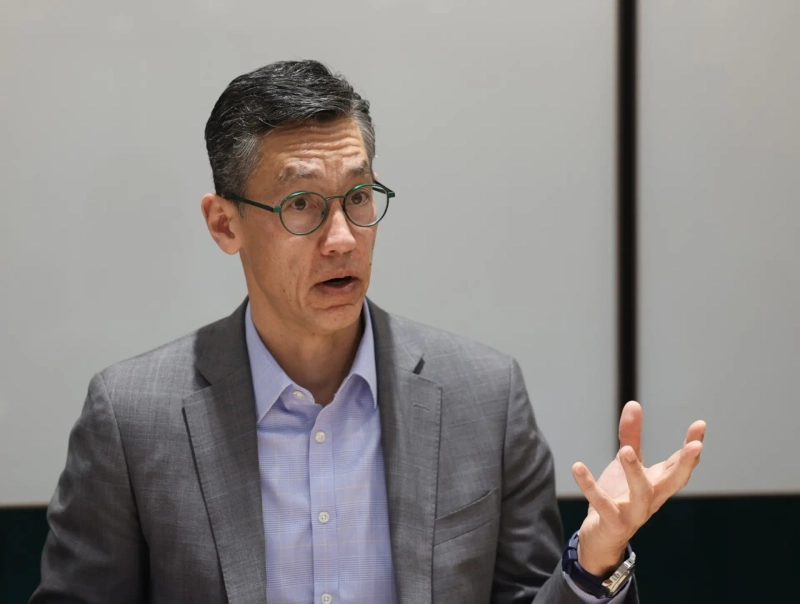
"Moves by neighboring countries such as the United Arab Emirates (UAE) and Qatar are key variables in whether the Iran crisis becomes prolonged. If they enter the war in earnest, the conflict could expand and drag on longer."
Lexon Ryu, President of U.S. strategic advisory firm The Asia Group (TAG), said this in an interview with The Korea Economic Daily on the 6th, discussing prospects for a prolonged crisis in the Middle East. Ryu is a geopolitical expert who oversaw foreign policy issues including Iran nuclear nonproliferation at the State Department and the National Security Council (NSC), and previously served as chief of staff to Defense Secretary Chuck Hagel in the Barack Obama administration. He also currently serves on the Defense Policy Board Advisory Committee under the Secretary of Defense. Ryu warned that "the key question is how long the Iran situation will last, and if it becomes protracted it could have wide-ranging adverse effects on East Asia’s security and economy."
▶ What impact is the Iran situation currently having on Asia?
"Issues related to oil and energy have already begun to have a very significant impact. Concerns are also emerging about global financial flows and supply chains, and everyone is watching closely. The question I’m asked most is how long this clash is likely to last and how we can anticipate that."
▶ Will the war be prolonged?
"U.S. President Donald Trump said it would 'continue as long as necessary,' and also that it 'could be about 4 to 5 weeks.' Israeli Prime Minister Benjamin Netanyahu said, 'The war will not go on endlessly; it will end swiftly and decisively.' But no one knows whether the conflict will subside or persist. Instead, we need to pay attention to several signs. The first is whether the United States continues to treat Iran’s new leader as a military target. Previously, both President Trump and Prime Minister Netanyahu stated that if Ali Khamenei’s son is elected, they would not recognize him as the leader. As long as attempts continue to remove Iran’s leadership, it is an important signal suggesting the conflict could persist."
▶ What is the biggest variable that will affect the course of the conflict?
"Whether neighboring countries in the Middle East become directly involved in the military confrontation. For example, if countries such as the United Arab Emirates (UAE), Saudi Arabia, Qatar, and Türkiye join the war (in response to Iran’s attacks), the conflict could expand and intensify. If that happens, the risk that the fighting lasts longer also rises. Iran is threatening to use every means at its disposal to block the Strait of Hormuz. The longer the situation continues, the more tanker traffic will decline sharply, and countries such as South Korea, Japan and China have limits to their strategic energy reserves."
▶ Will the involvement of Kurdish militias cause major repercussions?
"I’ve heard there are moves for the United States to arm groups known as Kurds. Even if there is actual military involvement, I’m not sure it will be able to have a substantive and significant impact on this war. It seems more likely to cause a degree of instability only in northern Iran. But the possibility that rebel forces expand their reach all the way to Tehran and threaten the regime looks very low."
▶ If the war becomes prolonged, what are the key concerns?
"There is a risk that more extreme scenarios unfold. In other words, if U.S. military action expands further, it could reach a point where the Iranian government cannot function normally. The biggest risk factor is a situation in which internal stability in Iran collapses. Also, the United States is using a significant amount of weaponry against Iran, and questions could be raised about stockpiles needed to respond to threats in Northeast Asia, including North Korea."
▶ How will the Iran situation affect U.S.-China relations?
"Before Iran, the United States also carried out a military operation in Venezuela this past January, and these are countries that not only cooperate with China on energy but are also strategic partner states. The conflict could affect U.S.-China relations, and if the situation continues for several more weeks, there could also be calls to reconsider President Trump’s visit to Beijing (scheduled for around April). At last year’s Asia-Pacific Economic Cooperation (APEC) meeting in Gyeongju, the U.S. and China agreed to a tariff truce, and the flow was toward continued dialogue through this year’s bilateral talks, APEC in China, and the Group of 20 (G20) summit hosted by the United States. But if the Iran situation reverses that trajectory, the impact could spread far more widely. It could have major ripple effects not only on governments but also on companies in the region."
▶ If U.S.-China relations worsen, will South Korean companies working with the U.S. also face disruptions in their China businesses?
"I think it will become a major issue for South Korean companies. In U.S. business circles, especially in advanced industries such as semiconductors and artificial intelligence (AI), a phenomenon of 'decoupling' with China is emerging. And South Korean companies are playing visible and important roles alongside the United States across multiple areas. For South Korean companies, so-called 'strategic ambiguity' is shrinking. As reported, the case in which the Chinese government singled out the won and imposed sanctions can be seen as an example of economic coercion by China. Companies must be able to anticipate geopolitical strategy, and in certain sectors they will be pushed into a situation where they must choose between China and Western markets."
▶ In relations with the U.S., what are South Korea’s tasks?
"It is worth rating highly that President Lee Jae-myung has been able to cooperate successfully with President Trump over the past year. Tariffs are a very difficult and sensitive topic. In that respect, I think President Lee and his team responded effectively in driving an initial agreement. A bilateral framework was announced, including an investment deal, and initial discussions on defense and security issues appear to have been relatively successful. However, South Korea recently faced another round of pressure for tariff increases from President Trump, who wants rapid progress on investment. Many people were surprised. For now, the task is to swiftly coordinate what progress can be made on investment."
The Asia Group (TAG) is a consulting firm that provides geopolitical strategy advice to the United States and governments and companies across Asia. It was co-founded in 2013 by Kurt Campbell, who served as Deputy Secretary of State and Indo-Pacific coordinator at the National Security Council (NSC) during the Joe Biden administration. TAG includes many people who previously served at major government departments including the U.S. State Department. Former Assistant Secretary of State for East Asian and Pacific Affairs Daniel Kritenbrink is also active as a partner at TAG, and Joseph Yun, former Chargé d’Affaires ad interim at the U.S. Embassy in South Korea, worked at TAG as a senior adviser before his posting to Korea.
Reporter Lee Hyun-il hiuneal@hankyung.com

Korea Economic Daily
hankyung@bloomingbit.ioThe Korea Economic Daily Global is a digital media where latest news on Korean companies, industries, and financial markets.