IEA moves to stabilize whipsawing oil prices… “Likely to fall into the $70s toward year-end”
Summary
- IEA member countries said they will attempt to stabilize oil prices in the short term by releasing up to a record 400 million barrels of strategic reserves.
- The decision helped cool prices, with WTI futures falling from $119.48 a barrel to around $81 a barrel, after the earlier surge.
- The U.S. Energy Information Administration (EIA) said it expects Brent crude to fall below $80 a barrel in the third quarter and then trade around the $70 level through year-end.
Forecast Trend Report by Period


IEA to release strategic reserves on a record scale
300–400 million barrels seen as most likely
To curb the recent surge in crude prices, member countries of the International Energy Agency (IEA) will release stockpiled oil to the market on an unprecedented scale.
According to overseas media outlets including The Wall Street Journal (WSJ), officials from the IEA’s 32 member countries held an emergency meeting in Paris, France, on the 11th to discuss the size of the release. The WSJ assessed that the volume would exceed the previous record set in 2022, when 182.7 million barrels were released.
Earlier, the Financial Times (FT), citing multiple sources, reported that the IEA is discussing a release of 300–400 million barrels, equivalent to 25–30% of its total reserves (about 1.2 billion barrels). The move follows a sharp rise in oil prices after the Strait of Hormuz was effectively closed following U.S. and Israeli attacks on Iran.
WTI futures, which had surged to as high as $119.48 a barrel on the 9th, fell back to around $81 a barrel on the 10th (local time) on news of the planned release.
Up to 400 million barrels expected… the largest release on record
Twice as much as during the Russia–Ukraine war… U.S. seen at 200 million; South Korea estimated at 25 million barrels
The IEA members’ agreement on a record release reflects heightened volatility in oil prices after the outbreak of war between the United States and Iran. Since hostilities began, WTI has swung up and down by 20–30% in a single day, and last week it even posted its largest weekly gain on record. While the measure may help cap prices in the short term, longer-term pricing is expected to hinge on how long the Strait of Hormuz remains blocked.
Release could total as much as 400 million barrels
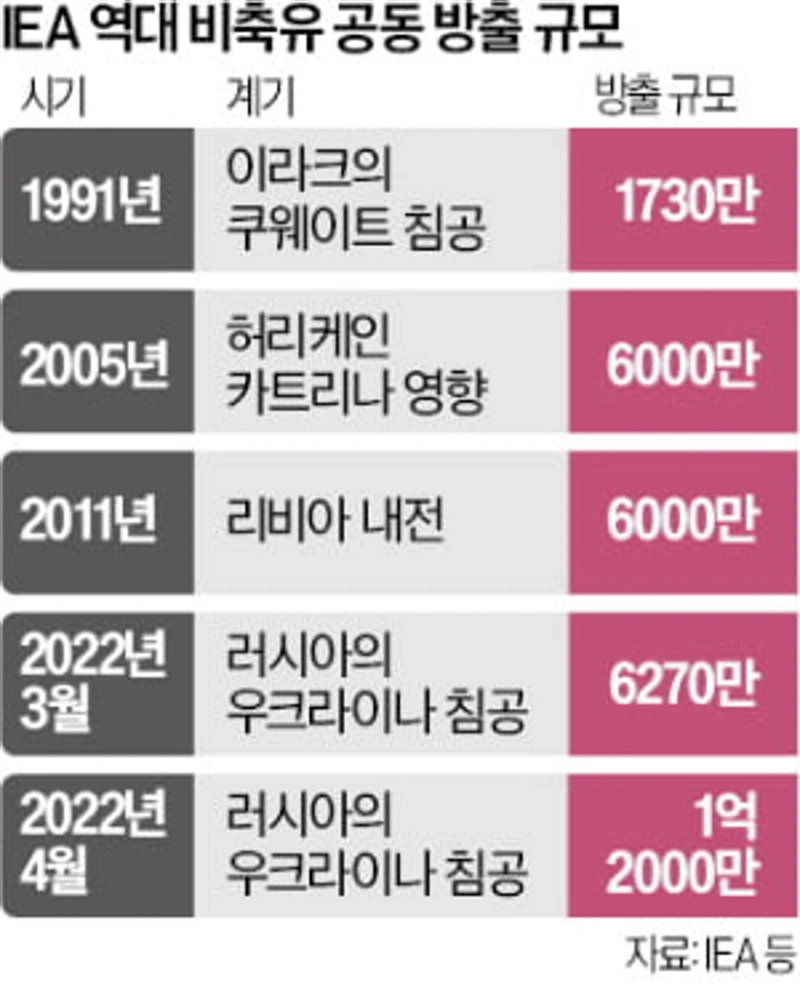
According to foreign media on the 11th, the scale of the IEA release is expected to surpass that seen during Russia’s invasion of Ukraine in 2022. At the time, IEA members released a combined 182.7 million barrels in two rounds. Industry participants expect this time the total could reach 400 million barrels—about twice that level.
Country-by-country volumes will be determined through separate discussions. Typically, the IEA has set allocations in proportion to each country’s share of global oil consumption. In 2022, the United States released 90.6 million barrels, or 49.5% of the total. It was followed by Japan (22.5 million barrels), South Korea (11.65 million), Germany (9.7 million) and France (7.9 million).
If 400 million barrels are released and the 2022 allocation shares are applied as-is, the United States would shoulder 198.3 million barrels—nearly half of its strategic petroleum reserve. South Korea would be estimated at 25.5 million barrels. This time, however, the U.S. share may be reduced while other countries take on more. U.S. Energy Secretary Chris Wright said, “We are coordinating U.S. strategic petroleum reserve oil sales with other countries’ releases.” The South Korean government is also discussing the scale of its release with the IEA.
Likely to hit the market within days
IEA stockpiles reach the market via two channels: “public stocks” and “industry mandatory stocks.” Public stocks are crude and petroleum products held by governments or specialized reserve agencies and supplied to refiners and others through a tender process. Industry mandatory stocks involve lowering the legally required minimum inventory levels for refiners or distributors, allowing the freed-up volumes to be directed to sales and refining.
The timing of when barrels reach the market differs by channel. Volumes freed up by easing mandatory stock requirements can be distributed within days as legal obligations are reduced. Public stocks, however, require steps such as tender announcements, awards, loading, transport and delivery—often taking weeks to months. During the 2022 release, the United States, which relied heavily on public stocks, issued its first tender announcement in early March, while India’s came only in late May. Countries in Europe and elsewhere that make extensive use of industry mandatory stocks moved faster by lowering holding requirements through statutes and administrative orders.
The impact of a release is expected to be immediate. In 2022 as well, U.S. crude prices fell 7% in a single day right after the U.S. administration announced a release.
“Oil won’t be in the $70s until year-end”
Some argue that a reserve release amounts to little more than a stopgap measure. Last year, crude volumes transiting the Strait of Hormuz averaged 20 million barrels per day. Even a 400 million-barrel release would amount to less than one month’s worth of those flows. The IEA also notes that “a coordinated stock release is merely a tool for responding to short-term supply crises and managing prices.”
Oil-producing countries have decided to respond to surging prices by increasing output. Eight core members of OPEC+ agreed to raise production by 206,000 barrels per day starting in April. Saudi Arabia is redirecting exports to Yanbu on the Red Sea coast to reduce dependence on the Strait of Hormuz.
The U.S. Energy Information Administration (EIA) said the previous day it expects Brent crude to remain above $95 a barrel for more than two months. The EIA projects prices will fall below $80 a barrel in the third quarter and then trade around the $70-a-barrel level through year-end.
By Kim Joo-wan, kjwan@hankyung.com

Korea Economic Daily
hankyung@bloomingbit.ioThe Korea Economic Daily Global is a digital media where latest news on Korean companies, industries, and financial markets.