A third war after the Gulf and Iraq wars… Why is the U.S. so fixated on the Middle East?
Summary
- It said U.S. engagement in the Middle East—including the war with Iran—stems from the fact that the Middle East is a geopolitical crossroads that controls global energy shipments and the lifeline of manufacturing.
- It reported that rising Middle East tensions are expanding U.S. defense contractors’ revenues, with Lockheed Martin and Northrop Grumman shares up 20% and more than 14%, respectively, after the Iran war.
- It said oil money from the six Gulf states is being invested heavily in U.S. financial assets, and that the petrodollar system is being maintained, exerting enormous influence on the U.S. financial industry and asset markets.
Forecast Trend Report by Period


DEEP INSIGHT
Five reasons for seeking hegemony in the Middle East
(1) An energy-shipping valve at the crossroads of three continents
(2) Growing into a new export base for the defense and arms industry
(3) Oil money that fattens up the U.S. financial industry
(4) A ‘main artery’ linking 90% of Asia–Europe data
(5) Large-scale investments by the Trump family, including golf courses
The 1990 Gulf War, the 2003 Iraq War, and the 2026 Iran War.
Since the end of the Cold War, the United States has fought three wars in the Middle East. If you include the war in Afghanistan, which borders the Middle East, it would hardly be an exaggeration to say that virtually every war was fought in this region. War aims such as “eliminating weapons of mass destruction” and “blocking nuclear development” were vague and at times inconsistent with the facts. Transformed into a net energy exporter through the shale revolution, the U.S. no longer covets Middle Eastern energy resources as it once did. So why is the United States so fixated on the Middle East? We looked at it from five angles.
A geopolitical crossroads
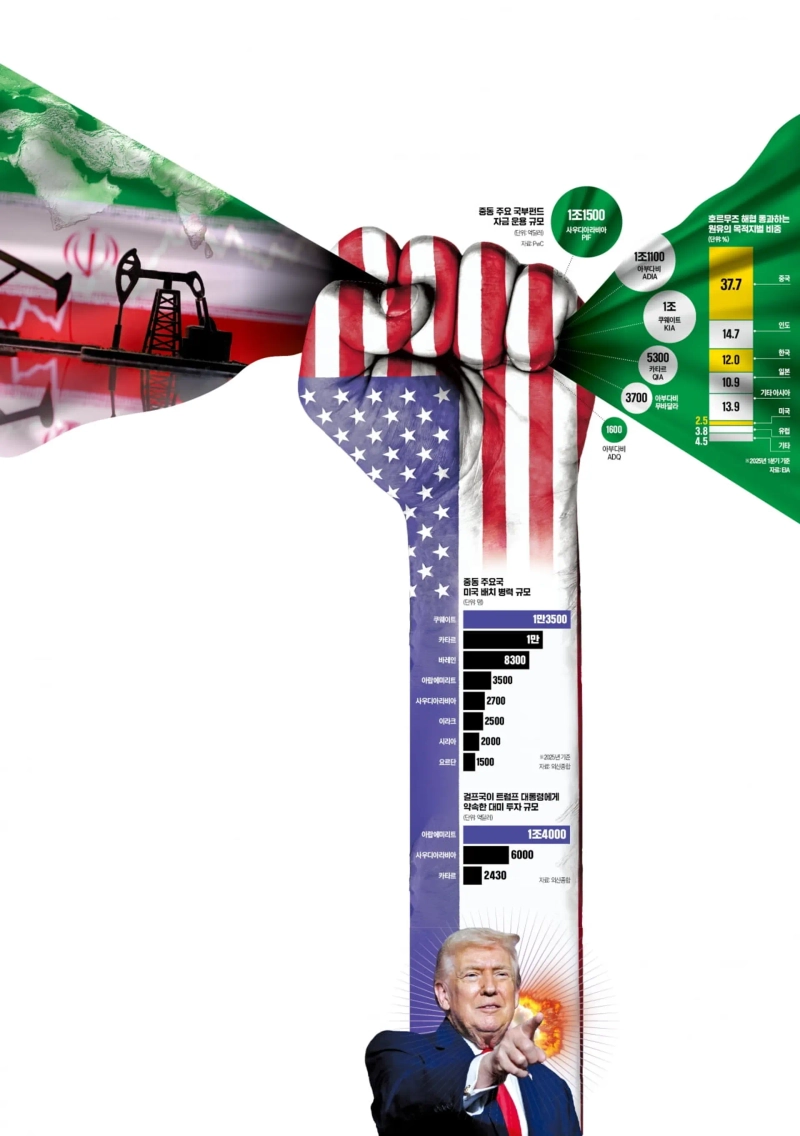
Geopolitically, the Middle East can be summed up as the “world’s valve.” U.S. Central Command (CENTCOM), which oversees the Middle East, defines on its website that “the Middle East is a crossroads where three continents meet,” and “a place where key sea lanes, air routes, and various pipelines over land converge.” It means a nodal point that underpins U.S. global hegemony militarily and diplomatically.
The numbers make it clear. According to the U.S. Energy Information Administration (EIA), crude oil passing through the Strait of Hormuz in the first half of last year averaged 20.9 million barrels a day, accounting for about 20% of global petroleum consumption. Liquefied natural gas (LNG) is on a similar scale. Around 4.9 million barrels a day of crude also move through the Suez Canal. Volumes via the Bab el-Mandeb Strait were 4.2 million barrels a day. Hormuz, Suez, and Bab el-Mandeb are a “chain of strategic chokepoints,” and trouble at just one can shake the global economy. Even more important is where the energy is headed. Last year, 89% of the energy that transited the Strait of Hormuz was bound for Asia. Of that, 74% was taken by South Korea, China, India, Japan, and others. That is why abandoning the Middle East would mean handing over the lifeline of global manufacturing.
The core of the U.S. military-industrial complex
The Middle East also needs to be managed to sustain America’s defense and arms ecosystem. In May last year, President Donald Trump visited Riyadh, the capital of Saudi Arabia, and signed a defense cooperation agreement worth $142 billion, the largest in U.S. history. It is not a one-off deal but a transaction that leads to decades-long contracts for maintenance, training, parts, and upgrades.
Former senior generals from Central Command move between the defense industry and government, building bridges for deals with Middle Eastern countries. A telling example is that, under both the previous Joe Biden administration and the first Trump administration, the defense secretary post was held by someone who had led Central Command. They worked as executives at defense contractors before being appointed defense secretary. Concentrated military assets and hundreds of generals spur additional military investment in the Middle East. The higher the military tensions in the region, the larger Central Command’s role becomes—and the more defense contractors’ revenues rise. Since the war with Iran began, Lockheed Martin shares have risen 20% and Northrop Grumman more than 14%. That is why some say, “Central Command is not simply a military force but a bureaucratic apparatus that institutionally reproduces U.S. intervention in the Middle East.”
The influence of oil money
The Middle East is also a gusher of oil money that fattens the U.S. financial industry. The six Gulf states—Saudi Arabia, the United Arab Emirates (UAE), Kuwait, Qatar, Bahrain, and Oman—manage more than $4 trillion (about 6,000 trillion won) in assets through 13 sovereign wealth funds. Of the amount newly invested by sovereign wealth funds globally last year, 43%—$126 billion—came from Gulf capital.
A significant portion flowed into the United States. As of the end of 2024, the combined total of U.S. financial assets held by Saudi Arabia, the UAE, and Kuwait reached $1.11 trillion. One Saudi sovereign wealth fund alone holds $25.55 billion worth of shares in U.S.-listed companies. Private equity managers such as Blackstone and Brookfield are opening offices in Dubai and Riyadh to attract Middle Eastern sovereign wealth fund money. Underpinning this structure is the “petrodollar” system. Under an informal 1974 understanding, Saudi Arabia prices oil only in U.S. dollars, and reinvests oil proceeds into U.S. assets such as Treasuries. In other words, countries around the world must hold dollars to buy oil.
The Red Sea’s digital artery
Recently, the Middle East has also been drawing attention as a conduit for global data. According to the International Telecommunication Union (ITU), as of last year more than 99% of international data traffic moved through about 500 submarine communications cables. Their total length exceeds 1.7 million km. A substantial portion of that runs through the Middle East.
According to the Center for Strategic and International Studies (CSIS), Egypt is a point through which about 17% of global internet traffic passes. In particular, more than 90% of submarine cables connecting Europe and Asia run through the Red Sea. Currently, 14 submarine cable systems are in operation in the Red Sea, with six more cable installations additionally planned. CSIS pointed to this stretch as “the most vulnerable place in the internet world.” In fact, in 2024, the anchor of a cargo ship hit by a Houthi rebel ballistic missile dragged along the seabed and severed three cables. As a result, 25% of data traffic between Asia and Europe was cut off, and it took six months to restore.
Trump family assets also concentrated
Some observers also link President Trump’s private business to the Iran war. The Trump family company, the Trump Organization, is pushing ahead with building a large-scale golf club in a development zone near Riyadh, Saudi Arabia. In Jeddah, the second-largest city, development is underway for “Trump Plaza,” which will include offices and luxury apartments. In Dubai, the Trump International Golf Club is also in operation.
By Kim Joo-wan

Korea Economic Daily
hankyung@bloomingbit.ioThe Korea Economic Daily Global is a digital media where latest news on Korean companies, industries, and financial markets.