Asian stock markets tumble in unison on Trump’s ‘reheated speech’
Summary
- It said markets were disappointed because Trump’s address to the nation presented neither a plan related to ending the war nor a solution for navigation through the Strait of Hormuz.
- It noted that the KOSPI fell 4.47%, the Kosdaq fell 5.36%, and Asian equities broadly declined, with sell-side circuit breakers triggered, while oil prices and the dollar index rose.
- It said Trump’s warning of strong strikes led markets to price in the possibility of a prolonged war, strengthening broader risk-off sentiment, including a rise in the won-dollar exchange rate, a sharp drop in cryptocurrency prices, and European stocks opening lower.
Forecast Trend Report by Period


Trump offers no end-of-war declaration
“Iran to be hit hard for 2–3 weeks”
Threatens additional strikes in address to the nation
Markets disappointed…KOSPI plunges more than 4%
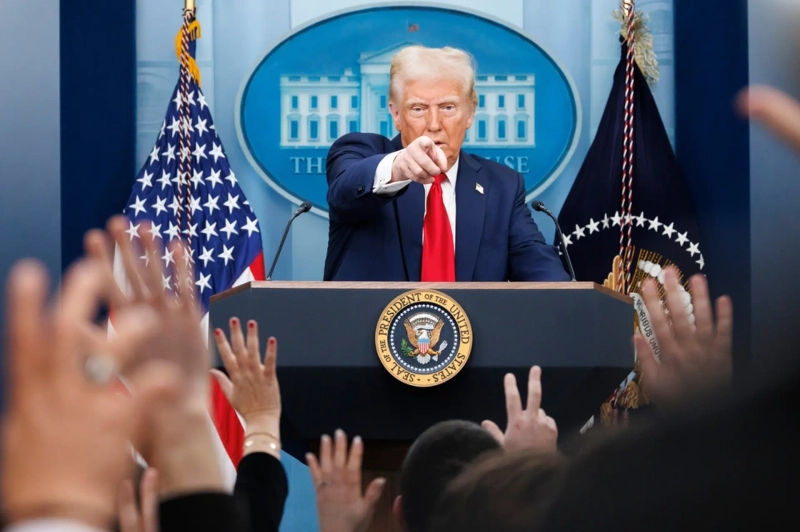
U.S. President Donald Trump’s address to the nation, which drew global attention, disappointed markets, as it failed to lay out any expected plan related to ending the war. Instead, he warned of even harsher attacks, saying the U.S. had “not reached an agreement with Iran,” sending equities sharply lower and oil prices rebounding.
In the address on the 1st (local time), Trump said that “negotiations between the two countries are continuing even at this moment,” and claimed that “a de facto regime change has taken place in Iran.” But with no deal reached, he said “we will hit them very hard soon,” adding that he would “attack ferociously for 2–3 weeks and send Iran back to the Stone Age.” He threatened that the U.S. could strike Iranian power plants all at once and also target oil facilities. He made no mention of deploying ground troops.
He offered no solution on navigation through the Strait of Hormuz. Reiterating his existing position, Trump said the U.S. does not need Iranian oil and that “we could help, but countries that rely on the Strait of Hormuz will have to solve it themselves.” He also urged countries to buy U.S. oil and to take direct control of the strait.
Disappointed Asian equities took a heavy hit. South Korean stocks, which had surged more than 8% the previous day on hopes of an end to the war, ended down 4.47% at 5234.05 after Trump’s speech. The Kosdaq fell 5.36%. Sell-side circuit breakers (temporary suspension of program sell orders) were triggered in both the KOSPI and Kosdaq markets.
The won-dollar exchange rate rose 18.4 won to 1519.7. Oil prices, which had fallen for two straight days, jumped, with Brent for June delivery up 6.7%.
Markets turn cold without an end-of-war plan
KOSPI·Kosdaq sell-side circuit breakers…Japan’s Nikkei and China’s Shanghai indexes fall
Trump’s address to the nation on the Iran war on the 1st (local time) had been abruptly teased two days earlier. It came as prospects for peace talks with Iran emerged while U.S. public opinion on the war was deteriorating.
Expectations in and outside the market swelled the day before the speech. Iran’s President Masoud Pezeshkian said he was “willing to end the war,” and Trump posted on social media that Iran had “requested a ceasefire.” Stocks rose and oil prices plunged.
But the speech, which began at 9 p.m., fell far short of expectations. Rather than detailing the manner or blueprint for ending the war, Trump pressured for an agreement by saying he would deliver a “strong blow” over the next “2–3 weeks.” He did not address the end-of-war plan markets were eager for, the resumption of passage through the Strait of Hormuz, or whether to dispatch ground forces. The New York Times panned it, saying he “rehash[ed] his Truth Social content.”
Financial markets disappointed
Trump’s speech poured cold water on equities starting in Asia. The KOSPI, which had surged 8.44% the previous day, had been up in the 1% range even before the speech.
But as Trump’s remarks unfolded, sentiment cooled rapidly. After steadily giving up gains, the KOSPI turned negative 17 minutes into the speech. At 2:34 p.m. and 2:46 p.m., sell-side circuit breakers were triggered in the Kosdaq and KOSPI markets, respectively. Japan’s Nikkei also opened up 0.61% but closed down 2.38%. Taiwan’s TAIEX fell 1.82%. China’s Shanghai Composite dropped 0.74%. European markets, which opened later, also started in the red.
The dollar index (DXY) rose 0.48% to around 100.13 (as of 5 p.m.). Prices of various cryptocurrencies also fell across the board. On the online betting site Polymarket, the share of bets that the Iran war would be under a ceasefire by the end of this month fell from 40% before the speech to 28% after it. The odds of a ceasefire by the end of June also slipped from 66% to 61%.
While Trump mentioned strong strikes to end the situation quickly, markets instead took it as a signal that “the war could last longer.”
Risk of a wider Middle East conflict
Trump offered little in the way of new messages that day. It is unclear whether a strategy of pushing ahead even at the cost of civilian casualties would bring about change in Iran.
Nor was it clear what contingency plan he has if Iran does not declare surrender after the strikes. In particular, his remark urging countries regarding the Strait of Hormuz to “even now, though late, muster the courage and just seize the strait” instead stoked anxiety. Trump said, “In any case, once this conflict ends, the strait will open naturally.”
But the situation is not that simple. Fortune analyzed that walking away from the Iran issue while abandoning the Strait of Hormuz could become a “decades-long headache” for the U.S. With Israel possessing nuclear weapons and Iran’s potential to develop them not fully blocked, other countries could feel a need to acquire nuclear arms of their own. In a phone interview with Reuters earlier that morning, Trump said he “doesn’t care” about the unclear whereabouts of Iran’s highly enriched uranium. In his address, he said he would monitor by satellite whether nuclear development actually takes place.
It is also unlikely that other countries would readily accept Iran’s plan to levy tolls for passage through Hormuz. As each moves to weaken Iran’s control, the Middle East could be drawn into endless conflict—one that could pull the U.S. back into the region. Bob McNally, who served as an energy adviser in the George W. Bush administration, told Fortune that in such a case it would be “an even bigger blow to U.S. foreign policy than the defeat in the Vietnam War.”
Washington=Correspondent Lee Sang-eun / Reporter Kang Jin-gyu selee@hankyung.com

Korea Economic Daily
hankyung@bloomingbit.ioThe Korea Economic Daily Global is a digital media where latest news on Korean companies, industries, and financial markets.