"The bottom is in" vs "Downside pressure persists"…Bitcoin 'bottom debate' spreads
Summary
- Bitcoin (BTC) rebounded about 1.81% last month, but the report said price volatility has increased recently and losses are continuing.
- The report said the market is focusing on macro factors such as a weakening seasonal pattern as well as the Middle East conflict and other geopolitical risks.
- Alphactal and CryptoQuant were cited as saying Bitcoin’s bottom is likely to form in September–November this year, and downside pressure could persist for several months.
Forecast Trend Report by Period



A debate is spreading in the market over where Bitcoin (BTC) prices may bottom out. While prices managed a modest rebound last month, macroeconomic uncertainty has grown amid spillovers from factors such as the Middle East conflict.
According to cryptocurrency data analytics firm Coinglass on the 2nd (Korea time), Bitcoin rose about 1.81% on a monthly basis last month. It was the first time in six months that Bitcoin posted a monthly gain, since September last year (5.16%). However, given the limited rise, it failed to offset the declines that have persisted for five consecutive months.
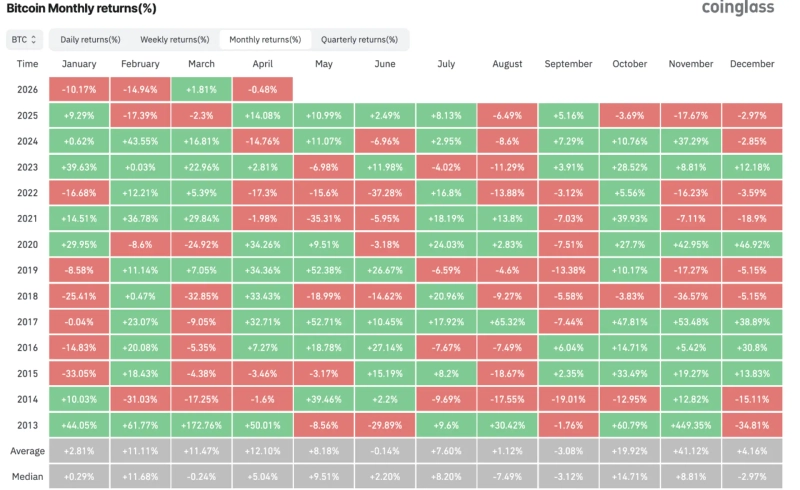
Analysts say price volatility has picked up this month, pointing to a fragile trend. According to CoinMarketCap, Bitcoin was down about 3.3% from the previous day as of that day, extending losses to the $66,000 range.
Typically, Bitcoin has shown strength every April. Coinglass data show that over the roughly 12 years from 2013 through last year, Bitcoin’s average April monthly return came to about 12.1%.
This year, however, departures from that seasonal pattern have repeatedly emerged. Bitcoin fell about 10% and 15% in January and February, respectively, far below the average monthly return. Last month’s rebound was also limited.
As the seasonal pattern weakens, the market is turning its focus to macro variables such as geopolitical risks. Binance Research, the research arm of global crypto exchange Binance, said that if signs of a ceasefire between the U.S. and Iran become more concrete, higher-beta assets with greater price volatility—such as Ethereum (ETH)—could stage a relatively strong rebound on the back of a recovery in the crypto market.
Some observers also say that, based on the cycle structure, Bitcoin is more likely to bottom out only in the second half of this year. Joao Wedson, CEO of crypto analytics firm Alphactal, said, "The peak of this cycle was formed 534 days after the halving," adding that "(recent Bitcoin) is showing a 'decay' pattern in which the cycle gradually shortens." He projected that applying past patterns suggests this cycle’s bottom is likely to form around 912–922 days after the halving—around September to October this year.
On-chain analytics firm CryptoQuant offered a similar view. In a recent post on X, CryptoQuant said Bitcoin’s bottom is likely to form in the second half of this year. In particular, CryptoQuant’s assessment is that Bitcoin may bottom out around September to November this year—implying that downside pressure could persist for the coming months.

Suehyeon Lee
shlee@bloomingbit.ioI'm reporter Suehyeon Lee, your Web3 Moderator.