Bitcoin Enters Key Support Zone as Thin Liquidity, Whale Selling Stoke Volatility Risk
Summary
- CryptoQuant contributor GugaOnChain said Bitcoin has entered a key support zone as market structure weakens amid an absence of institutional capital inflows, rising whale selling, and declining exchange liquidity.
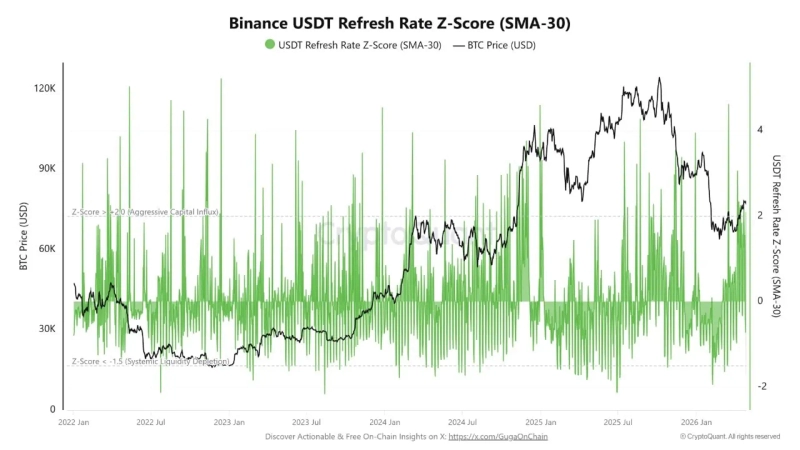
- Guga cited the IST (Institutional Spot Traction), exchange whale ratio, declining mega-whale holdings, a drop in the USDT refresh rate Z-score, and Binary CDD as evidence of thin liquidity and the potential for greater price volatility.
- GugaOnChain said short-term investor selling pressure is intensifying amid an absence of institutional spot demand and depleted liquidity, and that capital preservation should take priority over aggressive chase buying in the current market.
Forecast Trend Report by Period


Bitcoin has entered a key support zone, with the risk of wider price swings rising as thin liquidity coincides with increased whale selling.
CryptoQuant contributor GugaOnChain wrote on April 28 that Bitcoin was trading near $76,381 as market structure weakened. The analyst cited a lack of institutional inflows, heavier whale selling and declining exchange liquidity as factors that could amplify volatility.
The IST, or Institutional Spot Traction, indicator remained near zero, suggesting limited capital was entering the spot market to support prices.
Whale activity is also adding pressure. The exchange whale ratio rose to 0.7073, moving above a key selling-risk threshold. Mega-whales holding more than 10,000 BTC cut their holdings by about 25,160 BTC over the past 30 days, signaling distribution rather than accumulation. That trend was also reflected in network-wide accumulation and distribution indicators.
Liquidity signals also turned negative. Binance's USDT refresh rate Z-score fell to -1.75 on a 30-day basis, indicating a shortage of stablecoin buying power on the exchange. In that environment, volatility could rise sharply if long-term holders begin taking profits. The Binary CDD indicator, which points to the likelihood of long-term holder coin movement, also climbed to 0.42.
Selling pressure from short-term investors is also evident. Exchange deposit flows showed that more than 97% of total inflows over the past 24 hours came from short-term holders, suggesting weaker hands are exiting first near the market's lower end.
With institutional spot demand absent and liquidity depleted, even modest selling pressure could trigger outsized price moves, GugaOnChain said. The analyst said the current market calls for capital preservation rather than aggressive chase buying.

Suehyeon Lee
shlee@bloomingbit.ioI'm reporter Suehyeon Lee, your Web3 Moderator.