OpenAI’s $600 Billion Computing Commitments Questioned After Missing 1 Billion User Goal
Summary
- A report said OpenAI missed its goal of 1 billion weekly users and raised uncertainty over whether it can pay for data-center computing contracts worth $600 billion.
- The fallout sent shares of OpenAI-linked AI infrastructure companies including Oracle, SoftBank, and Nvidia lower.
- OpenAI said it is targeting $284 billion in revenue by 2030 through expanded advertising revenue from ChatGPT Go and collaboration with AWS and Amazon Bedrock.
Forecast Trend Report by Period


Is OpenAI’s growth losing momentum?
Users drift to rivals as competition intensifies
Concerns grow over ability to honor data-center contracts
Oracle and other related stocks slide
OpenAI bets on advertising to drive revenue

A warning is emerging that OpenAI’s once-breakneck growth may be faltering. The concern is that weaker-than-expected user growth could leave the company unable to carry out massive data-center spending plans. Shares of AI infrastructure companies tied to OpenAI tumbled on April 28.
Misses goal of 1 billion weekly users
OpenAI told Bloomberg on April 28 that its consumer and enterprise businesses are progressing smoothly. It also said demand continues to rise in its advertising business, which is still in its early stages.
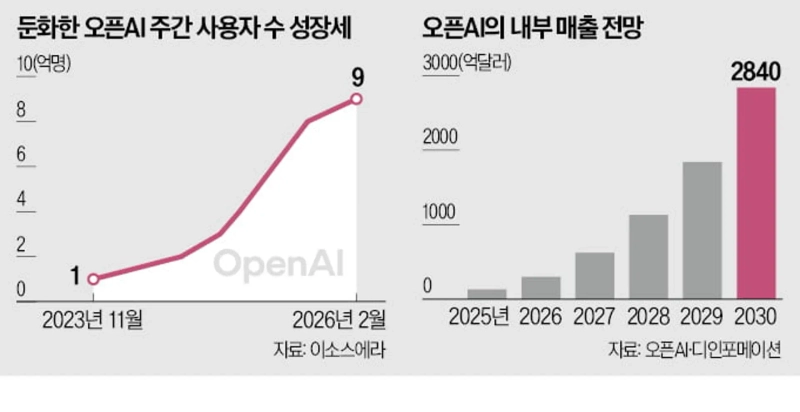
The remarks came as market anxiety mounted. The Wall Street Journal reported a day earlier that OpenAI failed to reach its goal of 1 billion weekly users by the end of 2025. Users are directly tied to the company’s revenue, and some have shifted to Google and Anthropic. Weekly users stood at about 900 million as of February.
The shortfall triggered friction between Chief Executive Officer Sam Altman and Chief Financial Officer Sarah Friar. Friar told the board that OpenAI may be unable to pay for $600 billion in computing contracts, prompting directors to review the company’s data-center agreements. The move effectively put the brakes on Altman’s “buy everything” strategy for data centers.
The two executives also clashed over the timing of an initial public offering. Altman wanted to move up a listing planned for the end of 2026, while Friar opposed the idea on the grounds that the company’s reporting standards still do not meet public-company requirements. As talk of discord spread, the two said in a joint statement that they are fully aligned on securing as much computing capacity as possible and are working toward that every day.
Pushes advertising and enterprise revenue
Investors appeared to put more weight on the Journal report. Shares linked to OpenAI fell across the board. Oracle, which is working with OpenAI on the $500 billion Stargate data-center project, dropped 4.05% to close at $165.96 on April 28. SoftBank Group, which had invested a total of $41 billion in OpenAI by the end of 2025, sank 12.11% in Tokyo trading. Nvidia, which supplies AI chips for Stargate and other projects, fell 1.63%.
OpenAI’s aggressive infrastructure spending rests on projections for rapid revenue growth. The company estimated revenue would rise from $13 billion in 2025 to $113 billion in 2028 and $284 billion in 2030. That would put it roughly in line with Taiwan Semiconductor Manufacturing Co.’s 2025 revenue of $121.9 billion by 2028, and above Microsoft’s 2025 revenue of $281.7 billion by 2030.
After missing its user target, OpenAI has few paths other than advertising to hit those revenue goals. That helps explain its push into the business. The centerpiece is ChatGPT Go, a lower-priced tier. The plan costs $8 a month in the U.S., less than half the $20 monthly price of ChatGPT Plus, but shows ads during chatbot conversations. OpenAI is targeting 112 million ChatGPT Go users, 37 times the current level, while accepting a decline in ChatGPT Plus subscribers.
The strategy would sacrifice part of the current paid subscriber base, which stands at about 5%, while lifting annual advertising revenue per user to $59 by 2030 from $3 this year.
OpenAI is also stepping up efforts to win enterprise customers through Amazon Web Services. AWS said on April 28 that it would offer OpenAI’s GPT models and Codex coding tool on Amazon Bedrock, its AI-model integration platform. Microsoft said a day earlier that it would end its exclusive rights to use OpenAI’s models.
Kim In-yeop, Silicon Valley correspondent, Hankyung.com, inside@hankyung.com

Korea Economic Daily
hankyung@bloomingbit.ioThe Korea Economic Daily Global is a digital media where latest news on Korean companies, industries, and financial markets.