PiCK
Circle’s Arc Raises $222 Million at $3 Billion Valuation to Build Institutional Stablecoin Infrastructure
Summary
- Circle said it raised $222 million through Layer 1 blockchain Arc and was valued at a $3 billion fully diluted valuation (FDV).
- Arc said it offers institution-focused integrated stablecoin infrastructure, USDC-based fees, a structure enabling automatic ARC conversion and burns, and tokenomics aimed at inflation neutrality.
- Global financial firms including BlackRock, Coinbase and Goldman Sachs have joined Arc, and industry participants said Circle has sufficient competitiveness in the fight to build a business network.
Forecast Trend Report by Period


Circle-developed L1 Arc raises $222 million
Stablecoin infrastructure targets institutions
Native token to power rewards distribution and token burns
“Ultimately it’s a business-network battle … Arc has enough of an edge”
Circle, the issuer of the world’s second-largest stablecoin, USDC, said it has raised a large funding round for its proprietary Layer 1 blockchain Arc. The financing is set to speed the buildout of integrated financial infrastructure aimed at linking the fragmented stablecoin ecosystem.
On May 11, Circle said it raised a total of $222 million through a presale of Arc’s native token, ARC, and investments including backing from Andreessen Horowitz, or a16z. The round valued Arc at a fully diluted valuation of $3 billion.
Arc’s central goal is to build an economic operating system for the Web3 ecosystem. The project is intended to support a stablecoin market that surpassed $30 trillion in annual transaction volume last year. It is designed to allow payments, lending and other functions that can take days to settle across separate closed networks to interact instantly on a single platform.
Global financial and technology companies have also joined the ecosystem’s expansion. Amazon Web Services, BlackRock and Coinbase took part in an earlier testnet, along with traditional financial firms including Goldman Sachs, Mastercard and Standard Chartered. South Korean participants included Kyobo Life Insurance, BDACS and Hecto Financial.
Stablecoin infrastructure for institutions
Arc offers deterministic settlement, configurable privacy and predictable fees based on stablecoins to meet institutional demand. Its ecosystem is organized into five layers: core contributors, assets and protocols, protocol services, developer kits and applications. The aim is to let developers build financial services easily without having to create foundational infrastructure first.
Institutions can use Arc to handle core functions such as asset settlement securely on-chain. Its configurable privacy feature is designed to preserve security while selectively disclosing necessary information to regulators or auditors, lowering barriers to adoption in regulated finance. Institutions can also participate directly in governance by voting on the system’s economic rules, including fees and inflation rates.
Arc’s security model starts with proof-of-authority, with trusted operators running the network, before shifting later to proof-of-stake, where participants gain authority by staking tokens directly. Entities validating network transactions are subject to strict identity checks and legal responsibility. The structure also allows retail investors to stake ARC and receive network rewards and governance rights based on the size of their holdings.
Decision-making authority is split between efficiency and decentralization. Circle will lead areas requiring speed, including system upgrades and responses to security incidents. Core economic matters such as the fee structure, token issuance and burn ratios will be decided through token-holder votes.
Fees can be paid in USDC, with ARC automatically converted and burned
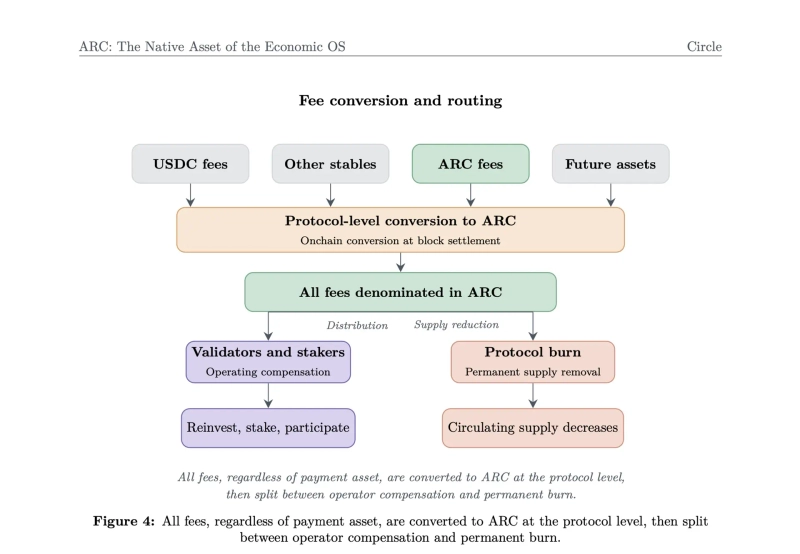
Automatic conversion and burns are central to Arc’s tokenomics. The network is designed to let users pay fees not only in USDC but also in various stablecoins and Arc’s native token. Regardless of the asset used, the protocol automatically converts it into ARC at the block-settlement stage.
The converted ARC is either distributed as validator rewards or permanently burned to defend against inflation. The network will begin with inflation of about 2% to 3%, with the long-term goal of reaching inflation neutrality, where the amount burned offsets new issuance.
ARC also has utility across the platform. Users who stake the token receive fee discounts on on-chain transactions. They also get lower fees and priority access across Circle’s Cross-Chain Transfer Protocol, or CCTP, as well as stablecoin minting, redemption and broader payment services.
“More about business than features … competitiveness is strong enough”
Industry participants said Circle’s Arc ecosystem push goes beyond a simple technical expansion and amounts to a broader effort to build a business network.
Bok Jin-sol, research lead at Populous Research, said features such as paying fees in stablecoins and high scalability are common claims among other specialized chains, making them hard to treat as clear technological differentiators. In the end, he said, stablecoin networks will be decided by business networks rather than by features or performance.
Bok said Circle had initially been viewed as having a shallower business moat than companies such as Stripe, which already has a vast global merchant base and user pool. But recent investments from major financial institutions including BlackRock, Intercontinental Exchange, Ark Invest, Standard Chartered and Apollo indicate Circle could offset much of that weakness on the business-network front.
Another industry official said Circle’s rapid expansion beyond remittances, foreign exchange and payments into areas such as agentic commerce, or AI agent-based commerce, is encouraging. If the company maintains that direction, Arc could become a highly competitive network in the market.
Technical validation ahead of the mainnet launch is in its final stages. The public testnet, launched in October 2025, had processed more than 244.1 million transactions as of May 5. Circle plans to launch the mainnet this summer based on investor demand for the financing round and the test results. A16z said that as global finance moves on-chain, only a handful of networks will become the foundation of a new financial system, and Arc is in a strong position to be one of them.

Doohyun Hwang
cow5361@bloomingbit.ioKEEP CALM AND HODL🍀