

PiCK
"The Buy Button Disappeared"... Investor Trust Collapses Due to Hyperliquid's 'Unauthorized Delisting'
Summary
- It was reported that investor trust collapsed due to Hyperliquid's unauthorized delisting.
- Concerns were raised about Hyperliquid's structural vulnerabilities and investor protection issues due to the system exploitation attack.
- The incident is being evaluated as an event that infringed on investor rights, similar to the Robinhood case, and legal controversy is expected.
The decentralized futures trading platform Hyperliquid (HYPE) responded to a system exploitation attack on the 26th (local time) with an extreme measure of 'unauthorized delisting,' raising concerns about the platform's trustworthiness and structural vulnerabilities.
The incident occurred due to Hyperliquid's unique liquidity provision method. Hyperliquid operates HLP (Hyperliquidity Provider) vaults that replace the role of market makers (MM) using users' funds and share the profits. The HLP vaults are designed to maintain market stability by taking over large-scale liquidations and liquidating positions based on market conditions. An anonymous whale exploited Hyperliquid's vulnerability by targeting the HLP vaults.
According to Arkham Intelligence data, the attacker established two long positions ($4.05 million) and one short position ($4.1 million) in the meme coin Jellymaijelly (JELLYJELLY, hereafter Jelly) trading pair through three accounts. They then induced the liquidation of the short position by purchasing Jelly coins on the spot market, intentionally offloading the short position onto the HLP vault. By manipulating prices through leveraged wash trading, they passed the loss onto Hyperliquid's HLP vault.
Jelly is a small-scale meme coin with a market cap of only $20 million. The HLP vaults had limitations in stably managing the millions of dollars in short positions they inherited.
Community participants also expressed dissatisfaction with Hyperliquid's HLP vault market-making method. An anonymous trader, CBB, who led the liquidation of Hyperliquid positions by a Trump insider, encouraged participation in the community, saying, "If you want to liquidate the short position, we must join forces. We have already formed a team and secured substantial funds." As a result, many traders took large long positions, and Jelly's price surged by about 550%, causing the total unrealized loss of the HLP vault to exceed $12 million.
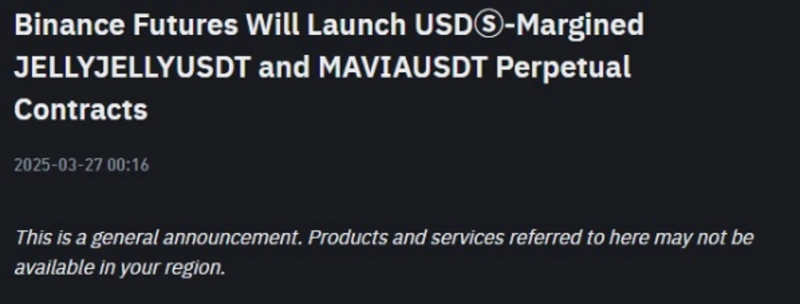
Subsequently, major centralized exchanges like OKX and Binance listed Jelly perpetual futures pairs, heightening the sense of crisis. Generally, a listing on a large exchange signifies increased liquidity, raising the possibility of further price increases. If Jelly's price reached the liquidation price ($0.16) due to the centralized exchange listing, the $230 million TVL (Total Value Locked) held by the HLP vault could have vanished entirely.
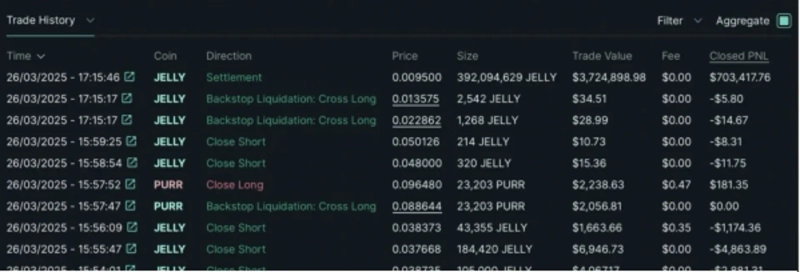
However, Hyperliquid delisted the Jelly futures trading pair without prior notice after Binance's listing announcement. They later stated on X, "Suspicious trading activities suspected of unfair trading were detected, and after a validator vote, we decided to delist the Jelly futures trading pair," adding, "The foundation will fully compensate all affected users." The sudden delisting of futures trading led to the liquidation of positions within the trading pair at the attacker's short position entry price ($0.0095). In this process, the Hyperliquid vault gained a profit of $700,000, while traders with forcibly liquidated positions faced unintended position closures.
On the 28th (local time), Hyperliquid announced additional measures, stating, "We plan to refund investors holding Jelly long positions at the closing price of $0.037555 at the time of settlement, and we will introduce risk management measures such as setting a cap on the ratio within the HLP vault, implementing sophisticated backstop liquidation logic, dynamically changing the open interest cap, and reviewing asset delisting through on-chain voting." However, investor dissatisfaction continues.
'Centralized' Decision-Making in the Face of Loss Crisis
Industry insiders pointed out that Hyperliquid, which claims to be a decentralized futures exchange (DeFi Futures), showed a dual attitude by making centralized decisions when faced with the risk of direct losses.
Renowned on-chain analysis expert ZachXBT criticized, "Hyperliquid claimed that trading could not be halted due to the decentralized mechanism when North Korean hacker groups traded hacked assets of numerous investors, but when large losses occurred in the HLP vault, a few validators immediately forced the closure of all futures positions." He explained that Hyperliquid, which had consistently turned a blind eye to issues like illegal money laundering by criminal organizations such as Lazarus, showed an active centralized approach by urgently convening validators composed of Hyperliquid officials when they faced losses.
Arthur Hayes, the founder of BitMEX, also expressed a critical stance, stating, "Hyperliquid can no longer be called a decentralized exchange."
The disappointment caused by Hyperliquid's extreme response is evident in on-chain indicators, including TVL. Shortly after the incident, approximately $140 million USDC was withdrawn from Hyperliquid. The HLP vault TVL also plummeted. According to DeFiLlama data, the HLP vault TVL, which was $286 million before the incident on the 26th (local time), has now decreased by about 34% to $188 million.
Market participants' concerns are also reflected in token prices. Hyperliquid's governance token HYPE dropped by about 22% to $13.08, according to CoinMarketCap, immediately after the incident. As of the 28th, it is trading at $14.69, recovering some of the losses.
The 'Robinhood GameStop Saga' of the Crypto Market... Trust Shattered
There are sharp criticisms that the Hyperliquid incident will remain as one of the worst cases of investor rights infringement, similar to the 'Robinhood GameStop purchase block' incident in the U.S. stock market.
Previously, the online financial trading platform Robinhood blocked investors from purchasing GameStop (GME) when it surged due to the meme stock frenzy in 2021. Subsequently, they had to explain the purchase block incident in a U.S. congressional hearing and were eventually fined $70 million by the Financial Industry Regulatory Authority (FINRA).
Similarly, claims have emerged that Hyperliquid, like Robinhood, has undermined investor rights and transparency, leading to market rejection. Gracy Chen, CEO of Bitget, stated on her X, "Hyperliquid's unauthorized delisting is a highly unethical act that betrays investors' trust, and if such trading structures continue, it could lead to a massive collapse in the virtual asset market, similar to the past FTX incident."
There is also an opinion that if U.S. regulatory agencies intervene, Hyperliquid will not be able to avoid legal responsibility. Jin Hyun-soo, the representative lawyer of the virtual asset law firm Decent, pointed out, "If an act of delisting a specific futures product without notice occurred in traditional finance, it would be a clear procedural violation," adding, "Prior disclosure and stakeholder participation rights are essential under the Capital Markets Act. It is a highly inappropriate decision in terms of investor protection."
He further added, "The possibility of class-action lawsuits by affected investors cannot be ruled out, and if regulatory authorities in the U.S. and other countries intervene, legal sanctions for market manipulation may follow."

Son Min
sonmin@bloomingbit.ioHello I’m Son Min, a journalist at BloomingBit