

PiCK
Stalled U.S.-China Trade Talks...Three Major Indices Slightly Down [New York Stock Exchange Briefing]
Summary
- It was reported that the three major indices of the New York Stock Exchange closed slightly down due to the stalled U.S.-China trade talks.
- Although President Trump did not take additional measures, tension continued as China expanded trade sanctions and adopted a 'slow and steady' strategy.
- Citi and Bank of America recorded strong first-quarter performance, but Boeing's stock price fell due to China's retaliatory measures.
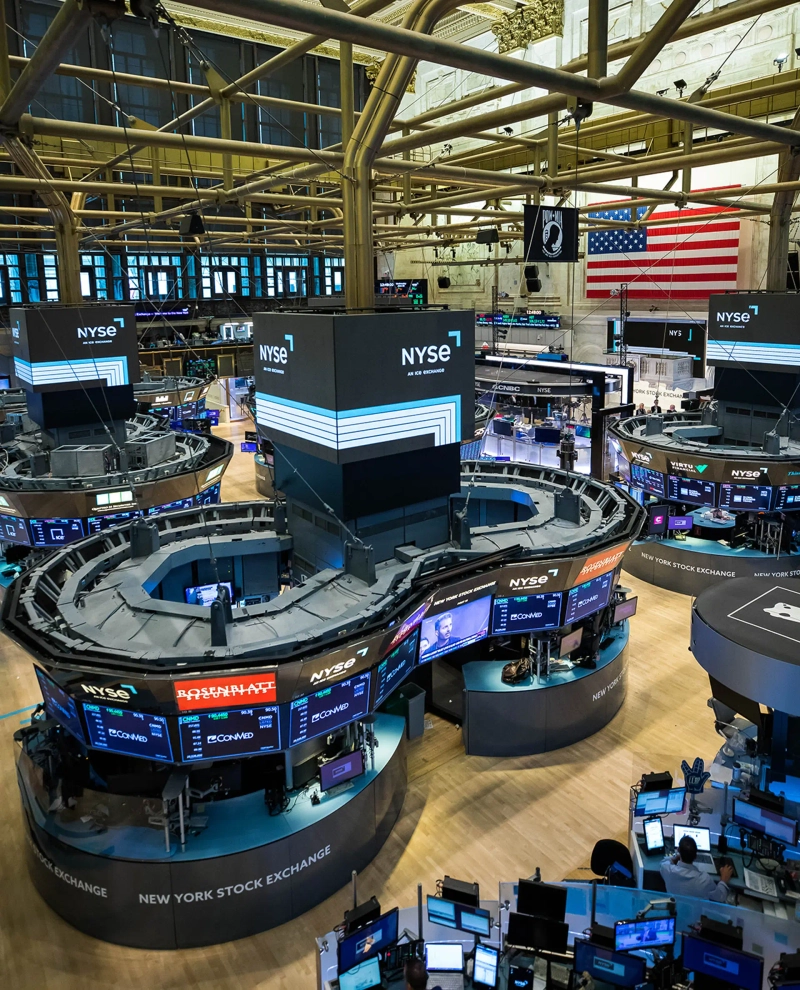
The three major indices of the New York Stock Exchange recorded slight declines. Amidst the ongoing power struggle over trade negotiations between the U.S. and China, the market also took a breather as U.S. President Donald Trump did not announce any additional tariff measures or statements.
However, Trump urged China to engage in negotiations, and China maintained tension by expanding trade sanctions against the U.S.
On the 15th (local time) at the New York Stock Exchange (NYSE), the Dow Jones Industrial Average closed at 40,368.96, down 155.83 points (0.38%) from the previous session. The Standard & Poor's (S&P) 500 Index fell 9.34 points (0.17%) to 5,396.63, and the Nasdaq Composite Index closed at 16,823.17, down 8.32 points (0.05%).
Trump did not announce any separate tariff measures or related statements on this day. Instead, the White House urged China to engage in negotiations.
White House spokeswoman Caroline Levitt said, "The ball is in China's court," urging, "China must negotiate with us." Levitt added, "There is no difference between China and other countries, only that they are much larger," and "China wants what we have, what every country wants, which is the American consumer and our money."
However, China seems to be adopting a 'slow and steady' strategy in trade negotiations, assuming that Trump is in a hurry.
On the 14th, China imposed restrictions on rare earth exports, and it was reported that Chinese authorities instructed domestic airlines not to receive aircraft and parts from American Boeing. Observations are growing that if U.S.-China trade negotiations continue as they are, Trump may become anxious.
The Financial Times (FT) pointed out that Xi Jinping holds more powerful cards than Trump, suggesting that Trump may become anxious.
Banks continued their strong performance in the first quarter. The tariff uncertainty triggered by Trump led to increased volatility, resulting in a surge in stock trading revenue. Citi announced that its first-quarter revenue reached $21.6 billion, exceeding the market expectation of $21.29 billion. Bank of America (BofA) also reported a 5.9% increase in first-quarter revenue to $27.51 billion compared to the same period last year, with net income up 11% to $7.4 billion.
Thanks to strong performance, BofA's stock price rose by over 3%, and Citigroup by over 2%.
Netflix saw its stock price jump by over 5% after executives expressed optimistic expectations for business expansion. Netflix executives stated, "We aim to double revenue and achieve a market capitalization of $1 trillion by 2030."
Boeing, the world's largest aircraft manufacturer, saw its stock price fall by over 2% due to China's retaliatory measures against the U.S.
Palantir showed strong performance for two consecutive days on news of winning a NATO AI system contract. The stock price rose by over 6%.
Shin Min-kyung, Hankyung.com reporter radio@hankyung.com

Korea Economic Daily
hankyung@bloomingbit.ioThe Korea Economic Daily Global is a digital media where latest news on Korean companies, industries, and financial markets.