

China warns of retaliation if harmed in tariff talks with the US... Threats to various countries
Summary
- China has announced that it will retaliate against countries that disadvantage it in tariff negotiations with the US.
- The US is indicating strong trade restrictions by demanding a reduction in Chinese imports in tariff negotiations with over 70 countries.
- Amid the trade war between the US and China, countries are at a crucial crossroads as they respond to US pressure while adjusting relations with China.
China pressuring countries in US tariff negotiations
Trade war sparks spread to third countries
Xi Jinping not stepping into tariff negotiations
Trump demands trade restrictions from various countries
Crackdown on China's rerouted exports by Vietnam, etc.
Inevitable US-China diplomatic balancing act
China warns of retaliation against US isolation strategy
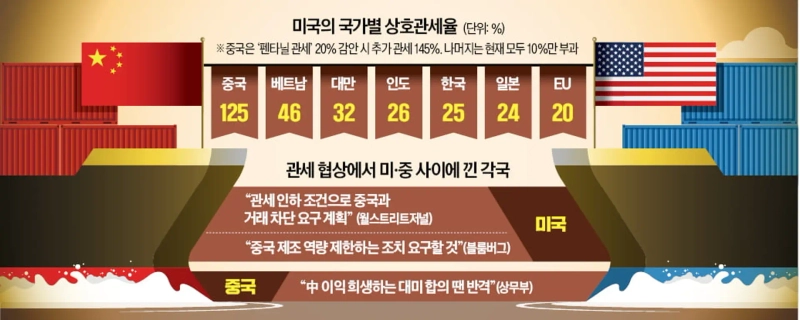
China has announced that it will retaliate against countries that disadvantage China in tariff negotiations with the United States. Observations have been made that the US will demand a reduction in trade with China as a condition for lowering tariffs, and some countries have shown actual movements in this direction, prompting China to issue a warning that it will not stand by. There are concerns that countries with significant trade relations with both the US and China will find themselves in a difficult position due to the trade war between the world's two largest economies.
◇China pressuring countries in US negotiations
A spokesperson for China's Ministry of Commerce stated on the 21st, "Some countries are trying to harm China's interests for short-term gains to be exempted from US tariffs," adding, "This is like asking a tiger for its skin (an impossible task), and it will inevitably fail." The spokesperson continued, "China firmly opposes any country achieving deals with the US at the expense of China's interests," and added, "If such a situation arises, we will never accept it and will take reciprocal countermeasures."
China's warning came after US media reported that the Trump administration plans to demand countries in tariff negotiations reduce trade with China and block rerouted exports of Chinese products. The Wall Street Journal (WSJ) reported that the US administration is demanding a reduction in imports of Chinese goods as a condition for lowering tariffs in mutual tariff negotiations with over 70 countries. The intention is to completely block Chinese companies from rerouting exports to third countries to avoid high US tariffs.
Bloomberg also reported that the US administration might raise the issue of 'secondary tariffs' with countries that have significant trade with China. This means additional tariffs could be imposed on goods imported from countries closely tied to China. President Trump also stated in a recent media interview, "There may come a time when countries have to choose between the US and China."
Some countries are yielding to US pressure. Vietnam has moved to block rerouted exports of Chinese products after the US threatened to impose a 46% mutual tariff. The Vietnamese government held an emergency meeting earlier this month to discuss strengthening control over illegal transshipment (known as 'transshipment'). They also decided to strengthen control over exports of sensitive items like semiconductors that can be diverted for military use. Vietnam plans to introduce a reporting and approval system to prevent US technology from flowing into China. It is known that they are negotiating with the US to lower mutual tariffs to 22-28%. Thailand is also taking steps to avoid a 36% mutual tariff imposed by the US. They plan to expand crackdowns on false certificates of origin submitted to avoid US tariffs.
◇Potential damage from 'whale fight'
Countries designated as the US's top priority tariff negotiation partners are facing a test. The US has designated five countries - South Korea, Japan, the UK, Australia, and India - as 'top priority negotiation partners' and plans to engage in intensive negotiations during a 90-day mutual tariff grace period. This strategy is interpreted as an attempt to pressure China by achieving early results in negotiations with major allies.
In the recently held US-Japan first tariff negotiations, China was not directly mentioned, but there is speculation that the US may demand Japan reduce trade with China in future negotiations. The Japanese government is reportedly considering cards such as expanding imports of US rice and simplifying automobile inspections ahead of the second negotiations. The US is also using the security card. Recently, a B-1B strategic bomber from Dyess Air Force Base in Texas was deployed to Misawa Air Base in Aomori Prefecture, Japan. The US military explained that this measure is for joint training with Japan and simultaneously a strategic measure to deter potential provocations in the Indo-Pacific region.
South Korea is also not free from US-China conflicts. The Korea-US tariff negotiations are scheduled to be held at 9 PM Korean time on the 24th.
Reporter Hyein Lee hey@hankyung.com

Korea Economic Daily
hankyung@bloomingbit.ioThe Korea Economic Daily Global is a digital media where latest news on Korean companies, industries, and financial markets.