

"If This Continues, Chaos... US Stocks Will Be Undervalued" A Terrifying Warning
Summary
- David Rosenberg warned that President Trump's financial policies could have a significant impact on the US asset market.
- He stated that the US stock and Treasury markets are likely to decline due to uncertainties such as the dismissal of Chairman Powell.
- In the current uncertainty, he advised increasing cash holdings and focusing on safe assets like gold.
Interview with David Rosenberg, Founder of Rosenberg Research
"If Trump Fires Chairman Powell, the Financial Market Shock Will Be Significant"
"China Has Greater Tolerance for Pain Than the US... Will Endure Longer"
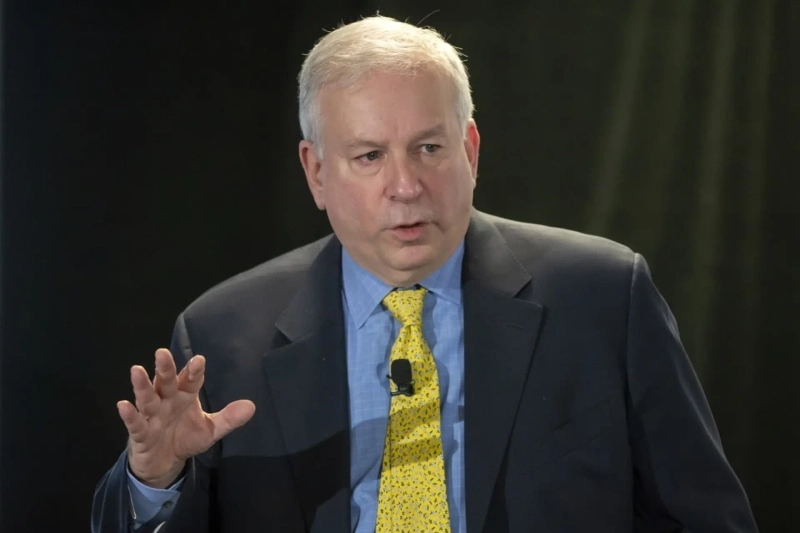
"Not only in the bond vigilantes but also in the dollar and stock vigilantes have emerged. Eventually, US assets will become undervalued."
David Rosenberg, a respected economist and market strategist on Wall Street, warned about the US asset market on the 21st (local time). As the founder of Rosenberg Research, he particularly foresaw that President Donald Trump's pressure to dismiss Jerome Powell, the chairman of the US Federal Reserve (Fed), would lead to turmoil in the US Treasury market.
Rosenberg predicted that due to President Trump's tariff policies, recession signals would become apparent in the next 3 to 4 quarters, and the Fed would aggressively cut rates. In the worst-case scenario, the S&P 500 could drop to 3000 within a year. Here is the Q&A.
▶ The Trump administration is considering dismissing Chairman Powell.
"This is a very serious issue. The US is a key currency country, and its status is entirely based on investor confidence and policy consistency. If Chairman Powell steps down midway, the chaos seen on New York Stock Exchange on 'Liberation Day' of April 2, when mutual tariffs were announced, will feel like a 'walk in the park'."
▶ What impact will it have on the financial market?
"This is something that would happen in a 'banana republic' (underdeveloped country). There will be further declines in the dollar, continued weakness in the stock market, and severe turmoil in the US Treasury market, which was considered a safe asset. Now, not only bond vigilantes but also dollar vigilantes, stock vigilantes, and credit market vigilantes have emerged. If President Trump dismisses Chairman Powell, (US assets) will be in a fire sale (undervalued sale)."
▶ What impact will the tariff policy have on the US and global economy this year?
"The economic war between the US and China has entered a new phase of trying to isolate each other. This is the 'elephant in the room' (uncomfortable truth). Due to this uncertainty, companies halt investment decisions, households reduce consumption, and investors switch to risk-averse mode. This uncertainty is impacting the US GDP growth rate by cutting it by 1-2 percentage points this year."
▶ There is a view that the US-China trade conflict will last much longer than expected due to China's endurance.
"The Chinese people have a much stronger ability to endure pain than Americans. President Xi Jinping of China is much younger than President Trump and can remain in power for a much longer period as he has no institutional constraints like elections. President Xi can implement a massive domestic demand-driven stimulus policy with a flick of a finger."
▶ Can tariffs solve the US trade deficit?
"The US economy is a consumption-based model. Theoretically, the sum of the current account and capital account is zero (0). As a result of the accumulated trade deficit, foreign investors today hold nearly $20 trillion in US stocks and real estate assets. The US has engaged with the world in this flow, securing a favorable position in the global capital market."
▶ But recently, Treasury prices have fallen.
"Global investors no longer believe US assets in general, especially US Treasuries, are as safe as they used to be. So now investors are attaching a 'risk premium' when buying US assets. This applies to stocks, corporate bonds, and Treasuries alike."
▶ Is President Trump pushing the tariff policy knowing this structure?
"To be honest, I don't think he understands it at all. He has consistently approached trade and tariff issues with the attitude of a 'dog with a bone' (obsessive persistence). It's more a product of obsession and political instinct than reason."
▶ Has the role of the White House staff changed from before?
"In Trump's first term, there were high-ranking officials with a free trade support tendency like Treasury Secretary Steven Mnuchin or National Economic Council (NEC) Chairman Gary Cohn, who are no longer in the White House. During Trump's first term, there was confusion due to the clash between free traders and protectionists within the administration, but the financial markets were relatively stable. Now the administration is stable, but the global economy and capital markets have turned chaotic."
▶ Isn't Treasury Secretary Scott Besant still considered someone who understands the market?
"Even he is not fully playing the role of 'devil's advocate' (counterbalance). No one opposes the president. The general atmosphere is 'let him do what he wants'."
▶ Do you think tariffs help US manufacturing jobs as President Trump says?"
"The US is now a service powerhouse, not a manufacturing powerhouse. Even if manufacturing returns, it's more likely that robots will fill the jobs, not people."
▶ Is it questionable whether the tariff policy is sustainable?
"None of President Trump's tariff policies have been legislated. They have all been implemented through emergency measures or executive orders. Building a factory in the US itself requires long-term investment over several years, and if the regime changes in 2028, this policy itself could disappear. This is a huge uncertainty factor that makes companies delay investment decisions."
▶ What is your outlook for the US stock market this year?
"If the US can get through without an economic recession, just with 'stagnation', the S&P 500 index could drop to the 4300 level. That's the best-case scenario. If the US experiences a severe recession, the S&P 500 could fall to the 3000 level. This could happen this year or within the next 12 months."
▶ If the New York Stock Exchange falls that much, won't more investment flow into safe assets like Treasuries or dollars?
"For the first time in my nearly 40-year career, I have started to question the safety of US assets. It's not simply a matter of whether US Treasuries or dollars are 'safe assets' or not, but the fact that this question itself has become a 'debate' is significant."
▶ What are your inflation and interest rate forecasts for the next 12 months?
"The price shock from tariffs will reduce real wages, which will in turn shrink real consumption. The pressure for a recession will increase. The moment the Fed recognizes this inflation as temporary, it will aggressively cut rates."
▶ Do you see a possibility of a recession?
"I definitely see the pressure for a recession increasing. And the signs will become more apparent in the third or fourth quarter of this year. The economic figures we are seeing now are distorted due to pre-orders and consumer stockpiling before the tariffs were implemented. But in the second half, there will be a demand gap."
▶ Are there any economic indicators you are paying attention to these days?
"There is a very interesting phenomenon these days. In 'soft data', which are survey-based economic indicators on business and household sentiment, there are already signals that a recession has started or is imminent. However, in 'hard data', which are actual statistics on employment, production, and consumption, there are no clear signs of a recession. We need to see if the 'soft data' that Chairman Powell mentioned will translate into 'hard data'."
▶ What is the most important indicator in hard data?
"The moment non-farm payroll numbers start to decline, 'the game is over'."
If the price shock is contained in the labor market, inflation can be curbed again.
▶ What strategies can governments adopt in this era of protectionism?
"Countries need to find ways to stimulate their domestic economies endogenously. They should look for ways to activate domestic demand through fiscal and regulatory reforms. In this regard, Germany is the first country to take action. It has embarked on a policy shift to expand domestic demand, even at the cost of abandoning its long-held fiscal soundness principle. This is why the euro has recently strengthened, and the European stock market is performing more robustly than the US stock market."
▶ How should individual investors prepare for the current uncertainty?
"Since global stock markets mostly move in tandem, European, Asian, and Canadian markets may fall less than the US, but avoiding a decline altogether is difficult. Now is the time to increase cash holdings and secure liquidity. I recommend paying attention to assets that move inversely to the weakening US dollar, such as gold and precious metal commodities."
New York = Correspondent Park Shin-young nyusos@hankyung.com

Korea Economic Daily
hankyung@bloomingbit.ioThe Korea Economic Daily Global is a digital media where latest news on Korean companies, industries, and financial markets.