

IMF Halves Korea's Growth Rate
Summary
- The IMF announced that it has halved South Korea's economic growth forecast from 2% to 1%.
- The decline in South Korea's growth rate was the third largest among major countries.
- It was reported that a predictable trade environment is needed to respond to increased uncertainty.
Outlook for This Year Drops from 2% to 1% in Three Months
US Down by 0.9%P, China by 0.6%P
The International Monetary Fund (IMF) has revised down South Korea's economic growth forecast for this year from 2% to 1%. Amidst a series of downward revisions for major countries' growth forecasts due to the tariff war initiated by the Donald Trump administration, it is predicted that South Korea's economy, which is highly dependent on trade, will suffer a greater impact.
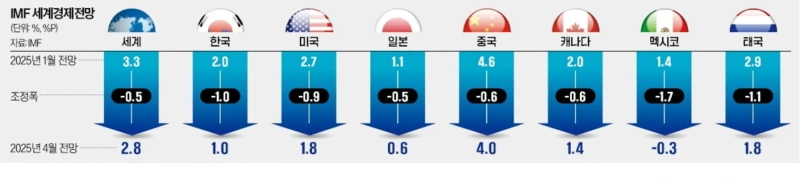
On the 22nd, the IMF released its 'April World Economic Outlook', predicting that the global economy will grow by 2.8% this year. This is a 0.5 percentage point decrease from the January forecast of 3.3% in just three months. South Korea's growth forecast for this year was also halved to 1.0% compared to the initial forecast. This is lower than the forecasts of the government (1.8%), the Bank of Korea (1.5%), and major private research institutes.
The decline in South Korea's growth rate was the third largest among major countries, following Mexico (1.7 percentage points) and Thailand (1.1 percentage points). Mexico and Thailand are expected to lose their competitiveness as manufacturing bases for China's bypass exports due to the US tariff barriers. The IMF lowered the US growth rate for this year from 2.7% to 1.8%, a 0.9 percentage point decrease, amidst concerns of an economic downturn due to unprecedented tariff policies. China's growth rate, which is engaged in retaliatory tariffs with the US, was also lowered from 4.6% to 4.0%.
The IMF analyzed that "the downside risks to the global economy have increased due to trade conflicts, leading to a contraction in consumption and investment."
'Tariff Shock' Realized... Korea's Growth Rate Decline Ranks Third Globally
South Korea, along with Mexico and Thailand, is predicted to be among the most affected by the tariff war waged by US President Donald Trump against the world. The higher the dependence on trade with the US, the greater the damage. It is expected that the slowdown in the US growth rate will be larger than that of China. The shockwaves received by European countries were relatively smaller.
◇Contraction in Global Consumption and Investment Due to Trade Conflicts
In the 'April World Economic Outlook' released on the 22nd, the IMF revised down the economic growth rates of major countries for this year and next year. It forecasted South Korea's economic growth rate for this year at 1%. This is a halving of the 2% growth forecast from January in just three months. The growth rate for next year was also presented at 1.4%, which is 0.7 percentage points lower than the January forecast of 2.1%.
The growth rates of other countries mostly went down as well. The IMF lowered this year's global growth rate from 3.3% to 2.8%. The growth rates for the US and China, which are engaged in a global power struggle, were lowered to 1.8% and 4.0%, respectively. Compared to three months ago, the US was down by 0.9 percentage points and China by 0.6 percentage points. The impact on European countries was relatively less. Major European countries such as the UK (1.1%), Germany (0.0%), and France (0.6%) also saw their forecasts drop by 0.2 to 0.5 percentage points.
The IMF cited "the contraction in consumption and investment due to increased policy uncertainty such as trade conflicts" as the reason for the adjustment in growth rates. It analyzed that the tariff war initiated by US President Donald Trump has had a negative impact on the global economy. The IMF warned that "the contraction in consumption and investment, lack of fiscal and monetary policy leeway, and high volatility in financial and foreign exchange markets are risk factors that could slow down the global economy."
In this analysis, the IMF presented different forecasts based on the reference date instead of a single forecast. The US government's announced tariff policy became the reference point. On the 2nd, President Trump imposed a basic tariff of 10% on all imports worldwide and imposed reciprocal tariffs of 11-50% on 57 countries including South Korea. The reciprocal tariffs were scheduled to take effect from the 9th but were deferred for 90 days for most countries except China.
Based on the criteria before the US announced reciprocal tariffs on the 2nd, the IMF lowered this year's global economic growth rate to 3.2%, a 0.1 percentage point decrease from the January forecast of 3.3%. However, the growth rate reflecting the deferral of reciprocal tariffs and US-China retaliatory tariffs after the 9th was lowered to 2.8%, a 0.5 percentage point decrease from the previous forecast. The 2026 global growth rate was also revised down from 3.3% to 2.9%.
◇Tariff War Impact Continues Next Year
A notable aspect is the adjustment range for South Korea. The decline in South Korea's growth rate was the third largest after Mexico (1.7 percentage points) and Thailand (1.1 percentage points). The IMF did not specifically explain the reason for lowering South Korea's growth rate. Experts analyze that due to the economic structure that relies on trade for about 90% of the Gross Domestic Product (GDP), the impact of the tariff war is greater.
The growth rate forecast for Japan, which received similar reciprocal tariffs as South Korea (25%), was revised from 1.1% to 0.6%. The adjustment range is half that of South Korea. The proportion of trade in Japan's economy is about 45%, roughly half of South Korea's.
Domestic and international institutions and investment banks (IBs) are also lowering South Korea's growth rate due to prolonged political uncertainty and the impact of the tariff war. The Bank of Korea lowered its growth forecast from 1.9% to 1.5% in February and is expected to make further adjustments next month. The Organization for Economic Cooperation and Development (OECD) lowered its forecast from 2.1% to 1.5%, and Standard & Poor's (S&P) from 2.0% to 1.2%. JP Morgan lowered its forecast for South Korea's growth rate to 0.7% on the 8th.
The IMF advised that in response to increased uncertainty and slowing growth, "efforts are needed to refrain from indiscriminate industrial subsidies and to prevent the fragmentation of trade through the expansion of regional and multilateral trade agreements to create a predictable trade environment."
Reporter Jeong Young-hyo hugh@hankyung.com

Korea Economic Daily
hankyung@bloomingbit.ioThe Korea Economic Daily Global is a digital media where latest news on Korean companies, industries, and financial markets.