

Worst Construction Market Hits Exports... "Korea, Virtually in Recession"
Summary
- According to the Bank of Korea's analysis, the first quarter GDP growth rate recorded -0.2% due to internal and external uncertainties and construction market weakness.
- Experts pointed out that the excessive household debt and aging population are prolonging the domestic recession, and the decline in export competitiveness of Korean companies is a problem.
- Professor Lee Seung-heon warned that without improving the structural problems of the economy, long-term low growth could become entrenched.
Q1 GDP Growth Rate -0.2%
Negative Growth, Blamed on Unexpected Adversities...
Impeachment Crisis and Wildfires Severely Impact Domestic Demand
First Time for 0% Growth for Four Consecutive Quarters
Loss of 'Resilience' Due to Lack of Innovation
Delayed Household Debt and Self-Employment Restructuring
Reduced Personal Consumption Capacity and Decreased Corporate Competitiveness
The Bank of Korea analyzed that the negative growth in the first quarter was due to a combination of unexpected adversities. They expect that if the effects of the three interest rate cuts since last October appear and trade and political uncertainties are resolved, the growth rate could return to positive from the second quarter.
Private experts' diagnoses are far from this optimistic judgment. They pointed out that the domestic recession is showing signs of prolongation due to excessively accumulated household debt and an aging population. The export competitiveness of Korean companies struggling between innovative companies in the U.S. and China was also pointed out as a problem. Lee Seung-heon, a professor at Soongsil University's Graduate School of Business and a former deputy governor of the Bank of Korea, warned, "If we do not properly reform the structural problems of our economy, long-term low growth could become entrenched."
Long-term Zero Growth Unseen Even During the Foreign Exchange Crisis
Lee Dong-won, Director of the Economic Statistics Department 2 at the Bank of Korea, began the press conference on the first quarter's real Gross Domestic Product (GDP, preliminary figure) statistics on the 24th by saying, "There is something I need to explain first," and detailed the reasons why the first quarter GDP growth rate (-0.2%) fell significantly below the Bank of Korea's forecast (0.2%) two months ago.
He analyzed that economic sentiment recovery was delayed due to internal and external uncertainties, the construction market was weaker than expected, and consumption and investment were further contracted due to large wildfires and highway bridge collapse accidents. The impact of the delay in Samsung Electronics' high-bandwidth memory (HBM) orders due to NVIDIA's artificial intelligence (AI) accelerator overheating issue was also mentioned. A high-ranking official from the Bank of Korea emphasized, "If these adversities normalize from the second quarter, they will be a positive factor for the growth rate," and "If the uncertainty of the U.S. Donald Trump administration's tariff policy is cleared and the supplementary budget execution begins in earnest under the new government, the growth rate should rise."
Middle-Class Consumption Capacity Reduced by Household Debt
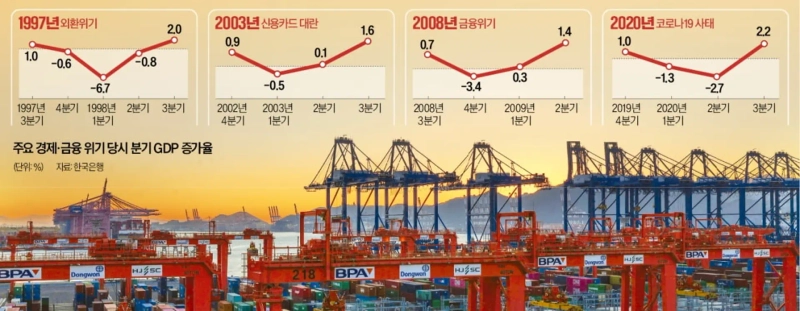
However, most experts focused on structural problems rather than these temporary factors. They reasoned that low growth has persisted for too long compared to the potential growth rate estimated at around 2%. The GDP growth rate recorded '0.1% or less' for four consecutive quarters from the second quarter of last year to the first quarter of this year.
This low growth phase has not been experienced even during past large-scale economic and financial crises. During the 1997 foreign exchange crisis, after three consecutive quarters of negative growth, the fourth quarter (third quarter of 1998) recorded high growth of 2%. During the 2003 credit card crisis, the 2008 global financial crisis, and the 2020 COVID-19 crisis, the growth rate rebounded significantly after one or two quarters of decline.
Economists unanimously said, "The vitality of the Korean economy is noticeably declining" (Lee Seung-hoon, a researcher at Meritz Securities). This is because the consumption capacity of the middle class is rapidly decreasing due to aging and household debt, and the real income of self-employed and small business owners is also decreasing due to intensified competition. The retreat of Korean companies' competitiveness on the global stage is also considered a structural problem.
The Bank of Korea also acknowledges these structural problems. In the briefing, Director Lee mentioned the slowdown in consumption due to household debt increase and aging, saying, "It is true that domestic demand is not contributing properly to growth as it did in the past."
Possibility of Recession Already Started
Professor Lee said, "Korea's export and domestic demand engines have been gradually weakening since the mid-2010s," and "There is an aspect that we did not quickly recognize while going through the domestic real estate bubble and the COVID-19 crisis."
There are also many experts who view the current situation as the beginning of a recession. Ahn Dong-hyun, a professor of economics at Seoul National University, said, "Recession generally refers to a case where the quarterly GDP growth rate experiences negative growth for two or three consecutive quarters," but added, "Considering the situation where the growth rate is excessively low compared to the potential growth rate (1.8%) of our country for a long time, we must also suspect the possibility that a recession has already started."
Reporter Jwa Dong-wook leftking@hankyung.com

Korea Economic Daily
hankyung@bloomingbit.ioThe Korea Economic Daily Global is a digital media where latest news on Korean companies, industries, and financial markets.