

Summary
- President Trump hinted at the possibility of lowering tariffs on Chinese imports within 2-3 weeks.
- Amid US supply chain instability, the White House is reportedly considering reducing the 145% tariff rate on China to around 50%.
- China denied the ongoing tariff negotiations with the US as groundless, insisting that all unilateral tariffs must be abolished.
US-China Tariff U-turn... US "New tariff rates to be announced in 2-3 weeks"
Trump continues to send conciliatory messages
WSJ "Possibility of China tariffs dropping from 145% to 50%"
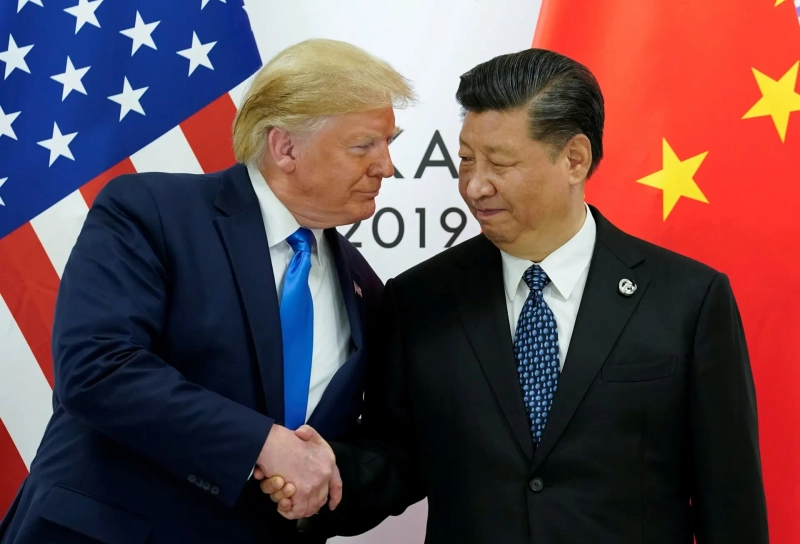
US President Donald Trump hinted at the possibility of lowering tariffs on Chinese imports within 2-3 weeks. There are projections that the 145% tariff rate imposed on China after the inauguration of the Trump administration's second term could be reduced to around 50%.
On the 23rd (local time), President Trump stated, "We will set (new) tariff rates in the next 2-3 weeks," adding that "China could be included." This follows his previous statement that "the 145% (additional) tariff on China is very high. The tariff rate will significantly decrease after negotiations," and he even mentioned the timing of the reduction. When asked by reporters if direct negotiations with China were ongoing, President Trump replied, "Yes, we are doing it every day."
The Wall Street Journal (WSJ), citing a senior White House official, reported that "there is a high possibility that the tariff rate on China will be lowered to 50-65%." It also mentioned that there is a plan under consideration to apply about 35% tariffs on items unrelated to national security and at least 100% high tariffs on items important to the strategic interests of the US.
Analysts suggest that after China consistently held its ground and President Trump unilaterally raised tariffs, he suddenly made conciliatory gestures towards China due to backlash from the market.
However, White House spokeswoman Caroline Levitt said in a Fox News interview that "there will be no unilateral tariff reduction on China." Meanwhile, the Chinese Ministry of Commerce refuted President Trump's statement about ongoing US-China negotiations as "groundless" during a press conference on the 24th.
Despite 'supply chain collapse' warnings, US-China tariff conciliation measures introduced...
Trump "Tariff rates to be decided in 2-3 weeks", domestic 'tariff backlash' spreads
President Trump stated that tariff negotiations with China are underway, but China outright denied it as "groundless." While President Trump, after unilaterally raising tariffs on China, is making conciliatory gestures to bring China to the negotiation table amid market turmoil, China has denied the very fact of negotiations. Meanwhile, in the US, retailers are warning that "shelves will be empty." Analysts suggest that the background to the Trump administration's consideration of reducing tariffs on China lies in such supply chain instability.
Trump makes a sudden shift amid 'supply chain collapse' warnings
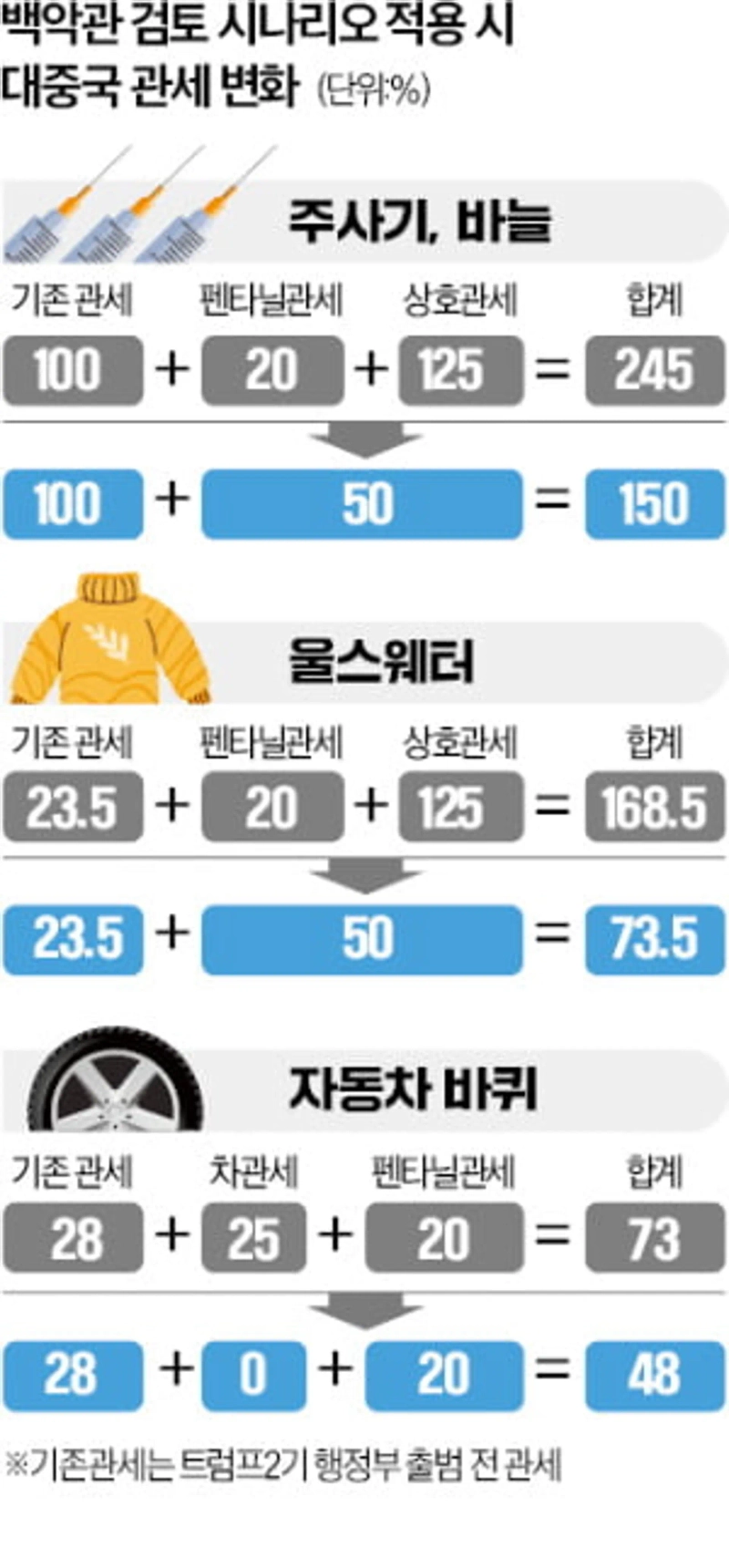
According to scenarios under consideration by the White House, if the current 145% additional tariff on China is lowered to around 50%, the total tariff rate on Chinese syringes and needles, which are subject to the highest tariffs, will drop from 245% to 150%. The tariff on Chinese wool sweaters could also decrease from 168.5% to 73.5%, a reduction of nearly 100 percentage points.
Recently, President Trump has been retreating from his tariff policies, such as deferring mutual tariffs and abolishing tariffs on some electronic products. This contrasts with the statement made just three weeks ago by Peter Navarro, White House Trade and Manufacturing Policy Advisor, and Howard Lutnick, US Secretary of Commerce, that "there will be no change in tariff rates." It is interpreted that the backlash from the international community, including allies and competitors, concerns over financial market shocks, and stagflation (economic stagnation amid rising prices) have influenced this shift.
Major foreign media outlets analyzed that the atmosphere changed particularly after a closed-door meeting with major retail CEOs such as Walmart, Target, and Home Depot on the 21st, where they warned that "store shelves could be empty" or "supply chain disruptions could start within two weeks." However, the Trump administration has not yet made a final decision, and internal discussions are ongoing at the White House over various scenarios.
The Wall Street Journal (WSJ) evaluated President Trump's policy shift as a 'Mitterrand moment,' likening his actions to those of former French President François Mitterrand. After taking office in 1981, President Mitterrand initially pushed for strong socialist policies but reversed most of them within a year due to market backlash and shifted to a centrist approach.
However, it remains uncertain whether trade negotiations will proceed smoothly. On the 24th, Chinese Ministry of Commerce spokesman He Yadong stated, "There are no trade negotiations with the US," and "all unilateral tariffs imposed on China must be abolished." President Trump stated the previous day that "(tariffs) will not be zero (0%)," drawing a line on the possibility of restoring tariff rates to their original state.
Logistics to the US halted... 'Red light' on performance
Supply chain instability is becoming a reality. Due to the impact of high tariffs, Chinese exporters are halting shipments to the US or reducing production lines for the US. Some are even considering permanent withdrawal from the US market. German shipping company Hapag-Lloyd stated that "about 30% of cargo heading from China to the US has been canceled," and "demand for goods heading to Thailand, Cambodia, and Vietnam is surging instead due to the trade dispute." Wang Xin, president of the Shenzhen Cross-Border E-Commerce Association, representing about 3,000 Chinese exporters, said, "Chinese companies are securing cash by terminating warehouse rental contracts in the US."
US companies are directly hit by trade conflicts. According to Bloomberg Intelligence, as of the second quarter, 27% of S&P 500 companies have lowered their earnings guidance for this year, while only 9% have raised it.
As the situation worsens, state governments are taking action. On this day, 12 states, including New York, Oregon, and Arizona, filed a lawsuit with the US Court of International Trade, claiming that President Trump illegally implemented tariff policies without going through the federal Congress, which has the authority to decide tariffs.
Lim Dayeon/Han Gyeongje reporters allopen@hankyung.com

Korea Economic Daily
hankyung@bloomingbit.ioThe Korea Economic Daily Global is a digital media where latest news on Korean companies, industries, and financial markets.