

Choi Sang-mok and Ahn Deok-geun Meet with U.S. Negotiators, Requesting Tariff Deferral on Cars
Summary
- Korea and the U.S. discussed ways to reduce the trade surplus through increased imports, requesting a deferral of tariffs on automobiles and semiconductors.
- Korea proposed reducing trade imbalance by expanding purchases of U.S. LNG and aircraft.
- The government prepared for the U.S. side's non-tariff barrier demands by forming a large delegation with officials from various ministries.
Start of Korea-U.S. '2+2 Trade Talks'
Trump Does Not Appear at Negotiation Venue
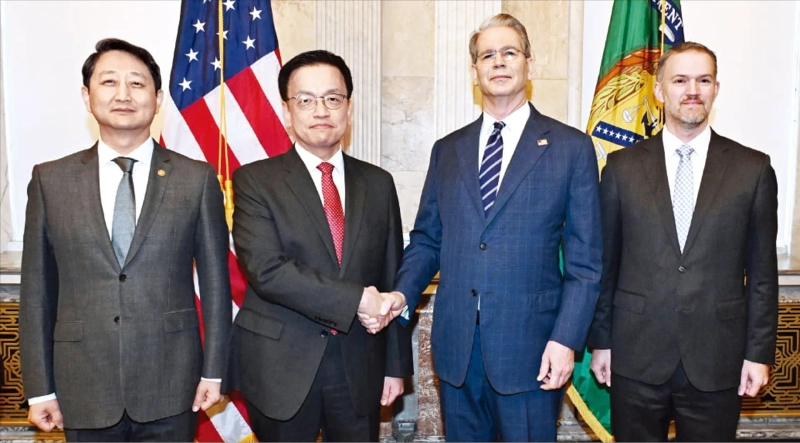
On the 24th, Korea and the U.S. held a '2+2 Ministerial Trade Talks' in Washington, D.C., to lower the tariffs imposed by President Donald Trump.
Deputy Prime Minister and Minister of Economy and Finance Choi Sang-mok and Minister of Trade, Industry and Energy Ahn Deok-geun held a finance and trade ministerial meeting with U.S. Treasury Secretary Scott Besant and USTR Representative Jamieson Greer for about 1 hour and 20 minutes at the U.S. Treasury Department in Washington, D.C., starting around 8:10 a.m.
In the talks, which were arranged at the suggestion of the U.S. side, the two sides discussed ways to reduce Korea's trade surplus with the U.S. and cooperation in the energy and shipbuilding sectors. The Korean side reportedly proposed increasing imports by expanding purchases of U.S. liquefied natural gas (LNG) and commercial aircraft, as it is difficult to reduce exports.
The Korean side is said to have requested the maximum deferral of the 25% reciprocal tariff announced by the U.S. President. President Trump announced a 25% reciprocal tariff on Korea on the 2nd, but only imposed a 10% basic tariff from the 3rd, deferring the 15% individual tariff for 90 days.
Korea also appears to have requested a deferral of tariffs on automobiles and semiconductors, Korea's top two export items. The U.S. imposed a 25% item tariff on foreign automobiles from the 3rd.
Unlike the negotiations with Japan last week, President Trump did not make a surprise appearance at this meeting. It is not known whether the U.S. side demanded an increase in defense cost-sharing during this negotiation.
Proposal to Reduce Trade Surplus through U.S. LNG Imports
According to the Ministry of Trade, Industry and Energy and other relevant authorities, the 2+2 meeting on the 24th was held for about 1 hour and 15 minutes in a consecutive interpretation format. Afterward, Minister of Trade, Industry and Energy Ahn Deok-geun continued a one-on-one meeting with USTR Representative Jamieson Greer.
Our government has set a policy to negotiate as quickly as possible on the three major wishes of the U.S. side, which Acting President Han Duk-soo mentioned in a phone call with President Donald Trump on the 8th: reducing the trade surplus with the U.S., participating in the Alaska LNG project, and Korea-U.S. shipbuilding cooperation.
It is reported that the government prepared a 'correct answer sheet' for most of the non-tariff barrier items mentioned in the USTR's National Trade Estimate (NTE) report and attended the meeting. To this end, the government organized a large joint delegation of about 50 people for this visit to the U.S.
The delegation included not only the Ministry of Economy and Finance and the Ministry of Trade, Industry and Energy but also director-level officials from relevant ministries such as the Ministry of Foreign Affairs, the Ministry of Science and ICT, the Ministry of Land, Infrastructure and Transport, the Ministry of Environment, the Ministry of Agriculture, Food and Rural Affairs, and the Ministry of Health and Welfare. This was to gather working-level officials on issues that the U.S. side might raise as non-tariff barriers.
Initially, the government did not intend to address non-tariff barriers in this negotiation, but it is analyzed that they considered the fact that non-tariff barriers were detailed in last week's talks with Japan. The U.S. has pointed out issues such as rice and beef imports over 30 months old as non-tariff barriers in the agricultural sector. In the IT sector, concerns of U.S. big tech companies such as the Platform Act and Google Maps export were raised, and in the industrial sector, import car environmental standards were questioned.
It is reported that opinions were coordinated on the assistance that Korea can provide regarding the U.S.-desired LNG purchases and maritime and shipbuilding cooperation. A government official explained, "The basic policy of the negotiation is to clearly mention the parts where Korea can contribute to the U.S. supply chain as an ally and to provide some assistance in the prompt negotiations desired by the U.S. side."
A government official said, "The talks between the ministers of the two countries on this day were a place to coordinate the direction of Korea-U.S. trade cooperation and tariff negotiations in the future," and "Specific details will be discussed in future working-level consultations."
Reporters: Kim Dae-hoon/Kim Ri-an, Washington Correspondent: Lee Sang-eun daepun@hankyung.com

Korea Economic Daily
hankyung@bloomingbit.ioThe Korea Economic Daily Global is a digital media where latest news on Korean companies, industries, and financial markets.