

PiCK
[New York Stock Market Briefing] Rising for the Third Day as Tariff Uncertainty Eases...NVIDIA Gains Over 3%
Summary
- The New York stock market reported a three-day consecutive rise as tariff uncertainty decreased.
- President Trump's announcement of parts tariff exemptions positively influenced investor sentiment.
- Technology stocks showed strong performance, with the Philadelphia Semiconductor Index rising 5.63%.
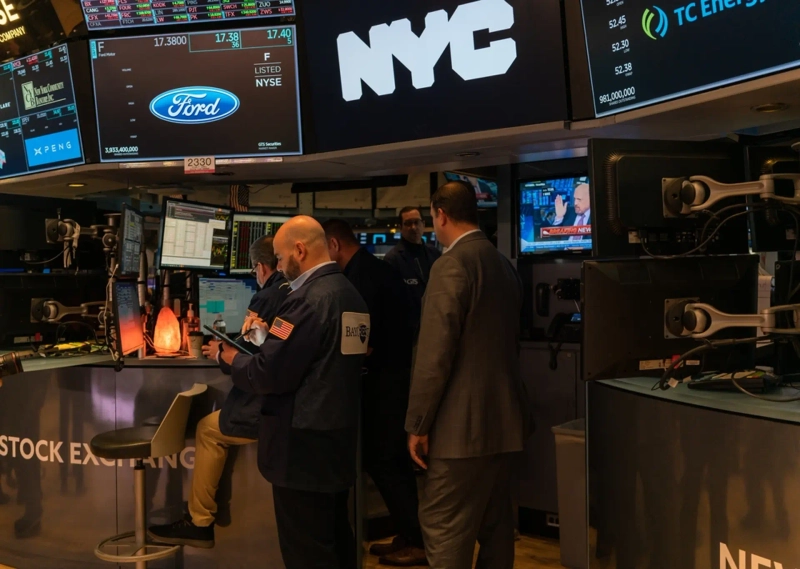
The major three indices of the New York stock market closed with gains for the third consecutive day. This is attributed to the easing of investor anxiety as the U.S. engages in tariff negotiations with major countries.
On the 25th (local time) at the New York Stock Exchange (NYSE), the Dow Jones Industrial Average rose 486.83 points (1.23%) to close at 40,093.4. The Standard & Poor's (S&P) 500 index increased by 108.91 points (2.03%) to 5,484.77, and the tech-heavy Nasdaq Composite Index jumped 457.99 points (2.74%) to close at 17,166.04.
There was no clear positive factor to drive the stock market up. The U.S.-China trade negotiations have sparked doubts as both sides provided conflicting explanations, suggesting that the negotiations are stalling.
U.S. President Donald Trump, during a luncheon meeting with Norwegian Prime Minister Jonas Gahr Støre at the White House, was asked who he was negotiating trade with in China, to which he replied, "They had a meeting this morning."
President Trump stated that it doesn't matter who attended the meeting, saying, "We might reveal it later, but they met this morning, and we have been continuing meetings with China."
This contradicts the Chinese side's explanation. Earlier that day, the Chinese government stated that they were not engaged in trade negotiations with the U.S. The Chinese Foreign Ministry said, "As far as I know, the two sides have not negotiated or consulted on tariff issues," adding, "Let alone reaching an agreement."
The Chinese Ministry of Commerce also indicated that "If the U.S. truly wants to resolve the issue, it should withdraw general tariff measures against China and resolve differences through equal dialogue," suggesting that they would not enter negotiations until tariff measures are withdrawn.
Despite the U.S.-China trade negotiations faltering, investors' buying interest was observed. This is due to the expectation that tariff uncertainty will eventually subside as the U.S. enters tariff negotiations with major trading partners such as South Korea, Japan, and India.
President Trump's announcement to exempt some parts tariffs for automakers also supported this outlook.
The core of this measure is to exclude auto parts from the 25% tariffs imposed on steel and aluminum worldwide. This measure led to expectations that the scope of tariff exemptions would expand further.
Ross Mayfield, an investment analyst at Baird, said, "China clearly stated overnight that negotiations are not ongoing," adding, "The market seems somewhat convinced that the Trump administration wants an agreement instead of raising tariffs unreasonably, and yesterday's optimism may still linger."
However, there is an analysis that the possibility of a U.S. economic recession has increased. UBS strategist Sean Simmons said, "The market is quickly pricing towards a U.S. economic recession," noting that "stocks sensitive to tariffs are being aggressively readjusted, currently down 20% compared to the market."
Bridgewater Associates, the world's largest hedge fund, also pointed out, "We anticipate an economic recession due to tariff policies," adding, "The possibility of a recession has increased."
By sector, all stocks except consumer staples rose, with technology stocks surging 3.54%. The Philadelphia Semiconductor Index jumped 5.63%. All 30 stocks that make up the index were strong, with TSMC, Qualcomm, and AMD up over 4%, and Broadcom, Texas Instruments, and Arm up over 6%.
The 'Magnificent 7' (M7), referring to the seven giant tech companies, also rose. Microsoft, NVIDIA, Amazon, and Tesla all gained over 3%.
Alphabet announced first-quarter earnings that exceeded market expectations after the market closed, rising over 4% in after-hours trading. During the day, it was up over 2%.
Toy company Hasbro surged 14% as its first-quarter earnings significantly exceeded market expectations. Netflix jumped 4.50% due to improved earnings guidance.
On the other hand, beverage manufacturer PepsiCo fell 5% due to the impact of lowering its earnings outlook for this year. Consumer goods manufacturer Procter & Gamble also fell nearly 4% as tariff uncertainty eased.
U.S. Federal Reserve (Fed) officials continued to make cautious remarks. Fed Governor Christopher Waller said, "If the employment market starts to deteriorate severely, more rate cuts are expected sooner," adding, "If the employment market contracts significantly, it's important for the Fed's mandate to intervene on the employment side."
Beth Hammack, President of the Federal Reserve Bank of Cleveland, said about the possibility of a rate cut in May, "I think it's too early," adding, "We need to be patient."
New orders for durable goods manufacturers in the U.S. in March far exceeded market expectations. However, excluding aircraft, the increase was minimal, confirming that companies are cautious about investing.
According to the U.S. Department of Commerce, last month's durable goods orders recorded $315.7 billion on a seasonally adjusted basis, a sharp increase of $26.6 billion (9.2%) from the previous month. However, non-defense capital goods orders excluding aircraft, considered a gauge of business investment, only increased by 0.1% to $75.1 billion.
The number of new unemployment insurance claims filed in the U.S. for the week increased again. According to the weekly unemployment insurance claims report released by the U.S. Department of Labor, the number of new unemployment insurance claims for the week ending on the 19th was 222,000 on a seasonally adjusted basis, an increase of 6,000 from the previous week.
According to the Chicago Mercantile Exchange (CME) FedWatch Tool, the probability of the Fed keeping the benchmark interest rate unchanged by the end of June fell by about 3 percentage points to 38% compared to the previous day's close. The probability of a 0.25 percentage point cut rose to 58%.
The Chicago Board Options Exchange (CBOE) Volatility Index (VIX) fell 1.98 points (6.96%) to 26.47 compared to the previous session.
Reporter Goh Jung-sam, Hankyung.com jsk@hankyung.com

Korea Economic Daily
hankyung@bloomingbit.ioThe Korea Economic Daily Global is a digital media where latest news on Korean companies, industries, and financial markets.