

"Trump tariffs add 'risk premium' to dollar assets... US loses trust"
Summary
- Professor Maurice Obstfeld pointed out that Trump's tariffs have added a 'risk premium' to dollar assets.
- It may take time for the US to regain trust, and Trump's policies are systematically attacking the global trade system.
- Korea should strengthen regional cooperation and respond by joining the CPTPP and enhancing relations with ASEAN.
Interview - Maurice Obstfeld, Professor at UC Berkeley
The Miran report is completely wrong
The claim that trade deficits are tolerated to supply dollars
No direct correlation... Absurd claim
Policy goals are contradictory, leading to dilemmas
The Trump administration demands changes in other countries' economic and monetary policies to favor the US
Trump wants division... Countries must cooperate
If you succumb to Trump, more demands will follow
Korea should not comply with everything... Must join hands with China and Japan
Need to join CPTPP and strengthen relations with ASEAN
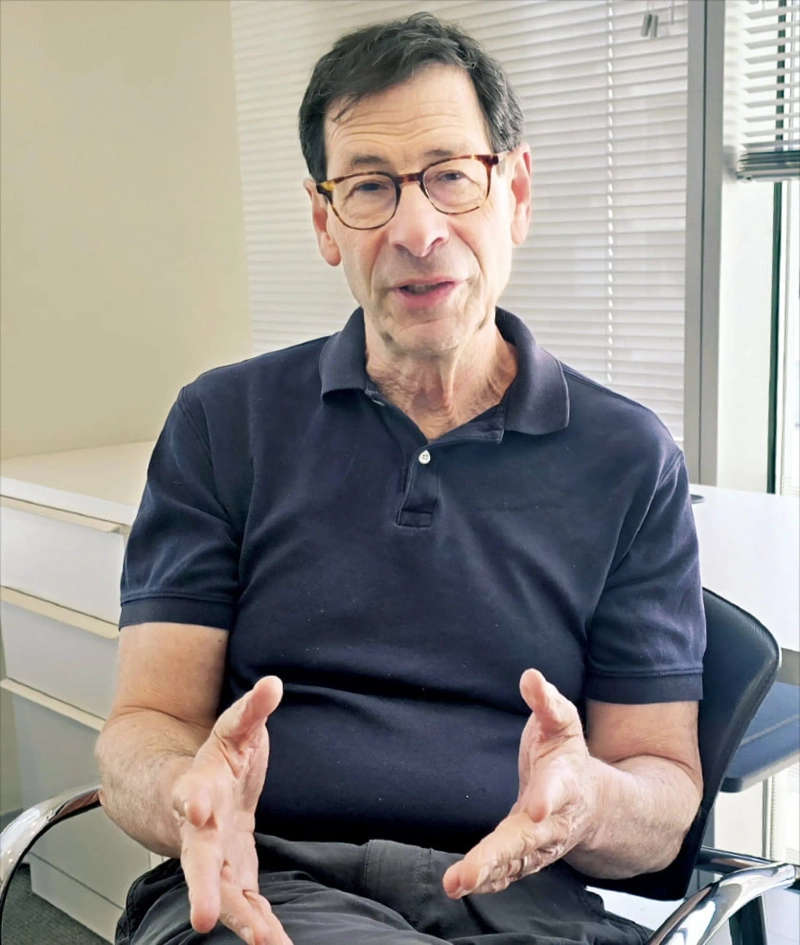
"Trump wants other countries to change their economic policies to suit America's needs. The problem is that even if you accept those demands, it's unclear if that will be the end of it." Maurice Obstfeld, a world-renowned international economist and former chief economist at the International Monetary Fund (IMF), said in an interview with Korea Economic Daily that Korea should not comply with all of President Donald Trump's demands in tariff negotiations. He dismissed the Trump administration's logic that the US is a victim of international trade, claiming that the US tolerates trade deficits to supply dollars to the global economy as "foolish and absurd." The interview with Professor Obstfeld took place at the Peterson Institute for International Economics in Washington DC, ahead of Trump's 100th day in office. He is also a senior fellow at the institute.
▷The market is in turmoil due to 'Trump tariffs'.
"The value of the dollar has fallen, and a 'Trump premium (risk premium)' has been added to dollar-denominated assets. Dollar assets have been valued for their safety and liquidity, allowing the US to apply lower interest rates in the (bond market), but trust in the dollar is weakening, and the US's global (leadership) role is being questioned. It's impossible to say how big the impact will be or when things will return to normal."
▷Will it be the same even if the next administration changes policies?
"It won't be easy. It may take more than a few years for the US to regain trust."
▷There are criticisms that the US's all-out tariffs are reminiscent of the Great Depression.
"The Smoot-Hawley Tariff Act (1930) introduced during the Great Depression and Trump's tariffs have different purposes. During the Great Depression, tariffs were strongly motivated by the desire to protect US industry. In contrast, Trump's tariffs are a systematic attack on the global trade system. The goal is to change the entire trade system to suit US interests."
▷In Trump's terms, is it about preventing other countries from taking advantage of the US?
"The story driving the Trump administration's policy is that the US has provided a public good (dollar) to the world but has not benefited from it. The US is portrayed as a victim of the global economic structure, and this needs to change."
▷Is the US a victim?
"While the dollar, as the key currency, is a public good in international trade and there are costs associated with public goods, the costs are not as large as they claim. On the contrary, the dollar being the key currency gives the US financial system a strategic advantage as the center of the world. There are also advantages in monetary policy, and the US's voice is naturally reflected in policies on terrorism, corruption, and overseas money laundering."
▷Isn't the structural strength of the dollar inevitable because it's the key currency?
"There are various estimates of the dollar's strength effect due to being the key currency. Some estimate it at about 2% of GDP, but recent IMF analysis did not yield statistically significant results."
▷The Trump administration also claims that the dollar's strength has increased the US trade deficit.
"While a strong dollar can reduce trade surpluses, it doesn't necessarily lead to trade deficits."
▷Trump is demanding a reduction in the US trade deficit in tariff negotiations.
"To reduce the trade deficit, the fiscal deficit must be reduced first. (The trade deficit is mainly due to the US's lack of savings and overconsumption), and the US government is spending too much compared to its revenue."
▷Is it possible to revive US manufacturing through tariffs?
"It's impossible. The era when factory workers earned high wages on car assembly lines like in the 1950s will not return. The US must look to the future in advanced manufacturing and service sectors."
▷You must be negative about the 'Miran report' by Stephen Miran, Chairman of the White House National Economic Council.
"The report is highly misleading. Especially the claim that the US tolerates trade deficits to supply dollars to the world is completely wrong. There is no direct correlation between the dollar liquidity supplied by the US to the world and the trade deficit. For example, in 2015-2016, China sold $1 trillion worth of US assets (reducing dollar liquidity). However, the US trade deficit did not decrease by that amount. (The claim that the US is a victim) is foolish and absurd."
▷There are criticisms that such claims are the starting point of Trump's policies.
"The policy goals of the Trump administration are contradictory, leading to several dilemmas. They want to lower interest rates (to stimulate the economy), but they also want a strong dollar (to offset inflation from tariffs), and at the same time, they want the dollar to weaken (to promote manufacturing)."
▷Are these goals impossible?
"One way the Trump administration can resolve these conflicting goals is by forcing other countries to abandon their policy goals and change their monetary, fiscal, and industrial policies in the direction the US wants. Through means like tariff threats. However, it's hard to see countries around the world abandoning their national interests and policy tools for the sake of the US."
▷What if the US continues to pressure?
"If not careful, countries may try to separate their trade and financial systems from the US to block its pressure. The US accounts for about 25% of the global economy. The remaining countries account for 75%. The idea that the US can pressure the world to change policies in its favor is wrong."
▷President Trump wants concessions from countries.
"The real issue is that President Trump may not be satisfied with small concessions. Trump wants Korea to pay more for defense, import defense industry goods from the US, or cooperate in rebuilding the US shipbuilding industry. But will that be enough? Can Europe provide what Trump wants while avoiding becoming a complete subordinate to the US? Will Trump, who has so far advocated extreme goals, retreat and compromise with more reasonable measures?"
▷The demands are also unclear.
"Even if President Trump presents clear demands, it's unclear if accepting those demands will be the end of it. Mexico and Canada replaced the North American Free Trade Agreement (NAFTA) with the United States-Mexico-Canada Agreement (USMCA) through negotiations during Trump's first term. Trump himself called it 'the greatest achievement in history.' The Korea-US Free Trade Agreement (FTA) was also renegotiated. It was a tough and serious negotiation, but suddenly it became invalid. If you succumb to Trump's demands, more demands may follow, and trust issues may arise with countries that comply."
▷How should we respond?
"Korea is particularly vulnerable to pressure given its geographical location and regional tensions. More regional cooperation should be pursued. Joining the Comprehensive and Progressive Agreement for Trans-Pacific Partnership (CPTPP) and strengthening relations with ASEAN (Association of Southeast Asian Nations) can be a good start. Many countries in the region are in similar situations. Cooperation with China and Japan is also necessary."
▷With the presidential election approaching, Korea may find it difficult to make bold decisions for the time being.
"Korea is not in a relaxed situation. While dialogue with Washington is necessary, other actions must be pursued simultaneously. The Trump administration wants to target countries one by one. It hopes other countries do not cooperate and remain divided. Therefore, countries must come together in cooperation."
Maurice Obstfeld is a scholar in international economics and monetary fields... Advised policies at IMF and Bank of Japan
Maurice Obstfeld is a scholar in the field of international economics. He graduated from the University of Pennsylvania, studied at the University of Cambridge in the UK, and earned a Ph.D. in economics from the Massachusetts Institute of Technology (MIT). His books, <Foundations of International Macroeconomics> co-authored with Kenneth Rogoff of Harvard University, and <International Economics> co-authored with Paul Krugman of the City University of New York, are considered representative textbooks in the field of international economics.
He has been actively involved in real economic policy-making. From 2002 to 2014, he served as an honorary advisor at the Institute for Monetary and Economic Studies at the Bank of Japan, providing theoretical foundations for then-Prime Minister Shinzo Abe's economic policy, 'Abenomics.'
He emphasized the need for structural reforms, stating that Japan's structural problems, such as aging and increasing debt, cannot be solved by monetary policy alone. He served as a member of the White House Council of Economic Advisers (CEA) under the Obama administration (2014-2015) and as the chief economist at the International Monetary Fund (IMF) (2015-2018). He is currently an emeritus professor of economics at UC Berkeley and a senior fellow at the Peterson Institute for International Economics (PIIE).
Washington = Lee Sang-eun, Correspondent selee@hankyung.com

Korea Economic Daily
hankyung@bloomingbit.ioThe Korea Economic Daily Global is a digital media where latest news on Korean companies, industries, and financial markets.