

PiCK
Stagnant US-China Trade Talks... Divergent Trends in Major US Indices [New York Stock Market Briefing]
Summary
- It was reported that as US-China trade talks were delayed, the Dow and S&P 500 among the three major indices of the New York Stock Exchange rose slightly, while the Nasdaq fell.
- Major tech companies' earnings announcements are scheduled, and Apple, Microsoft, Amazon, etc., are expected to be key variables in this week's stock market.
- Nvidia fell more than 2% due to news that Chinese company Huawei is developing a high-performance AI chip.
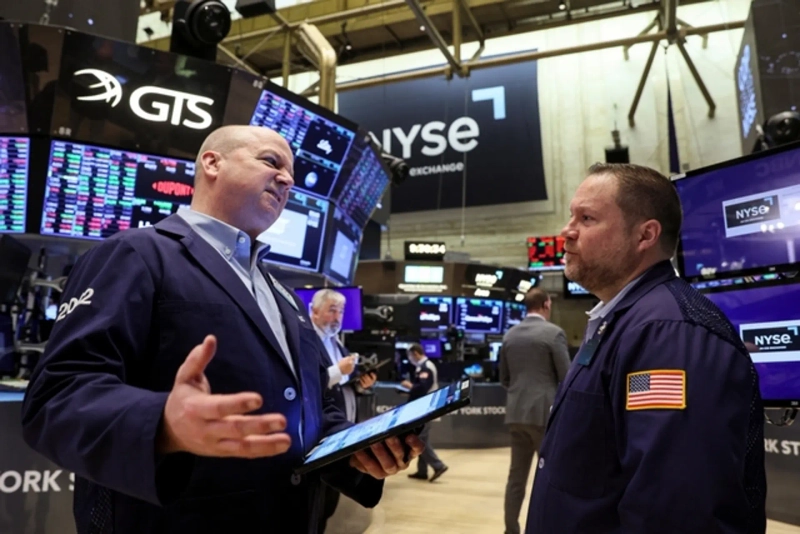
The trends of the three major indices on the New York Stock Exchange were mixed. The Dow and the Standard & Poor's (S&P) 500 indices rose, while the Nasdaq index fell slightly. However, the fluctuations were not significant. This was because the US-China trade talks did not show significant progress, even as major big tech companies were scheduled to announce their earnings.
On the 28th (local time) at the New York Stock Exchange (NYSE), the Dow Jones Industrial Average closed at 34,227.59, up 114.09 points (0.28%) from the previous session. The S&P 500 index rose 3.54 points (0.06%) to 4,528.75, while the Nasdaq index fell 16.81 points (0.1%) to 13,366.13.
On this day, US Treasury Secretary Scott Besant mentioned that the trade talks were not progressing properly. When asked in a media interview if there were plans to call China to resume negotiations, he said, "We have to see what happens with China," and "This is an important issue." He added, "The Chinese side may also see that the current situation is not sustainable," and "They might call us someday."
Previously, US President Donald Trump stated that he had recently had a phone call with Chinese President Xi Jinping and reiterated that the US was conducting trade talks with China. Besant's remarks on this day differ from Trump's statements.
Chinese Foreign Ministry spokesperson Guo Ja-kun also stated, "As far as I know, there was no phone call between the two leaders," and clarified that China is not currently engaged in tariff negotiations with the US, directly contradicting Trump's remarks.
Jonathan Miller, an economist at Barclays, said, "There are signs that the recent US-China trade conflict is somewhat easing," but added, "It remains doubtful whether there will be enough concrete momentum in the trade talks to avoid a US economic downturn."
On this day, the major stock indices increased their intraday declines to over 1%. The Nasdaq index expanded its decline to -1.46%, and the S&P 500 index to -1.02%. This is interpreted as a profit-taking adjustment following the recent sharp rebound in stock indices. Last week, the Nasdaq index rose more than 6%, and the S&P 500 index rose more than 4%.
This week's stock market atmosphere is expected to be influenced by the earnings of the 'Magnificent 7 (M7),' which refers to seven giant tech companies. This week, the earnings of Apple, Microsoft, Amazon, and Meta will be announced.
By sector, consumer discretionary, consumer staples, and technology fell slightly. No sector fluctuated by more than 1%. Among the M7, Apple, Meta, and Tesla were slightly positive. On the other hand, Nvidia fell more than 2%. The news that Chinese tech company Huawei is developing a high-performance artificial intelligence (AI) chip to replace Nvidia's flagship H100 chip was a negative factor.
Major pharmaceutical company Eli Lilly recorded a slight decline after HSBC downgraded its investment rating from 'buy' to 'sell' and drastically lowered its target price from $1,150 to $700. Information technology company IBM rose 1.61%. IBM announced that it would invest $150 billion in the US over the next five years.
The US Treasury announced that it expects to borrow $514 billion from the private sector in the second quarter (April to June) of this year. This is a significant increase from the $123 billion suggested in early February. The Treasury explained that this reflects lower-than-expected cash balances at the beginning of the second quarter and lowered net cash flow forecasts.
According to the Chicago Mercantile Exchange (CME) FedWatch Tool, the probability of the federal funds rate remaining unchanged by the end of June in the federal funds futures market was 37.5%, similar to the previous day's closing. The probability of a 25 basis point (1bp=0.01% point) cut was also the same at 57.2%.
The Chicago Board Options Exchange (CBOE) Volatility Index (VIX) rose 0.31 points (1.25%) to 25.15 from the previous session.
Jin Young-ki, Hankyung.com reporter young71@hankyung.com

Korea Economic Daily
hankyung@bloomingbit.ioThe Korea Economic Daily Global is a digital media where latest news on Korean companies, industries, and financial markets.