

Franklin Templeton Chief Strategist: "Tariffs to Remain Despite U.S. Administration Change... Dollar Weakness is Normalization Process"
Summary
- Franklin Templeton's Stephen Dover, Chief Strategist, stated that tariffs are likely to remain even if the U.S. administration changes.
- Dover interpreted the dollar weakness as a normalization process after the pandemic, explaining that the dollar was overvalued.
- He emphasized the need for investors to diversify their portfolios, recommending small adjustments rather than large-scale buying or selling.
Franklin Templeton's Chief Market Strategist
Interview with Stephen Dover
"China is more prepared than during Trump's first term"
"Investment Strategy: Not the time for buying or selling, need for portfolio diversification"
"Revival of U.S. Manufacturing, Biggest Obstacles are Labor Shortage and Education"
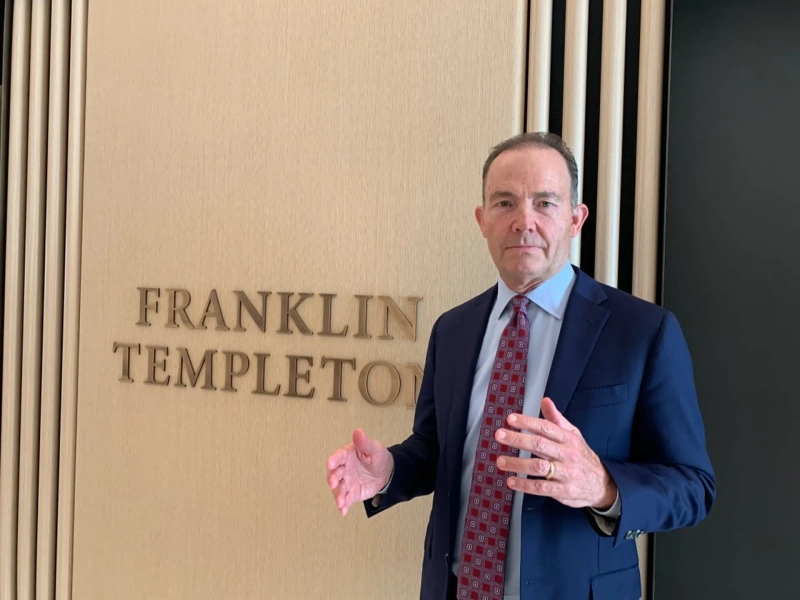
"Even if the U.S. Democrats take power, tariffs will not disappear. This is because some left-wing factions also support certain tariff policies."
Stephen Dover, Chief Market Strategist at Franklin Templeton, stated this in an interview with the Korea Economic Daily at his office in Manhattan, New York City, on the 22nd (local time). This was in response to some views that tariffs imposed by the Trump administration could be removed if the administration changes, as they were based on executive orders.
Dover also interpreted the recent weakness of the U.S. dollar as a "normalization process." He explained that the dollar had been overvalued since the pandemic. The following is a Q&A.
▶What does President Donald Trump ultimately want to achieve with tariffs?
"President Trump believes that a country with a trade deficit is a weak country. So what he wants is a 'state without a trade deficit.' Tariffs are simply a 'symptom,' not the essence. Trump is trying to change the structure of the U.S. economy itself."
▶But 70% of the U.S. GDP is made up of consumption.
"President Trump wants to shift the U.S. economy from being consumption-centered to investment-centered. Some officials within the Trump administration even advocate a kind of moral principle that 'the number of consumers should decrease, and the number of people engaged in production activities should increase.'"
▶China is at the center of Trump's trade war.
"China is the opposite of the U.S. China has a small consumption ratio and is export-centered. In fact, even if Trump were not president, the U.S. and the global economy were already in a situation to change. The dollar value was too high, the U.S. fiscal deficit was too large, and China's excessive exports were harming the global and U.S. economies. These structural changes were bound to happen anyway, but Trump has driven them very quickly and all at once."
▶President Trump sees not only China but also other countries as taking advantage of the U.S.'s trade deficit and military support.
"That's correct. President Trump is trying to renegotiate these issues. However, Korea is different from China. The Trump administration sees Korea as an 'ally.' There is no one in the Trump administration who considers Korea an enemy. The problem is China. Some people think China is 'not an ally.' Geopolitical divisions are occurring."
▶How will China overcome the current situation in the future?
"China is increasing exports and expanding production on a large scale, while the U.S. is trying to curb it. There is a conflict between the two countries. In the long term, China will need to increase consumption. To do this, it will expand fiscal spending. Korea may also need to increase consumption slightly."
▶Is Trump ready to give up a strong dollar to solve the trade deficit?
"Have you seen the paper by Trump's economic advisor, Steve Miran? In his paper last November, he suggested that 'the U.S. should persuade foreign countries to appreciate their currencies against the dollar using tariff threats and security support as bait.' Although this has not been adopted as an official position by the Trump administration, some in the economic team prefer a weak dollar."
▶Some say the U.S.'s status as a key currency country is being shaken.
"The dollar is currently overvalued. I believe the dollar value can fall by 10% to 20%. A weak dollar does not mean the status as a key currency disappears. The key currency status remains, but it means the market may see a weak dollar."
▶What if China holds out longer than expected?
"China is much better prepared and strategically more meticulous than during Trump's first term. Chinese companies have been preparing for trade conflicts with the U.S. for eight years and have diversified their production bases worldwide. There is no clear winner in this fight. However, relatively speaking, China is likely to hold out quite well. China will eventually need to increase domestic consumption and will expand fiscal spending to do so. And China has the capacity to grow its domestic market."
▶Companies are more concerned about uncertainty than the tariffs themselves.
"That's exactly the problem. The strength of the U.S. has always been the certainty of its legal system, but now even that is shaking. The premium on the U.S. market is disappearing. Honestly, I would like to give a more certain answer, but there is no unified direction even within the U.S. government right now."
▶The fact that President Trump imposed tariffs through executive orders rather than legislative changes could also be a risk.
"That's correct. President Trump is imposing tariffs based on a national emergency. However, if the court rules that 'this is not an emergency,' the authority to impose tariffs will return to Congress. In principle, tariffs are the authority of Congress. From Korea's perspective, it's like negotiating without being sure if the other party can keep their promises. Companies need to respond very flexibly. For reference, Korean companies are very good at this flexibility."
▶Will there be changes in tariff policy if the administration changes?
"Not all tariffs will disappear just because the Democrats take power. Some left-wing factions within the Democratic Party also support certain tariff policies."
▶If Trump's tariff policy succeeds and manufacturing returns to the U.S., will there be enough labor to handle it?
"There is a shortage of labor itself, but the bigger issue is the level of education. In the past (1940s-50s), a high school diploma was enough to work in a factory, but now modern production lines require higher skills and education. The U.S. needs to strengthen its education and training system, but it has not been successful so far. Automation is an important point. Also, if Korean companies invest in the U.S., they should be prepared to train local workers directly."
▶What is the outlook for the Magnificent 7 on the New York Stock Exchange?
"The Magnificent 7 companies still have excellent growth potential and opportunities. The Trump administration would also want these companies to grow. However, I think Tesla has damaged its brand now. But overall, these large tech companies will still dominate the market."
▶What do you see as the biggest risk factors over the next 12 months?
"Geopolitical risks (such as U.S.-China relations, Russia-Ukraine war) are the biggest risks. There is a risk that the bond market, dollar, and stock market could all collapse simultaneously. In other words, it's what we call a 'tail risk.'"
▶What advice would you give to foreign investors investing in the U.S. stock market?
"My advice is 'When you don't know the situation well, don't make big moves and stay centered.' Now is not the time to make large-scale purchases or sales. It's better to review your existing portfolio and make small adjustments. Most Korean investors have too high a proportion of the Magnificent 7. I recommend continuing to invest in the U.S. market but diversifying your holdings more."

Korea Economic Daily
hankyung@bloomingbit.ioThe Korea Economic Daily Global is a digital media where latest news on Korean companies, industries, and financial markets.