

'Rust Belt' Shakes as Trump Eases Car Tariffs
Summary
- President Trump announced plans to ease the tariff burden on cars and car parts.
- U.S. car companies also expressed dissatisfaction with excessive tariffs, leading to a decision to ease tariffs on manufacturers.
- President Trump explained that the tariff policy aimed at reviving the Rust Belt economy could instead harm local companies and workers.
Trump Eases Car Tariffs…Excludes Steel and Other Item Tariffs
Discontent Grows Among U.S. Car Companies
Retreats on Tariffs Ahead of 100th Day in Office
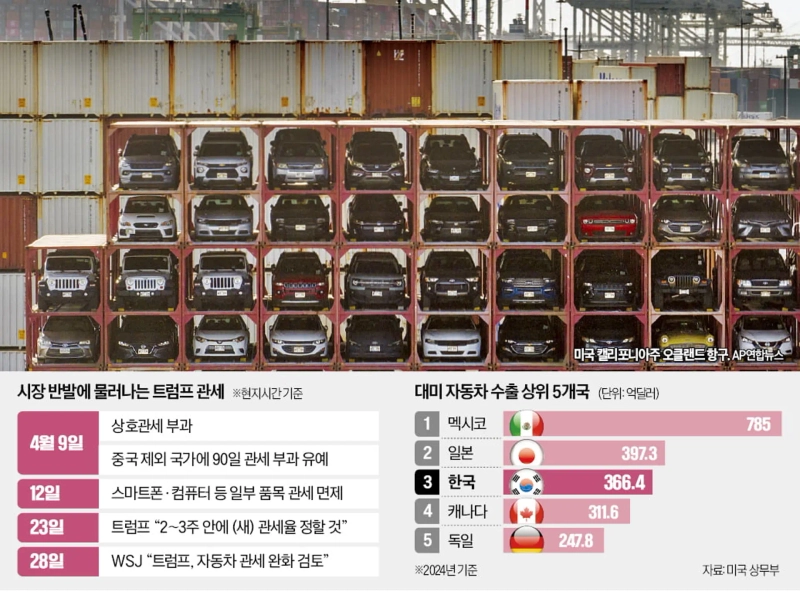
U.S. President Donald Trump is reportedly set to ease the tariff burden on imported cars and car parts. Even U.S. car companies have expressed dissatisfaction with the excessive tariffs, prompting a step back.
The Wall Street Journal (WSJ) reported on the 28th (local time), citing sources, that President Trump is scheduled to visit Detroit, Michigan, the center of the automotive industry, on the 29th, marking his 100th day in office, and is expected to announce these measures to appease the auto industry beforehand.
According to the report, the measures include not imposing additional tariffs on other items like steel and aluminum, in addition to the 25% tariff currently imposed on imported cars since the 4th. The 25% tariff on imported car parts, set to be imposed from the 3rd of next month, is also expected to be eased. In the first year of imposing tariffs on car parts, importers are expected to receive a refund of up to 3.75% of the vehicle price, and up to 2.75% in the second year.
Excluding Item Tariffs Like Steel on Imported Cars Paying 25% Tariff
Manufacturing Revival Through Tariffs? Instead, It Causes Harm, Giving Time to Move Factories to the U.S.…
President Trump, who had been pushing for tariffs on imported cars and parts, has stepped back due to the unexpected significant impact of the tariffs. The paradoxical situation arises where tariffs are imposed to protect U.S. cars, but even these car companies and workers are suffering.
◇Layoffs in U.S. Car Companies
President Trump chose Macomb County, a suburb of Detroit, Michigan, as the venue for the 100th-day commemorative event on the 29th. Michigan is a representative Rust Belt (declining industrial area) where major U.S. car companies like General Motors (GM), Ford Motor, and Stellantis have concentrated factories. 20% of the local economy depends on the automotive industry. According to the Wall Street Journal (WSJ), President Trump is expected to announce measures to ease car tariffs before arriving in Michigan.
Before taking office, President Trump promised to protect the automotive industry, symbolizing the decline of U.S. manufacturing, as a key pledge for the revival of U.S. manufacturing. This helped him secure victory with a 56% vote rate in Michigan, a battleground state, in last year's election. However, the 'tariff war' chosen as a means to protect the Rust Belt after taking office has instead provoked strong opposition from local companies and labor circles.
The 25% tariffs on imported steel and aluminum, which took effect in March, and the 25% tariffs on imported cars, implemented on the 4th of this month, are placing a significant burden on U.S. manufacturers. The Anderson Economic Group, a U.S. think tank, predicted that the price of new cars in the U.S. could rise by up to $12,000 (17.6 million won).
Tariffs are also impacting the jobs of Rust Belt workers, who are a core support base for President Trump. Shortly after tariffs were imposed on imported cars earlier this month, Stellantis announced the temporary layoff of 900 workers at five plants in the U.S. This measure is due to concerns that tariffs imposed during the assembly process of U.S. parts in Canadian and Mexican plants could increase vehicle manufacturing costs. Gabriel Ehrlich, a professor at the University of Michigan, predicted that 600 automotive manufacturing jobs in Michigan would disappear by the end of next year due to steel and aluminum tariffs, with an additional 1,700 jobs lost in related service industries.
The Center for Strategic and International Studies (CSIS), a U.S. think tank, stated in a report that "Trump's tariff policy aims for reshoring (returning production facilities to the U.S.) of the automotive manufacturing industry, but the complex supply chain and cumulative tariff structure could instead hinder that goal," adding that "it will ultimately shock the supply chain while causing consumer price increases."
◇Car Companies Still in Wait-and-See Mode
Despite the White House's expectation that this easing of car tariffs will 'give time to move factories to the U.S.,' it is uncertain whether car manufacturers will actually relocate their production facilities to the U.S. Observations are emerging that tariffs will not be sustained long-term, as President Trump has recently been seen retracting policies he introduced, such as high tariffs. It is pointed out that deciding on large-scale new investments worth trillions of won is not easy in a situation with high uncertainty. John LaRocca, senior vice president of the American Automotive Policy Council (AAPC), said, "So far, there has been no significant movement from companies," adding, "Most are waiting and observing."
A representative from a Korean auto parts company said, "There was a lot of concern about the possibility of a double chain impact if tariffs were imposed on both finished cars and parts," adding, "It's a relief to be able to get it back."
Reporter Dayeon Lim / Jeong-eun Shin allopen@hankyung.com

Korea Economic Daily
hankyung@bloomingbit.ioThe Korea Economic Daily Global is a digital media where latest news on Korean companies, industries, and financial markets.