

Between Innovation and Fraud... Diverging Views on Virtual Assets [Hankyung Koala]
Summary
- The US is reportedly providing strong policy support aimed at innovation and economic development in the virtual asset industry.
- President Trump is emphasized to be swiftly fulfilling his promise to make the US a 'Bitcoin superpower.'
- In contrast, Korea is stuck in discussions about restrictive allowances for virtual assets, risking falling behind in global competition.
Minseung Kim's ₿ficial
What does crypto mean to you?
About ten years ago, I worked with three Americans and one Briton. One day, John, an American, came with a piece of writing and angrily asked, "Does this make sense?" The writing was as follows:
"How to make tea: First, boil water. Put a suitable amount of tea leaves in a teapot. Pour the boiling water into the teapot. Wait for about 3 to 5 minutes, then strain the tea. Using a tea strainer is convenient. Pour the tea from the teapot into a cup. Drink the tea."
I asked John what the problem was. He replied, "Tea is made by putting a teabag in a mug. That's how it's done in America." The usually calm Briton, who enjoyed tea, turned his head to hide his laughter, and the other two straightforward Americans covered their faces with their hands simultaneously. Then came the words "in your neighborhood."
In some part of America where John lived, it might have been natural to make tea by putting a teabag in a mug. Therefore, the method of using tea leaves in a teapot and tools like a tea strainer might have seemed unrealistic and incorrect to him. Moreover, since the writing was in English, John from America might have wanted to correct it.
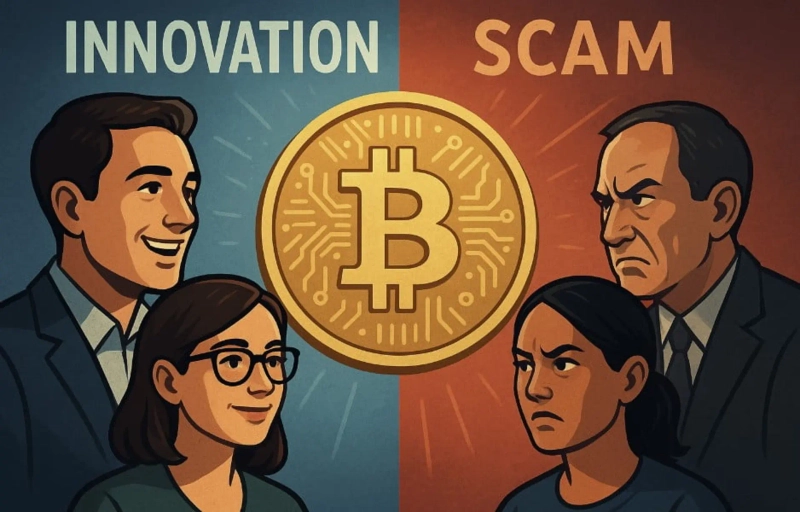
Virtual assets, cryptocurrencies, crypto, and coins are similar. Their meanings differ depending on the person and the neighborhood. For example, Michael Saylor, CEO of Strategy, considers Bitcoin the ultimate future technology to replace currency and finance. Presidential candidate Trump used it as a key to election victory, and President Trump used it as a means to strengthen national finances and dollar hegemony. Fed Chair Powell and former SEC Chairman Gary Gensler recognized Bitcoin as digital gold, and companies like BlackRock and Fidelity judged it as disruptive innovation and the future of institutional finance.
On the other hand, some people solidify their belief that coins are all crimes and frauds by only reading about 'coin investment fraud' incidents where cash is extorted under the guise of investment or the price volatility of some 'altcoins.' To these people, Bitcoin or any unknown 'Kimchi coin' with only a plan to be made are all the same 'bad things.' In the US, Democratic senators, including Elizabeth Warren, considered crypto as "bad people making bad money in bad ways" and pursued a strong anti-crypto policy, eventually leading to handing over power to Trump.
How is the US moving now? The January 23 executive order titled 'Strengthening American Leadership in Digital Financial Technology' defined the digital asset industry as playing an important role in American innovation and economic development, as well as international leadership, and stated that it is the administration's policy to support responsible growth and use of digital assets, blockchain technology, and related technologies in all sectors of the economy. It also ordered relevant agencies, including the Treasury Secretary, Attorney General, and SEC Chairman, to identify all regulations, guidelines, and orders related to this policy within 30 days, to decide what to repeal, amend, or adopt within 60 days, and to submit legislative and regulatory proposals including all these within 180 days.
The March 6 executive order titled 'Establishment of Bitcoin Strategic Reserve Asset and US Digital Asset Reserve' ordered a legal review within 30 days on transferring all digital assets owned by US government agencies to strategic reserve assets or digital asset reserves, and the Treasury Secretary was ordered to submit a review report on legal and investment considerations for establishing and managing Bitcoin strategic reserve assets and digital asset reserves within 60 days.
As the US rapidly renews its policies on digital assets, various shadow regulations that have suppressed the growth of the US crypto industry are also being dismantled. On January 23, the day the first executive order was issued, the US Securities and Exchange Commission (SEC) announced SAB122, which repeals SAB121, a guideline that instructed financial institutions to record virtual assets in custody as liabilities. On February 11, at a Senate Banking Committee hearing, Fed Chair Powell was harshly criticized for the 'debanking' issue where crypto businesses were denied banking services without reason. On March 7, the US Office of the Comptroller of the Currency (OCC) announced through Interpretive Letter 1183 that banks in the US can enter the crypto industry, and on April 24, the Fed announced the abolition of the obligation for banks to pre-report activities related to crypto assets. The industry sees this as a clue to solving the 'debanking' issue.
What about our country? Interest in the virtual asset industry has increased around the time of the corporate account allowance and the US strategic reserve asset executive order, but the discussions are largely stuck on 'what to allow restrictively.' The discussions mainly take place among institutional finance and legal experts. Most people with expertise in the crypto industry, technology, or economy are excluded from the discussions.
If you ask a firefighter for their opinion on electric cars, they will talk about the risk of fire and the difficulty of extinguishing it. If you ask a dermatologist for their opinion on a vacation at a tropical beach, they will talk about skin damage and the risk of skin cancer from UV rays. If you ask institutional financiers, legal professionals, and regulators for their opinion on virtual assets, only the 'disruptive' part of 'disruptive innovation' will be mentioned. It's no different from John from a rural American town claiming that 'tea is made by putting a teabag in a mug.' That's how the current discussions on virtual assets in Korea are.
It contrasts sharply with President Trump inviting representatives of major industry companies in the US to a 'crypto summit' the day after signing the March 6 executive order. Industry people know best what the obstacles to fostering a healthy ecosystem and long-term development of the industry are and what needs to be improved. The opinions that decision-makers need to hear are not those of financiers and legal professionals, but those of people in the virtual asset industry.
The White House's 'crypto czar' declared that the US has 'entered the golden age of digital assets,' and Trump is quickly and surely fulfilling his campaign promise to make the US a 'Bitcoin superpower' and 'the crypto capital of the world.' In line with the federal government's moves, each state in the US is proceeding with the strategic reserve assetization of digital assets, and Russia and China are also showing movements related to Bitcoin to check the US. The visualization of the 'Bitcoin space race' is imminent. The global assault of the dollar stablecoin is already underway. In Congress, the legislation of stablecoin regulation and the market structure bill is progressing rapidly. While everyone denies it with 'no way,' the US is proceeding with a new economic hegemony through digital assets on a national scale.
How are we responding to these changes now? Are we not gathering people who believe that virtual assets and blockchain are fundamentally fraud and bubbles to think about what to allow restrictively to maintain the current system?
Trump promised this in Nashville last July. "We will have regulations, but from now on the rules will be written by people who love your industry, not hate your industry." Trump is keeping that promise. It's an advanced case we must refer to.

Minseung Kim is the Director of Korbit Research Center...
He is a founding member and director of the Korbit Research Center. He works to simplify complex events and concepts occurring in the blockchain and virtual asset ecosystem and helps people with different perspectives understand each other. He has experience in blockchain project strategic planning and software development.
▶This article is an external contributor column introduced to provide various perspectives to cryptocurrency investment newsletter subscribers and does not represent the position of the Korea Economic Daily.
Reporter Mihyun Cho mwise@hankyung.com

Korea Economic Daily
hankyung@bloomingbit.ioThe Korea Economic Daily Global is a digital media where latest news on Korean companies, industries, and financial markets.