

U.S. warns of high tariffs in unilateral notice if deadline missed by the 8th
Summary
- The U.S. government warned that after the July 8 reciprocal tariff negotiation deadline, countries may face high tariff rates.
- Key negotiating partners such as Japan and the European Union are under pressure over core trade items like automobiles, rice, and LNG.
- The U.S. pharmaceutical industry urged that foreign drug price policies should be addressed through trade negotiations.
One week left until the end of tariff negotiations
Besant raises the level of warnings
Signals no extension of grace period
Besant: "Even with good faith negotiations, tariffs will revert to the April 2 levels"
Pressure on Japan over rice and automobile negotiations
Trump: "Will send a letter to Japan"
U.S. pharmaceutical industry: "Korean drug prices must come down"
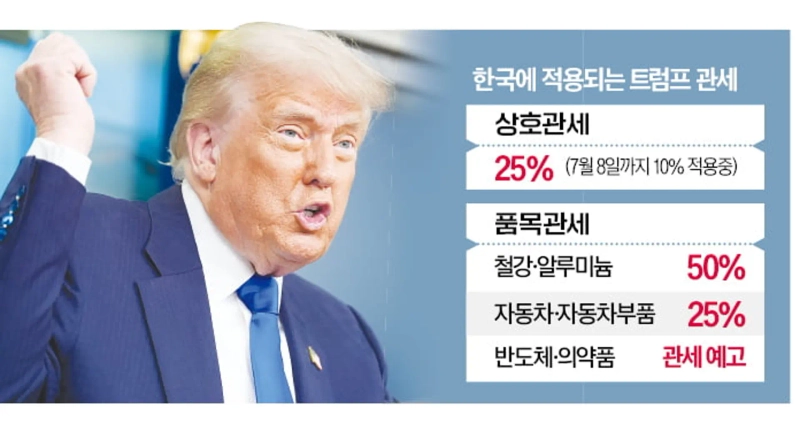
The U.S. government has warned that countries may face high tariff rates if the July 8 deadline for reciprocal tariff negotiations is missed. Until last week, there was a suggestion that the negotiating deadline might be extended, but after President Donald Trump made negative remarks about an extension, the U.S. administration also shifted its stance. This is interpreted as a strategy to keep the possibility of extension unclear until the last minute in order to pressure trading partners and extract more concessions.
◇"High tariffs for stubborn stances"
U.S. Secretary of the Treasury Scott Besant said in a Bloomberg TV interview on the 30th (local time) that countries may "face high tariff rates" after the 9th. He stated, "Even countries negotiating in good faith may revert to the high (reciprocal) tariff rates announced on April 2 if they fail to reach the finish line due to intransigent positions," and added, "I hope such a situation does not arise." He threatened that even countries that cooperate sincerely may be subject to high tariffs.
The Trump administration has repeatedly expressed hopes that the main negotiations will be concluded this week as the deadline approaches. White House Press Secretary Caroline Leavitt said at a press conference that President Trump will meet with the trade negotiation team this week to notify them of tariff rates. Secretary Besant said in the interview, "A series of deals are expected to be finalized."
In particular, Besant’s remarks are interpreted as targeting Japan, which has held seven rounds of talks but seen little progress on key issues such as automobile tariffs. President Trump stated on social media, "I want to show how countries have acted so rudely towards America," adding, "Will send a letter to Japan." He said, "I have great respect for Japan, but they are experiencing a severe rice shortage in their country while refusing to accept American rice." Japan has requested an exemption from automobile tariffs, but President Trump insists that Japan should import American-made vehicles. However, with Japan's House of Councillors election scheduled for July 20, it will be difficult for Japan to make concessions in negotiations until then.
India, where President Trump said a deal announcement was imminent, agreed to lower tariffs on thousands of items. The Financial Times (FT) reported that India agreed to import more liquefied natural gas (LNG) from the U.S. to reduce its trade surplus.
The European Union (EU) is also rushing final-stage negotiations with the U.S. Maroš Šefčovič, the European Union Commissioner for Trade and Economic Security, stated that his working team headed to Washington, D.C. on the 30th of last month, and that he himself would go there on the 1st.
◇U.S. pharmaceutical industry: "Korean drug prices are too low"
While President Trump continues to make unilateral statements, the Pharmaceutical Research and Manufacturers of America (PhRMA), a U.S. pharmaceutical lobbying group, urged that trade negotiations should be used as a lever to address unfair pharmaceutical policies and practices by foreign governments. This was stated in an opinion letter submitted to the Office of the United States Trade Representative (USTR) on the 27th of last month.
PhRMA singled out countries with severe issues, including South Korea, Australia, Canada, Japan, the United Kingdom, and the EU. They pointed out that Korea’s health insurance authority keeps drug prices below fair market value. The U.S. government is currently investigating the impact of imports of semiconductors, timber, copper, pharmaceuticals, etc., on national security. After collecting industry opinions, the Trump administration added appliances such as refrigerators and washing machines to the list of products subject to the 50% steel tariff.
It is said that previous draft proposals sent by the U.S. to the Korean government included many industry complaints without much filtering. For example, there was reportedly a claim that “because the average income of Korean workers is lower than in the U.S., they are more competitive than U.S. companies, which could serve as a basis for imposing tariffs.” However, it is expected that unreasonable demands will be naturally eliminated as negotiations progress. A senior government official said, "The sooner we identify areas of mutual interest and resolve uncertainties, the more it will benefit both sides."
Washington—Sang-eun Lee, Correspondent selee@hankyung.com

Son Min
sonmin@bloomingbit.ioHello I’m Son Min, a journalist at BloomingBit