

"There Is No Quiet Rest"...The World Economy Shaken by the 'Trump Tax Cut Act' [Global Money X-File]
Summary
- With the implementation of the "Trump Tax Cut Act (OBBBA)", volatility in global bond yields and the US dollar has increased, with instability spreading even to the traditionally safe bond market.
- Due to OBBBA, industries such as semiconductors have benefited from expanded US tax credits, but environmental sectors like EVs and batteries face increased concerns over weakened demand due to the reduction of subsidies.
- US-driven tax cuts and increased fiscal spending have led to a short-term rally in global stock markets, but the risks of weakening liquidity in emerging economies and declining trust in the US dollar are spreading worldwide.
No Safe Haven in Stock or Bond Markets
Korea Fears Impact on EV Batteries
!["There Is No Quiet Rest"...The World Economy Shaken by the 'Trump Tax Cut Act' [Global Money X-File]](https://media.bloomingbit.io/prod/news/22f6a135-7b5a-4eef-8849-356d44cd0841.webp?w=800)
Summary
·Green energy subsidies reduced, debt ceiling raised
·Wider volatility in global bond yields and US dollar
·'Defense' and 'semiconductors' up, 'EVs' and 'renewables' down
·Semiconductors benefit, EVs and batteries burdened in Korea
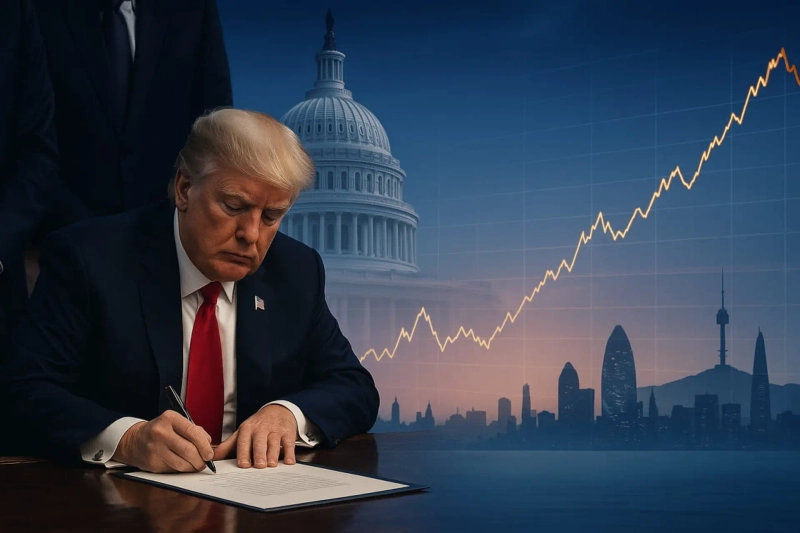
Countries worldwide are on high alert in response to the impact of the 'One Big Beautiful Bill Act' (One Big Beautiful Bill Act·OBBBA), which was signed by US President Donald Trump on the 4th. The OBBBA, a gigantic legislative package encompassing the key national agenda of Trump’s second-term administration, is expected to influence global markets through various channels.
Encompassing Trump’s Second-term Policy Priorities
A core pillar of OBBBA is tax reform. OBBBA has lowered the tax burden on remittance of overseas profits by adjusting the overseas income taxation system for multinationals. It has also either ended early or reduced clean energy subsidy and tax credit programs based on the 2022 Inflation Reduction Act (IRA).
All subsidies for electric vehicles are abolished. The expiration of solar and wind power generation tax credits is accelerated from 2032 to 2027. Meanwhile, for the semiconductor industry, the investment tax credit for US-based manufacturing facilities was raised from 25% to 35%.
Federal fiscal spending was adjusted and the debt ceiling was raised. Medicaid budget was cut by $1 trillion, and qualification requirements for some low-income support programs are strengthened. The federal debt ceiling is increased by $5 trillion.
!["There Is No Quiet Rest"...The World Economy Shaken by the 'Trump Tax Cut Act' [Global Money X-File]](https://media.bloomingbit.io/prod/news/62dda398-b769-4afc-8c6d-546e60e6b9f8.webp?w=800)
There are also provisions to reduce reliance on overseas supply chains and strengthen taxes on foreign investors. Regulations were tightened to strip tax credits if parts or minerals procured from 'foreign entities of concern (FEOCs)' exceed a certain threshold. Provisions enabling higher withholding tax on dividend income for foreign investors are also included.
Tax reform and extensions of tax cuts are applied retroactively to the 2025 tax year and took immediate effect. Discretionary spending cuts are set to be implemented step by step from fiscal 2026. The debt ceiling increase took effect as soon as President Trump signed it.
Turbulence in the Global Bond Market
The global financial market has been shaken by the implementation of the OBBBA. Such large-scale tax cuts and spending laws translate directly into increased government bond issuance and rising yields. The US 10-year Treasury yield climbed to over 5% from the high-4% range before and after the Act’s passage. The 30-year yield neared 5%. The 30-year US Treasury yield jumped to 4.861%.
This reflects a market consensus that the US government will issue more Treasuries to raise funds. Concerns of oversupply have started to be priced in. Rising Treasury yields often serve as a benchmark for higher global rates. Government bond yields in developed nations such as Europe, as well as emerging market dollar-denominated bond yields, all face upward pressure. Countries whose bond rates closely track US rates—such as the UK and Australia—are also likely to respond sensitively.
For emerging markets, higher US rates lead to capital outflows and thus higher local bond yields (lower bond prices). Yet, if the US rate hike and dollar strength are limited, some capital investing in global bonds may shift to emerging market bonds with relatively higher yields than US Treasuries.
Global credit rating agency Moody's downgraded the US government’s sovereign rating from AAA to Aa1 in May, stating, “Federal government debt will continue to rise over the next 10 years, sharply increasing interest costs,” and, “With the current fiscal policy, reducing deficits will be difficult.” Moody’s further noted that the recent tax cut extensions under the OBBBA weaken government revenue while mandatory spending, like for seniors, continues to grow, hampering any fiscal outlook improvement.
Global Stock Markets Warm Up in Advance
Analysts point out that global equities have already priced in the Act’s impact. The US S&P 500 index surged over 23% with a 13-week winning streak between April and June. The MSCI ACWI (All Country World Index) rose 7% from the start of the year, hitting an all-time high. The Canadian TSX index also broke above 27,000 for the first time ever, reflecting broad gains in major markets.
The surge is attributed to expectations that OBBBA’s sweeping tax cuts and infrastructure spending will boost US growth next year.
!["There Is No Quiet Rest"...The World Economy Shaken by the 'Trump Tax Cut Act' [Global Money X-File]](https://media.bloomingbit.io/prod/news/34934d0c-b35f-4b92-88bd-fef344b53399.webp?w=800)
Tax-cut policies typically boost corporate earnings, which fuels stock gains. OBBBA concentrated tax benefits toward tech and domestic-oriented companies. Government spending on defense and energy also increased, acting as a boon for certain sectors. This US-led rally spread abroad, propelling European and Asian equity markets higher as well.
However, Chinese stocks underperformed due to weakening investor sentiment toward tech names amid US pressure. In European equities, defense and energy stocks rose along with the US. Yet, US subsidy cutbacks are regarded as a negative factor for the EU’s green industries.
In Korea, semiconductor stocks outperformed amid expanded US investment tax credits, while secondary battery names faced mild pullbacks due to concerns about declining demand following reduced US subsidies, resulting in sectoral divergence.
Germany-based asset manager FERI commented, “Equity markets are expected to initially react positively to the tax relief measures in the OBBBA,” but against this, “Concerns over US government debt sustainability in bond markets may lead to higher US Treasury yields.”
Commodities markets globally may also react sensitively. International oil prices are under upward pressure amid rising expectations that large-scale US tax cuts will spur economic and transport demand. Previously, experts projected that US West Texas Intermediate (WTI) crude would gently decline in the $55–70 range in the second half of the year.
Yet, some expect that the passing of OBBBA may increase demand and trade frictions, boosting oil price volatility.
Industrial metals such as copper and aluminum have reasons to rise due to expectations of increased US infrastructure and defense spending. However, uncertainty about Chinese demand and global trade friction are likely to put a cap on gains. OBBBA stands as both a tailwind (stimulating US-led demand) and a headwind (increasing trade friction) for commodity demand.
Is the US Dollar Mixed?
!["There Is No Quiet Rest"...The World Economy Shaken by the 'Trump Tax Cut Act' [Global Money X-File]](https://media.bloomingbit.io/prod/news/b1362869-903c-456b-a064-3245bcc65ca8.webp?w=800)
In global FX markets, the US dollar is expected to be mixed. Between April and May, the dollar index hit a three-year low at one point. This was as investors reduced their share of dollar assets amid political uncertainty in the US and worries about Fed independence. As the Trump administration pushed for major tariffs, there was also some ‘de-dollarization’ movement at the international level.
Thierry Wizman, global strategist at Australia’s Macquarie Group, said, “Market participants are far more wary of politicians or the president influencing the Federal Reserve (Fed) into cutting rates than of rate cuts themselves,” noting this political risk is weighing on dollar confidence.
Conditions reversed somewhat in July. As the US economy performed well and global risk assets rallied, market expectations for an early Fed rate cut faded, and the dollar began rebounding from late June onward. Even after the OBBBA passes, dollar direction will likely depend on Fed policy and global investor confidence.
However, the more blatantly the US pursues ‘America First’ economic policies under OBBBA, the more some countries are likely to reduce their dollar exposure.
OBBBA is also expected to affect global liquidity flows. Expanded US fiscal spending could boost liquidity in the short term. As disposable income rises due to tax cuts and corporate cash receipts increase, both household and corporate consumption and investment could rise, quickening the circulation of money in the private sector and driving up credit demand.
If the US issues additional Treasuries, it will absorb global capital, which will be a burden on emerging market liquidity.
Which Korean Sectors Benefit?
!["There Is No Quiet Rest"...The World Economy Shaken by the 'Trump Tax Cut Act' [Global Money X-File]](https://media.bloomingbit.io/prod/news/e4a48d25-3559-4dd6-ac39-b6d5fdb9ca55.webp?w=800)
How will Korea’s economy be affected? As Korea relies heavily on exports to the US and operates an open economy, significant spillover effects are expected. Industries with high US market exposure—such as autos and secondary batteries—are seen as suffering most. If EV subsidies disappear completely, US EV sales may sharply decline. Battery makers would be hit by the reduction in subsidies for EVs.
Domestic solar and other renewable energy sectors are also expected to be impacted by OBBBA. The accelerated termination of power generation tax credits and smaller scope for subsidies could weaken returns on new US solar investments. In contrast, the outlook for the semiconductor industry is relatively positive.
The tax credit for investments in US foundries and semiconductor R&D facilities is expanded from 25% to 35%, which is expected to provide additional benefit.
Axel Angermann, economist at Germany-based asset manager FERI, commented, “The US stock, bond, and dollar markets have already suffered some erosion in confidence, but still wield dominant influence worldwide, so any turmoil triggered by the US will transmit directly to the global stage.” He added, “There will be no quiet rest for either the US or global markets this summer.”
[Global Money X-File highlights the crucial but often overlooked flow of global capital. For convenient updates on essential global economic news, subscribe to the reporter’s page.]
Kim Joo-wan, kjwan@hankyung.com

Uk Jin
wook9629@bloomingbit.ioH3LLO, World! I am Uk Jin.