

"Stablecoins Have Significant Impact on Monetary Policy...Urgent Need for Legislative Revisions"
Summary
- Kim Jong-seung, CEO of Xcrypton, stated that it is necessary to thoroughly analyze the effects on monetary and foreign exchange policy before introducing the Korean won stablecoin.
- He stated that due to insufficient institutional mechanisms and supervisory systems, urgent legislative revisions are needed for the introduction of the won stablecoin.
- He explained that as stablecoins can be an opportunity to enhance the won's competitiveness in the global foreign exchange market, the establishment of a supervisory and management system is important.
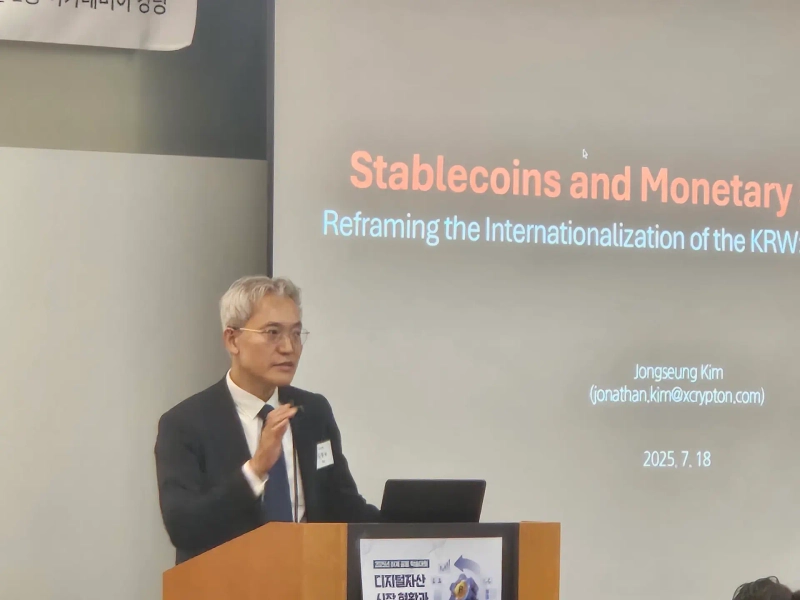
Discussions on Korean won stablecoins (virtual assets linked in value to fiat currency) are becoming active in South Korea. However, it has been pointed out that institutional mechanisms and supervisory systems for the introduction of the won stablecoin in the country are still lacking.
On the 18th (Korea time), Kim Jong-seung, CEO of Xcrypton, emphasized at the 2025 Summer Joint Academic Conference, held on the first floor Academia Room of the new building of Law Firm Kwangjang and co-hosted by the Digital Asset Exchange Joint Consultative Body (DAXA), that, "Before discussing the introduction of stablecoins, it is necessary to analyze the impact stablecoins can have on monetary and foreign exchange policy." The academic conference was held under the theme of 'The Current State of the Digital Asset Market and Key Legal Issues.'
CEO Kim explained that the emergence of stablecoins has caused a shock to the global currency system. He stated, "The scale of stablecoins is approaching 1% of M2, and they have emerged as a parallel currency," adding, "Consequently, countries have started to worry about their digital currency sovereignty, and this is also the case for South Korea."
He identified regulatory overhaul as the top priority for introducing the won stablecoin. Especially in this area, he explained that there are conflicts of interest emerging between the industry and the Bank of Korea. CEO Kim said, "(From the Bank of Korea's perspective) the use of stablecoins could pose a problem for the monetary policy that the central bank has employed so far," and further added, "If stablecoins become widely used, there is concern that the central bank’s ability to control money supply and adjust interest rates could be weakened." In addition, he pointed out issues such as disruption of the foreign exchange control system and liquidity provision by non-bank sectors as concerns.
However, CEO Kim believes there are limits to rejecting the won stablecoin simply due to these concerns. He explained that there are advantages the won stablecoin could bring. CEO Kim stated, "Even though South Korea is the world’s sixth-largest trading nation, the proportion of the won used in trade is only 2.7%," adding, "Stablecoins could be an opportunity for the won to gain competitiveness in the global foreign exchange market."
In reality, the Korean won’s competitiveness in the foreign exchange market lags behind major countries. Not only compared to the US dollar as the key currency, but also in comparison to quasi-reserve currencies like the Japanese yen, European Union euro, and British pound, the international usage of the won is limited. The absence of the offshore foreign exchange market has been pointed out as the main reason for South Korea’s failure to be included in the MSCI Developed Markets Index.
CEO Kim stressed, "Now is the time to focus on institutional design for the won stablecoin rather than only the capital requirements for the issuer," adding, "It is vital to establish a supervisory and management system that responds to changes in the global financial environment while preserving consistency in monetary and foreign exchange policy."

Uk Jin
wook9629@bloomingbit.ioH3LLO, World! I am Uk Jin.