

PiCK
Rep. An Do-geol from the Democratic Party of Korea: “Stablecoin Bill to Be Proposed Next Week”... Closely Monitoring Impact on Monetary and Foreign Exchange Policies
Summary
- Rep. An Do-geol of the Democratic Party of Korea announced that a stablecoin bill is expected to be proposed domestically next week.
- Current discussions include regulation at the level of financial institutions, tiered regulation, and a minimum capital requirement of 5 billion KRW.
- Agencies such as the Bank of Korea, Financial Services Commission, and Ministry of Economy and Finance stated they are closely monitoring regulatory measures regarding impacts on monetary and foreign exchange policies, investor protection, and prevention of illegal transactions.
Hosted by Rep. An Do-geol and Kim Hyun-jung of the Democratic Party of Korea
Stablecoin Policy Discussion Forum
Stablecoin Bill Expected to Be Proposed Next Week
"Should Be Regulated at Financial Institution Level"
"Tiered Regulation Needed Based on Scale"
Bank of Korea, Ministry of Economy and Finance, and Financial Authorities Begin Review
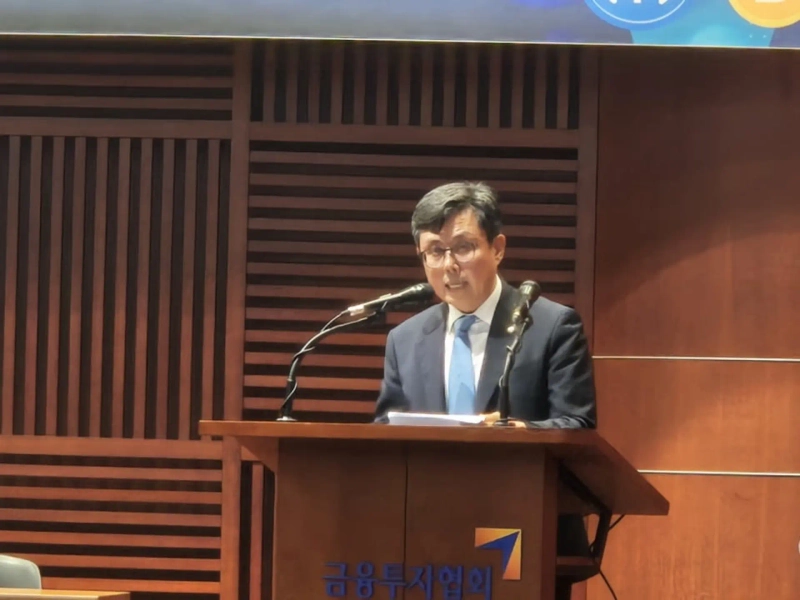
Following the final passage of the stablecoin bill 'GENIUS Act', which links the value of stablecoins (virtual assets pegged to fiat currency), in the United States House of Representatives on the 17th (local time), Korea is also accelerating the enactment of related legislation. As early as next week, the proposal of the stablecoin bill is anticipated.
At the 'Policy Discussion Forum for the Institutional Integration of Stablecoins' held at the Financial Investment Association in Yeouido on the 23rd, Rep. An Do-geol stated, "Currently, we are forming a task force with key personnel from the ministries to prepare the submission of the stablecoin bill," and "It seems likely we can propose it next week." The forum was co-hosted by Rep. An, Rep. Kim Hyun-jung of the Democratic Party of Korea, and the Korea Capital Market Institute.
Rep. An emphasized, "Stablecoins have quickly penetrated daily life by leveraging advantages such as fast fees and remittances. In particular, with the passage of the GENIUS Act in the US, major countries worldwide, including Hong Kong, Japan, the European Union (EU), and the United Kingdom, are expediting stablecoin legislation," and stressed, "We must not fall behind."
Regarding the bill's proposal, Rep. An stated that the influence of stablecoins is being recognized and that they will proceed with caution. He noted, "Stablecoins could impact monetary and foreign exchange policies," and "These factors will all be taken into consideration when proposing the bill."
"Stablecoin Issuers Should Be Regulated at the Level of Financial Institutions"
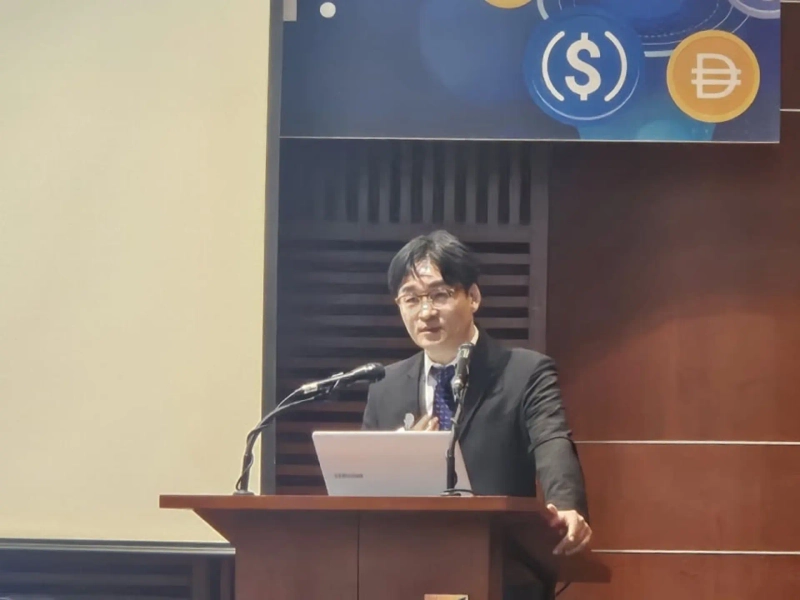
Kim Gap-rae, director at the Korea Capital Market Institute and presenter at the forum, argued that all issuers of KRW stablecoins should be treated at the level of financial institutions.
Director Kim explained, "Stablecoins are not merely products, but a financial system," and "it is necessary to apply regulations identical to those for financial institutions to stablecoin issuers." He noted that, more important than simply qualifying to apply, is whether the issuer fully meets the requirements.
He further stressed the need to review the issuer's business planning. Kim stated, "Stablecoins are issued based on demand, not supply," and advised, "A strategic approach linked to industrial policies in areas such as K-Content, trade settlement, and securities settlement will be needed." He added, "Like the US and EU, tiered regulation based on issuance scale should be considered," and "In the case of the US and EU, issuers are subject to different regulations according to issuance volume."
Additionally, Kim highlighted the importance of overseas stablecoin regulation for investor protection, reserve assets, and redemption structures as core components of stablecoin legislation.
Hwang Se-woon, senior researcher at the Korea Capital Market Institute, mentioned that stablecoin issuance should be allowed only for parties meeting qualification requirements, and that licensing, rather than registration, should be implemented for granting issuance rights.
Researcher Hwang commented, "To maintain the stable value of stablecoins, a licensing regime, not registration, should be adopted," and "It is advisable to set licensing scopes that allow various types of financial institutions to participate."
Notably, regarding the capital requirement for issuers, he proposed a minimum of 5 billion KRW, significantly higher than the 500 million KRW and 1 billion KRW previously suggested by Reps. Min Byung-deok and Kang Jun-hyun, respectively. Hwang explained, "Under the Electronic Financial Transactions Act, electronic money businesses require a capital base of 5 billion KRW, but stablecoins are even broader in scope and monetary aspect," emphasizing, "At least 5 billion KRW in capital is needed, and more would be acceptable."
Bank of Korea, Financial Services Commission, and Ministry of Economy and Finance Begin Stablecoin Review
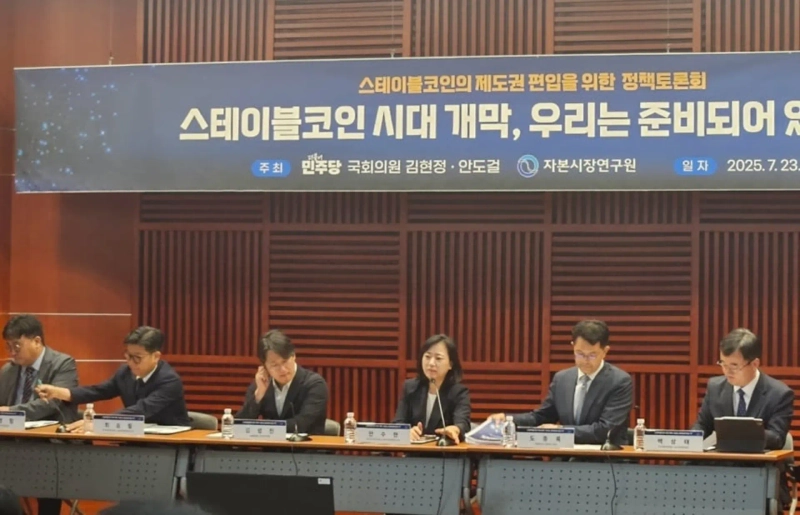
Ko Kyung-chul, former head of the Electronic Banking Team at the Bank of Korea and a panelist at the session, relayed that from the perspective of the central bank, they are closely monitoring any impact that stablecoins may have on monetary policy.
Ko commented, "In Europe, if stablecoin issuance affects monetary policy, central banks can express opinions," and "Korea should also examine the correlation between stablecoins and monetary policy." He added, "I also believe stablecoins could impact inflation."
Kim Seong-jin, director of the Virtual Asset Division at the Financial Services Commission, shared that through practical communication, they are exploring ways to add stablecoin-related content to the second phase of virtual asset legislation.
Kim said, "There is consensus that there are currently no protection mechanisms for overseas stablecoins distributed domestically and that regulatory design for KRW stablecoins is needed," and "We will create regulatory measures through active communication with the relevant ministries."
The Ministry of Economy and Finance is reviewing the foreign exchange aspects of stablecoins. Do Jong-rok, director of the Foreign Exchange System Division at the Ministry, noted, "Currently, stablecoins are mostly used for virtual asset investment," but, "since they can also be used in the real economy, the foreign exchange legal status of stablecoins must be examined."
He continued, "If stablecoins are used for export payments or remittances in the future, we are considering whether to recognize them as external payment methods," and added, "We are also contemplating how to monitor and penalize circumvention or illicit transactions."

Uk Jin
wook9629@bloomingbit.ioH3LLO, World! I am Uk Jin.