

South Korea-U.S. '2+2 Negotiations' Fall Through…Opposition Claims "U.S. Distrusts Lee Jae-myung Administration"
Summary
- The sudden cancellation of the South Korea-U.S. '2+2 Economic Talks' has raised concerns that tariff negotiations are facing major difficulties.
- While major countries such as Japan, the European Union, and the Philippines have achieved visible progress in tariff reductions with the U.S., the cancellation of these talks has heightened economic uncertainty for South Korea.
- Claims have arisen that President Lee Jae-myung and the Democratic Party of Korea are responsible for the current negotiation crisis, highlighting that restoring alliance trust is now a key issue for the national interest.
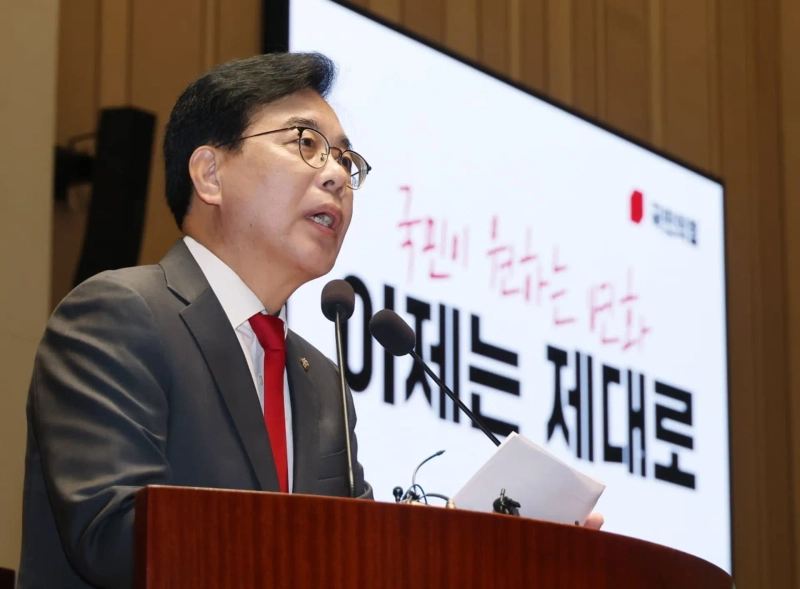
The People Power Party pointed out that the sudden cancellation of the South Korea-U.S. '2+2 Economic Talks' scheduled to be held in Washington, D.C. on the 25th was "the naked face of Lee Jae-myung's 'thank you' diplomacy."
On the 24th, Chairman Song Eon-seok wrote on Facebook, "Today, the 'South Korea-U.S. 2+2 Negotiations' were abruptly canceled. The government cited U.S. Treasury Secretary Scott Besant's 'urgent schedule' as the reason, but concerns are growing that tariff negotiations between the two countries are facing difficulties," adding, "In addition, with National Security Advisor Wi Sung-rak, who was promoting the 'Security Package Deal,' returning urgently during the negotiation period, public anxiety is further intensifying."
Chairman Song said, "Major export competitors have already achieved tangible results in tariff negotiations with the United States. Japan succeeded in lowering mutual tariff rates from 25% to 15%, and the European Union is on the verge of agreeing to lower rates from 30% to 15%. The Philippines agreed to a reduction to 19% on the condition of expanding military cooperation," adding, "By contrast, Indonesia, closely connected with China, settled at 19% down from 32%, but had to promise to lift import restrictions on agricultural products."
He continued, "Looking at these developments, it is clear that the current tariff talks are not just an economic issue, but are closely linked to the U.S. global strategy," emphasizing, "Responsibility for this negotiation crisis lies entirely with President Lee Jae-myung and the Democratic Party of Korea. In particular, last April, President Lee and the Democratic Party blatantly pressured former Prime Minister Han Duck-soo and former Deputy Prime Minister Choi Sang-mok not to participate in the tariff negotiations, asking them to pass it on to the next administration, and even went as far as to impeach cabinet ministers. As a result, our diplomacy has become paralyzed."
He further said, "Moreover, since its inception, the Lee Jae-myung administration has undermined trust in the South Korea-U.S. alliance by considering participation in China's Victory Day celebrations and suspending loudspeaker broadcasts to North Korea. The failure to hold a summit with the U.S. at the G7, and not attending the NATO summit, meant missing out on meetings with President Trump," adding, "With the cancellation of this negotiation, suspicions are mounting that the U.S. is distrusting the Lee administration. President Lee's style of diplomacy, saying 'Thank you' to China and 'Gamsahamnida' to Japan, is resulting in a loss of trust and diplomatic isolation in practice."
He concluded, "Even now, President Lee should work to resolve the suspicions of the Trump administration and restore the trust of our alliance," emphasizing, "That is the starting point for protecting our economy and restoring national interest through tariff negotiations."
Earlier, the Ministry of Economy and Finance officially announced to the press around 9:30 a.m. that "the '2+2 Negotiations' with the U.S., scheduled for the 25th, cannot be held due to Treasury Secretary Besant's urgent schedule." Attending on the Korean side were expected to be Deputy Prime Minister and Minister of Economy and Finance Koo Yun-cheol and Deputy Minister for Trade Yeo Han-koo; on the U.S. side, Secretary Besant and USTR Chief Jamison Greer, to discuss core issues of trade, tariffs, and currency.
Written by Hong Min-seong, Hankyung.com reporter mshong@hankyung.com

Korea Economic Daily
hankyung@bloomingbit.ioThe Korea Economic Daily Global is a digital media where latest news on Korean companies, industries, and financial markets.