

"Trump demands concessions for every 1%P tariff reduction"
Summary
- President Trump demanded specific concessions, such as expanding rice imports, for each 1% point reduction in tariffs during negotiations with Japan.
- The US said that after a deal, quarterly evaluations of implementation would be conducted, and if President Trump was dissatisfied, the tariff could return to a maximum of 25%.
- Amid political pressure and during the negotiation process, Japan withdrew its demand for eliminating auto tariffs and shifted its strategy toward tariff reductions.
Backdrop of US-Japan Tariff Negotiations
"Tariff reductions linked to discussions on expanding rice imports"
Similar demands likely to be made to Korea
Japan's Minister for Economic Revitalization targets close associate Howard Lutnick
Even rehearsed together the day before the meeting
US: "Quarterly review of Japan's implementation"
If Trump is dissatisfied, revert to 25%"
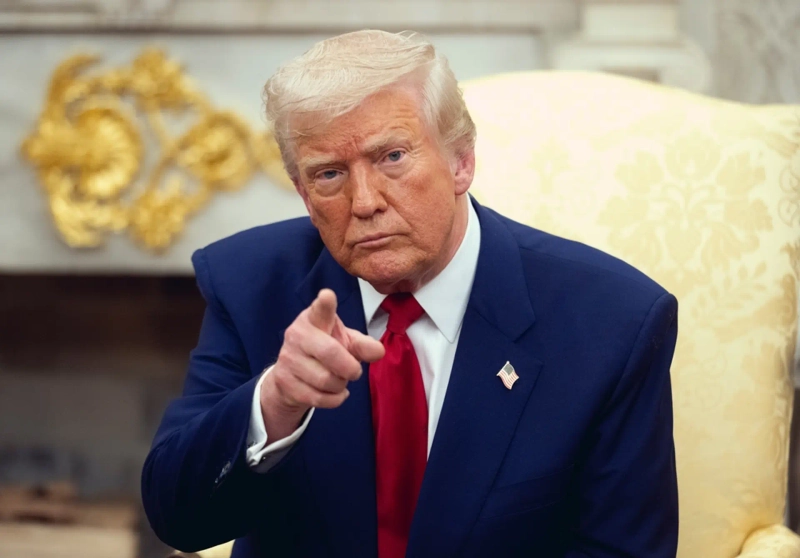
It has been reported that President Donald Trump of the United States demanded concrete concessions such as increasing rice imports for every 1% point cut in tariffs during trade talks with Japan. There is a possibility that the US may make similar demands during negotiations with South Korea.
On the 24th, the Yomiuri Shimbun cited government officials involved in the negotiations and reported, "President Trump made specific numerical demands." These officials told Yomiuri that it was difficult to withstand them.
In the early stages of negotiations with the US, Japan’s negotiating team was confused as different counterparts presented different arguments. As a result, they focused on targeting US Secretary of Commerce Howard Lutnick, who is close to President Trump. According to the Nihon Keizai Shimbun, Ryosei Akazawa, Japan’s Minister for Economic Revitalization, met Lutnick every time he visited the US. Discussions with him—including phone calls—totaled 15 times, spanning about 19 hours. Talks with Treasury Secretary Scott Besant lasted 7 times for about 8 hours, and with USTR Representative Jamison Greer, it was 3 times, about 5 hours in total.
According to Nikkei, it was the relationship Akazawa had built with Secretary Lutnick that allowed him to personally meet President Trump and finalize the agreement on behalf of Prime Minister Shigeru Ishiba. Secretary Lutnick even invited Akazawa to his house for a rehearsal the day before their meeting. Glen S. Fukushima, former president of the American Chamber of Commerce in Japan, told the New York Times (NYT), "The goal was to help President Trump claim a historic victory."
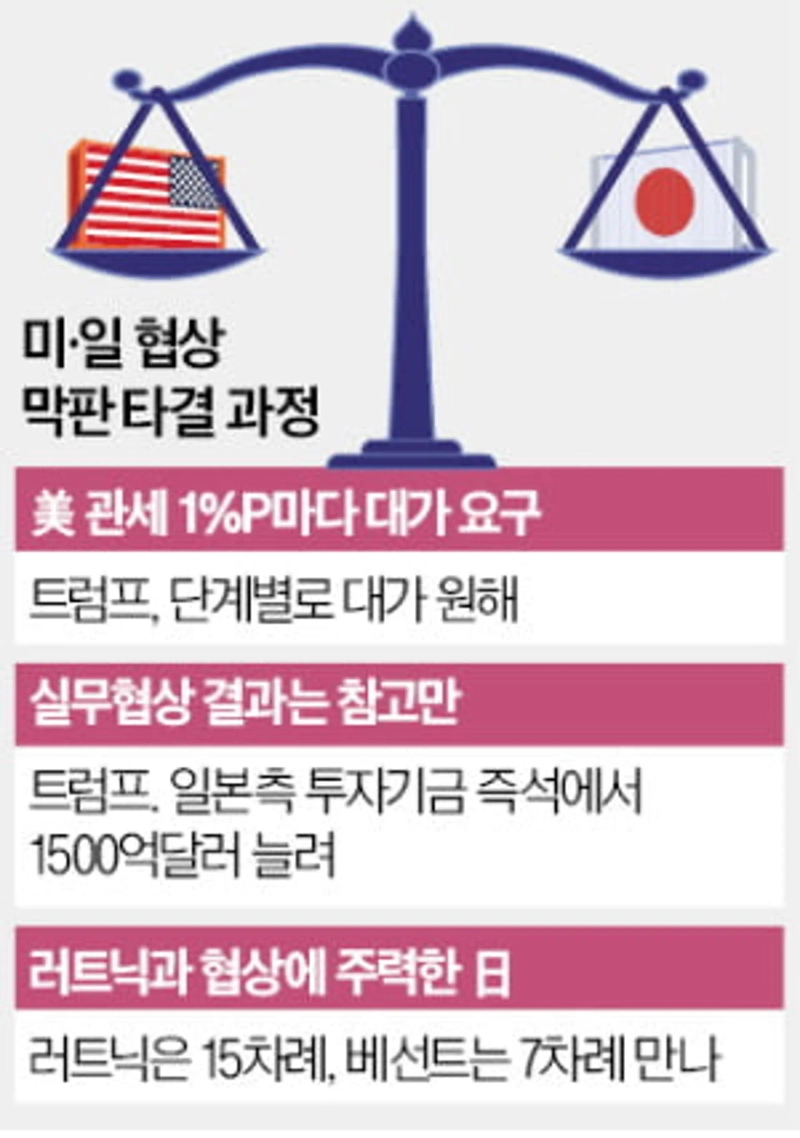
President Trump’s style of treating decisions by working-level staff only as reference and then changing the final figures at will was also evident in these negotiations. A high-ranking Japanese government official said, "President Trump had the authority to make the final decisions on the numbers, so we couldn't lose focus until the very end." A photo of the US-Japan tariff negotiations posted by a US congressman on social media shows that while Japan initially proposed a $400 billion investment fund to the US side, President Trump reportedly changed it on the spot to $550 billion.
It turned out the US also had plans to reimpose reciprocal tariffs on Japan if Japan failed to properly implement the trade agreement. In an interview with Fox News, Treasury Secretary Besant was asked how the US would ensure Japan’s compliance and responded, "We will conduct quarterly evaluations, and if the President is not satisfied, tariffs on automobiles and other products will revert to 25%."
The NYT reported that the ruling Liberal Democratic Party (LDP) of Japan's defeat in the July 20 House of Councillors election accelerated the conclusion of these talks. The LDP, having lost, was pressured to achieve results ahead of comprehensive tariff imposition, leading it to make major concessions in tariff negotiations. At the start of the US-Japan negotiations in April, Minister Akazawa strongly advocated for eliminating auto tariffs, even stating, "Steel is the state for the US; automobiles are the state for Japan," when President Trump said, "Steel is the nation."
However, after 7 rounds of negotiations with little progress, President Trump raised Japan’s reciprocal tariffs from 24% to 25% during the negotiation process. After the LDP lost the upper house election, at the 8th round of talks on the 22nd, Japan dropped its demand for elimination of auto tariffs and shifted its strategy toward tariff reductions.
David Boling, director of Japan and Asia trade at Eurasia Group, told the NYT, "Former Prime Minister Abe Shinzo was able to negotiate with President Trump from a position of power, but this time, Japan had to play the game under less favorable conditions."
Washington = Sang-Eun Lee / Tokyo = Il-Kyu Kim, Correspondents selee@hankyung.com

Korea Economic Daily
hankyung@bloomingbit.ioThe Korea Economic Daily Global is a digital media where latest news on Korean companies, industries, and financial markets.