

KOSPI Put to the Test... Will It Overcome US Tariffs and Tax Reform Bill?
Summary
- This week, the KOSPI index faces multiple uncertainties such as stalled US tariff negotiations, the announcement of the tax reform bill, and the US FOMC meeting.
- NH Investment & Securities and others noted tariff uncertainty and diminishing rate cut expectations as reasons for a bearish stock market outlook and also called attention to policy-related stock issues stemming from the tax reform bill.
- Meanwhile, recovery in South Korea's private consumption and expectations for strong second-quarter results in domestic consumer stocks, as well as cosmetics and duty-free sectors, were highlighted.
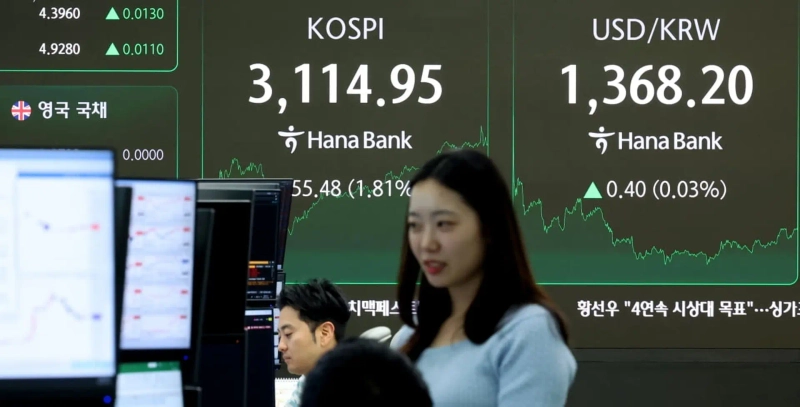
The KOSPI index faces a critical test this week (July 28–August 1). With tariff negotiations with the United States hitting obstacles and the tax reform bill set to be announced at the end of the month, there are several uncertainties in the market. The Fed's July Federal Open Market Committee (FOMC) meeting also has the potential to shake the stock market.
On the 27th, NH Investment & Securities suggested that the KOSPI would likely trade in the range of 2950–3250 this week. Compared to the closing price of 3196.05 on the 25th, this is a projection that leaves more room for downward movement than upward.
Jung-Hwan Na, a researcher at NH Investment & Securities, pointed to tariff negotiations with the US, the possibility of reduced expectations for a Fed benchmark rate cut, and the tax reform bill as factors that could drive the market down next week. Analysts in charge of market conditions at research centers of other securities firms are also focusing on similar issues.
First, the likelihood has increased that tariff negotiations between South Korea and the United States will not be concluded within the grace period for reciprocal tariffs granted by the US. The so-called 'South Korea-US 2+2 Ministerial Meeting' in the economic and trade sectors was originally scheduled to take place on the 25th (local time) in Washington, D.C., but it was canceled due to an urgent schedule for US Treasury Secretary Scott Besant. Instead, Jeong-Kwan Kim, Minister of Trade, Industry and Energy, met with US Secretary of Commerce Howard Lutnick on the 24th to discuss ways to conclude tariff negotiations. However, the two sides were unable to narrow their differences and are continuing additional negotiations.
Jung-Hwan Na of NH Investment & Securities explained, "Given that President Donald Trump and Secretary Besant have overseas engagements through the end of July, it will be difficult to lower tariff rates through negotiations before August 1st," and added, "The continued uncertainty over tariffs is a burden for export stocks."
The Fed's FOMC meeting, concluding on the 30th, is also cited as a source of instability. Although the US base rate is expected to remain unchanged, the future direction of monetary policy is hard to predict. Kyung-Min Lee of Daishin Securities said, "The pressure from President Trump for a rate cut is intensifying, and opinions are divided inside the Fed," adding, "A variety of variables affecting rate expectations are clustered around the FOMC meeting." The results of tariff negotiations between the US and major countries, announcements of the US Personal Consumption Expenditures (PCE) price index, and employment indicators were all noted as factors.
Meanwhile, in contrast to initial expectations at the launch of the new government, there is speculation that the government's tax reform bill may also have a negative impact on the stock market. The market initially only anticipated the possible introduction of separate taxation on dividend income, but recently, possible increases in securities transaction tax rates, tougher standards on large shareholder capital gains taxes, and possible taxation on reduced dividends have come to the fore. There is also talk of loosening the criteria for large shareholders who must pay capital gains tax from ₩5 billion to ₩1 billion, as well as possible increases in corporate tax and securities transaction taxes.
Jin-Hyuk Kang of Shinhan Investment Corp. commented, "Given the gap between market expectations and the stance of the government and ruling party, there is a possibility of sell-offs once the tax reform bill is made public," and added, "In particular, we may see 'sorting the wheat from the chaff' among policy-related stocks such as finance and holding companies."
Despite the uncertainties, consumer-related sectors were cited as ones to watch. Researcher Jung-Hwan Na stated, "In the second quarter, private consumption in South Korea showed signs of recovery, and the issuance of livelihood consumption coupons will favor domestic consumer stocks," and added, "There is also merit in watching cosmetics and domestic duty-free sectors, which are anticipated to see positive second-quarter results and stand to benefit from the summer vacation season."
Han Kyung-woo, Hankyung.com reporter case@hankyung.com

Korea Economic Daily
hankyung@bloomingbit.ioThe Korea Economic Daily Global is a digital media where latest news on Korean companies, industries, and financial markets.