

"The era of free-riding alliances is over... Korea must align with the US on key supply chains and security"
Summary
- Robert O'Brien said Korea should reduce dependence on China by building resilient supply chains and expanding partnerships.
- He stated that investment in advanced military technology development, expanded economic cooperation, and negotiations on increasing host-nation support are important to the Korea-US alliance and economic security.
- He also noted that issues like digital trade regulations and non-tariff barriers will remain top US priorities going forward.
Monday Interview
Trump's first National Security Advisor Robert O'Brien
US closely observing Korea's pragmatic diplomacy
Lee Jae-myung administration should lower reliance on China
Expand partnerships with Japan, Australia, etc. to counter Chinese economic coercion
Negotiation on increased host-nation support for US forces in Korea
Investment in advanced US military tech development
Importance of Korea’s creative and alternative approaches
Korea's 'digital barriers' including map data regulations
US companies being excessively discriminated
Will remain a top US agenda until resolved
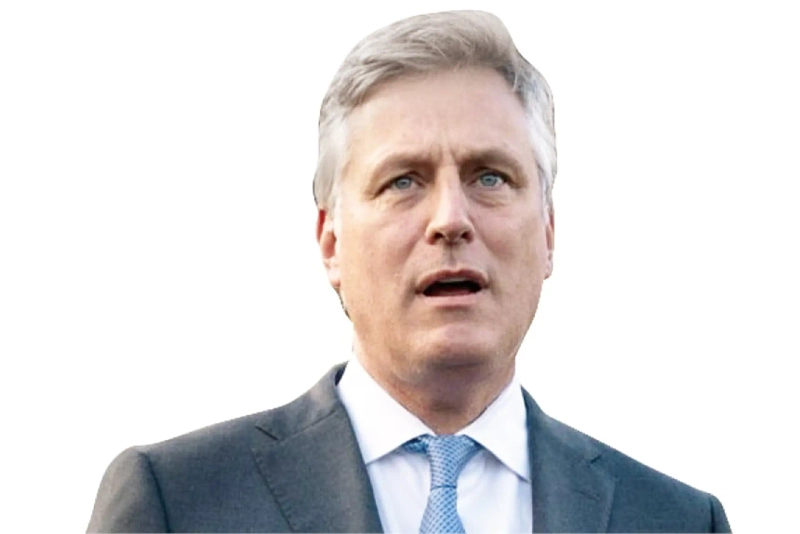
"The United States is closely watching how the Lee Jae-myung administration will conduct 'pragmatic' diplomacy with China and Russia."
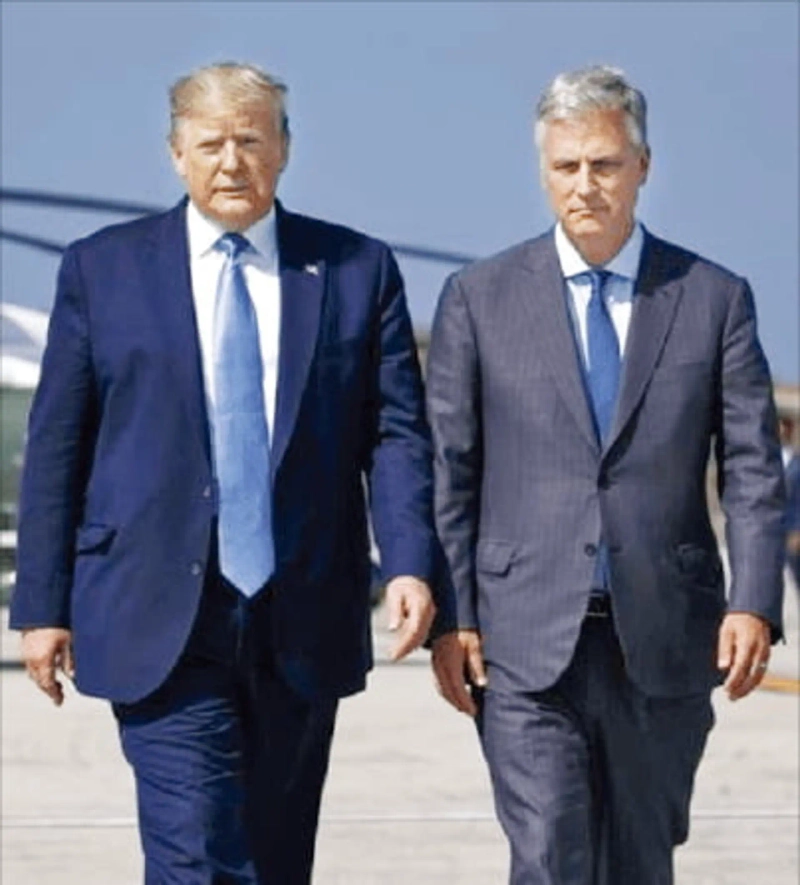
Robert O'Brien, chairman of American Global Strategies (AGS) and former White House national security advisor during the first Donald Trump administration, gave this answer in a written interview with The Korea Economic Daily on the 27th (local time), when asked about Korea's strategy amid intensifying US-China tensions. O'Brien, who leads the consulting firm AGS, is still known to advise President Trump on foreign affairs and security.
He said, "During President Trump's first term, we emphasized the risks of being overly economically dependent on China." He advised that the Lee administration should build resilient supply chains with countries other than China. Regarding host-nation support negotiations, he noted that it's not just about money, and that the US burden could be eased in other ways. On tariff negotiations, he said that Korea's regulations on map data and digital trade could become a core issue going forward, and asserted that the US would not easily back down in this area.
▷ What are the key features of the Trump 2nd term Asia security strategy, in your view?
"Compared to Trump's first term, the perception that China has emerged as a real and imminent threat in the (Indo-Pacific) region stands out more in a possible second term. There is also a heightened recognition of the crucial role that US allies and partners must play in maintaining the international order that has enabled their prosperity."
▷ The Trump administration is presenting 'security bills' to allies. Is there another approach besides more host-nation support for US troops in Korea?
"Creative and alternative approaches are important. For Korea to quickly secure military technological superiority over regional adversaries (such as North Korea and China), it must cooperate with the US in actively investing in the development of advanced defense industry technologies. Also, taking a cue from NATO, Korea needs to prepare to provide tangible assistance to the US in crisis situations by protecting key infrastructure, defending cyber networks, and strengthening civil preparedness. Korea needs to enhance its defense infrastructure base."
▷ There is much praise for the first Trump administration’s China policy, but Korea now has deep economic ties with both the US and China.
"My advice for the Lee Jae-myung administration is to reduce reliance on China by strengthening strategic partnerships with Japan, Australia, the European Union (EU), India, ASEAN (Association of Southeast Asian Nations), etc., and to build resilient supply chains to counter Chinese economic coercion. The US is closely watching how the Lee administration conducts pragmatic diplomacy with China and Russia."
▷ After the beginning of a second Trump administration, there is a move among various countries to set up new multilateral cooperation structures.
"The Trump administration’s emphasis on America First and reciprocal trade, rather than multilateral frameworks in relations with Korea, is aimed at protecting the Korea-US alliance. It is vital for the Korean government to take a firm stance against Chinese intransigence and North Korean threats, and to cooperate with the US in countering Chinese economic coercion. Continued efforts are needed to strengthen ties with Korea, Japan, and other Asian allies to appropriately deter and respond to the Chinese threat."
▷ What are areas where Korea-US cooperation is possible?
"Korea’s (technological) leadership in shipbuilding, artificial intelligence (AI), semiconductors, and cloud technologies could become a cornerstone for the economic and security interests of both countries. Expanding economic cooperation in semiconductors and green technologies, among other key industries, could simultaneously advance security and economic prosperity for both countries."
▷ The Trump 2nd-term tariff policy is more aggressive than that of the 1st term, and does not distinguish between allies and non-allies.
"The Trump administration’s clear position is that the existing model, in which allies enjoy economic benefits without sharing costs while the US guarantees security, is no longer sustainable. Instead, allies and partners should work together to harmonize their approaches to economic and national security. The idea is to jointly protect key supply chains, invest in the US, reduce the US defense burden, and open markets. Unfair trade practices and non-tariff barriers should be eliminated, and when the US tries to adjust trade imbalances through tariff policy, partners should not retaliate."
▷ Isn’t the US method for calculating reciprocal tariffs quite opaque and arbitrary?
"It reflects the degree of imbalance in goods trade between the US and its trading partners. This acts as a starting point of negotiations, which may gradually decrease. In most cases, countries retain high tariffs for individual items while being more likely to accept a minimum-pound tariff as presented by the US. Detailed negotiations can then further adjust and lower tariffs."
▷ Is the US demand for opening rice and beef markets about securing symbolic victories?
"The US is a major global supplier of agricultural products. Access to the global market is a crucial factor for the US economy. This has always been a central focus of US trade negotiations."
▷ Digital trade is also cited as a core issue.
"Not only myself, but also Jamieson Greer, a representative of the US Trade Representative (USTR), have argued that digital trade barriers are unfair non-tariff barriers to US companies. Korea's export restrictions on map data that limit US companies from offering comprehensive mapping services, new online platform legislation, and regulations imposing mandatory network usage fees on content providers are all problems."
▷ The Korean government explains that platform regulations are not discriminatory towards US companies.
"Essentially, what matters most is not intent, but outcome. The US believes that excessive levels of regulation, obligations, fines, and sanctions applied only to US companies but not to large Korean or Chinese firms is excessive and discriminatory."
▷ Is it safe to say the US is not backing down easily?
"A Korea-US digital trade enforcement act was introduced in the US Congress, proposing sanctions if Korea enforces digital services regulations or discriminates against US companies. The US government is also closely monitoring comments from the Korean Minister of Science and ICT on the network usage fee issue. Even if all the issues are not resolved by August 1, it will remain a top-priority agenda until they are. Resolving these matters should be treated as an important opportunity to deepen US-Korea relations."
▷ In Korea, there is public opinion seeking a return of wartime operational control along with increased burden-sharing.
"Since transition conditions were set in 2015, the US has consistently followed the operational control transition procedures. If it is assessed that North Korea’s threat response capabilities will not be compromised, the US will support transferring operational control to Korea."
▷ President Trump recently tried to send a personal letter to Kim Jong Un, but North Korea reportedly refused delivery. Do you see a chance for US-North Korea talks?
"North Korea has been providing military support to Russia, aiding President Vladimir Putin’s war effort, and President Trump is aiming to end this war. He is regarded as the only president who can complete negotiations with North Korea, terminate prohibited (nuclear) programs, and usher in a new era of prosperity in the region."
(The Trump 2nd term government, at first, sometimes referred to North Korea as a 'nuclear possessor,' appearing to recognize North Korea’s nuclear status but later repeatedly reaffirmed its existing position of pursuing the denuclearization of the Korean Peninsula.)
▷ Can Korea pursue the 'Korean Peninsula Peace Process' or 'mediator model' advocated during the Moon Jae-in government?
"President Trump welcomes support from partners and allies, but policies and negotiation approaches will be determined by himself."
■ About Robert O'Brien
Robert O'Brien, 59, served as White House national security advisor in the first Donald Trump administration from 2019 to 2021. He was appointed to the President’s Intelligence Advisory Board this February and is known to still advise President Trump in foreign affairs and security.
O'Brien was born in Los Angeles, California. He earned a BA in Political Science from UCLA and a JD from UC Berkeley. He has worked as an attorney at the UN and various private law firms, and entered public service under the George W. Bush administration. Early in the Trump administration he was a special envoy for hostage affairs before succeeding former national security advisor John Bolton. He did not agree with President Trump’s claims of election fraud after the 2020 presidential defeat. After the Biden administration took office, he founded the strategic consulting firm American Global Strategies (AGS), which provides policy and regulatory advice and consulting to US government relations. Since 2022, he has also served as chairman of the Nixon Foundation.
Washington = Sang-eun Lee, Correspondent selee@hankyung.com

Korea Economic Daily
hankyung@bloomingbit.ioThe Korea Economic Daily Global is a digital media where latest news on Korean companies, industries, and financial markets.