

Ecosystem Restoration Experiments Using NFTs Draw Attention
Summary
- The NFT-based ecosystem restoration project led by the Environment Foundation, Dunamu, and Korea Arboretum and Garden Management Service is drawing attention as an ESG (Environment, Social, and Governance) experiment, driving citizen participation.
- Citizens collect NFTs through online and offline missions, and actual native plant conservation areas are created according to the number of NFTs collected.
- This project is recognized for effectively using digital NFT assets to expand engagement and deliver environmental messages.
Restoration activities using Non-Fungible Tokens (NFTs), driven by the Environment Foundation, Dunamu, and Korea Arboretum and Garden Management Service, are gaining attention. For the past three years, they have carried out an experiment called the 'Seed Vault NFT Collection', which connects citizens' digital engagement with tangible biodiversity conservation outcomes.
[HanKyungESG] NOW
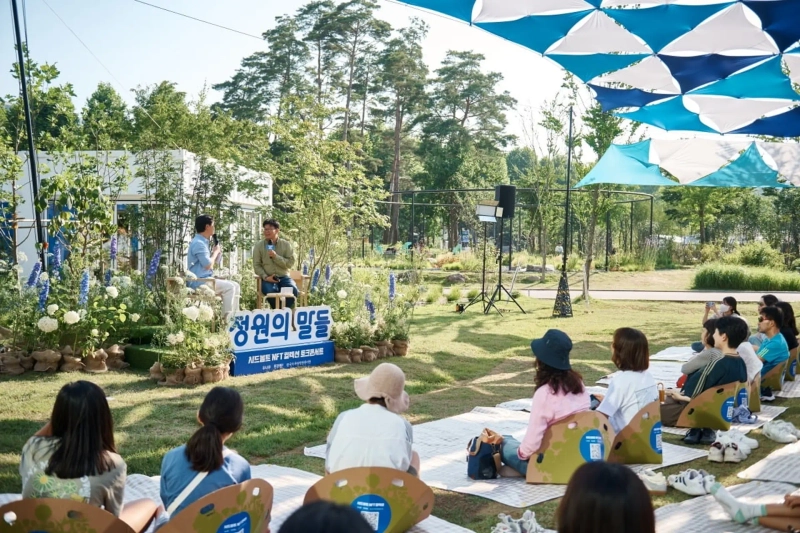
Ordinary citizens contributed to real ecosystem restoration by remembering plant names and solving quizzes with smartphones. Wherever citizens collecting NFTs ventured, native plant conservation areas were established. This three-year joint experiment by the Environment Foundation, blockchain company Dunamu, and Korea Arboretum and Garden Management Service showed that the 'Seed Vault NFT Collection' could be realized as a forest covering 2,000 m².
The Seed Vault NFT Collection operated on a model where participants collected NFTs through online and offline missions, and native plant conservation areas were created proportional to the number of NFTs collected. Based on images of seeds stored in the world’s only permanent wild plant seed facility, the Baekdudaegan Seed Vault, NFTs were issued to raise awareness for the value of endangered plants, earning recognition as a participatory ESG (Environment, Social, and Governance) model uniting technology and environmental stewardship.
Digital Citizen Participation, Leading to Biodiversity Conservation
This experiment was designed not just for NFT issuance and collection but also for turning digital engagement into practical biodiversity conservation results. Citizens joined as 'agents', completing online quizzes and verification missions to acquire NFTs, prompting the establishment of native plant conservation areas. Analyses suggest this has strong educational effects, as individual actions are directly linked to ecosystem restoration.
To address the limits of campaign centralization in metropolitan areas, both online and nationwide offline methods were implemented. Citizens joined the 'PocketC GO' event, earning NFTs through quizzes and missions, and explored Easter egg-type content on the Seed Vault NFT homepage, open chatrooms, and Instagram. They could also directly visit eco-friendly sites across the country, verify location QR codes, and collect NFTs—encouraging broader participation.
The Seed Vault NFT Collection was designed based on the planning and biodiversity conservation expertise of the Environment Foundation. Gamification elements allowed citizens to participate enjoyably and organically absorb environmental messages. Educational content on biodiversity was integrated into NFT acquisition to combine learning with action.
Dunamu, the technical partner, supported the system through the Upbit NFT platform, providing automatic NFT issuance, on-site QR code scanning, and more. Issued NFTs served as campaign participation certificates and event tickets, and participants could combine owned NFTs to generate new ones, increasing engagement.
Establishing conservation areas went beyond simple planting—priority was placed on ecological significance and educational value. The Environment Foundation, with Korea Arboretum and Garden Management Service, selected conservation sites based on growth environments, institutional expertise, and citizen accessibility, aiming for each space to serve as a biodiversity conservation and public education hub.
Expanding from Online Experiences to On-Site Participation
From 2023, the Seed Vault NFT Collection ran seasonal series. Season 1 focused online to boost accessibility to NFT technology, issuing nine types of NFT through activities like pet plant certification events and biodiversity quizzes, with over 10,000 participants.
Season 2 expanded into more offline activities. Following votes from Season 1 participants, a media art exhibition themed on 'Mugunghwa' took place at the Busan Arte Museum SEED Hall, attracting about 140,000 visitors. A sea plogging event at Songdo Beach, Busan, collected around 2,360L of ocean waste.
Season 3, held from May to July, centered on 'healing', featuring hands-on programs to experience ecological values. At a booth in Seoul’s Boramae Park, experiential programs such as meditation yoga and talk concerts—focusing on nature—were run, and native plant seeds and NFTs were offered based on personality assessments. Jae-Seung Jeong, a KAIST professor, at the 'Words of the Garden' concert, explored the connection between climate crisis and mental health under the theme of 'Nature's Hospitality, Healing, and Care.'
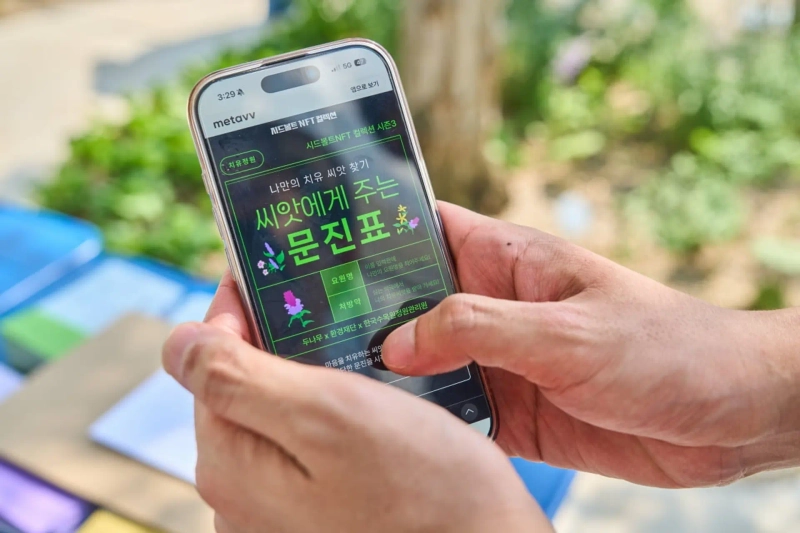
ESG Experiments Using NFTs Open a New Chapter for Environmental Campaigns
Across all three seasons, more than 40,000 people joined the campaign, and NFT issuance exceeded 100,000. According to the Environment Foundation, citizen-driven native plant conservation areas now total 2,000m². The first area, about 587m², was established at Shingu University Arboretum in Season 1, with 4,800 individuals from 83 native species. In Season 2, the second Mugunghwa-themed conservation site (1,130m²) was created at Jinhae Botanic Museum; Season 3 plans to open the third site (~430m²) at Boramae Park in Seoul.
The Seed Vault NFT Collection draws attention as a citizen-participatory ESG experiment leveraging digital technology. As a digital asset, the NFT proved effective at delivering environmental messages and broadening participation, with citizens contributing directly or indirectly to ecosystem restoration by collecting NFTs. This has reportedly lowered participation barriers and improved accessibility.
A Dunamu spokesperson stated, "We focused on the potential of NFT technology to deliver environmental messages and will continue ESG activities based on blockchain." An Environment Foundation representative said, "By combining technology and environmental messages, we designed the program so citizens can participate in environmental actions in a fun and easy way, and we will continue promoting sustainable environmental conservation initiatives."
Reporter: Seungkyun Lee, HanKyungESG csr@hankyung.com

Korea Economic Daily
hankyung@bloomingbit.ioThe Korea Economic Daily Global is a digital media where latest news on Korean companies, industries, and financial markets.