

EU paid $1.3 trillion to the US to maintain '15% auto tariffs'… A crisis was averted for now
Summary
- The United States and European Union (EU) agreed to implement a 15% mutual tariff, with the EU pledging to purchase $1.35 trillion worth of U.S. energy and commit to investments in the U.S.
- Although this agreement reduces the risk of a trade war, it was stated that differences remain between the two sides regarding the application of tariffs to semiconductors and pharmaceuticals.
- There is still additional uncertainty due to the lack of clarity around the timing and specifics of the EU's investments in the U.S.
'15% mutual tariff' agreement reached, following Japan
$750 billion purchase of U.S. energy
Additional $600 billion investment promised
Disagreements remain over the 'details'
Timing and content of EU investment in the U.S. not specified
Divergent statements on inclusion of semiconductors and pharmaceuticals
50% tariffs on steel and aluminum remain
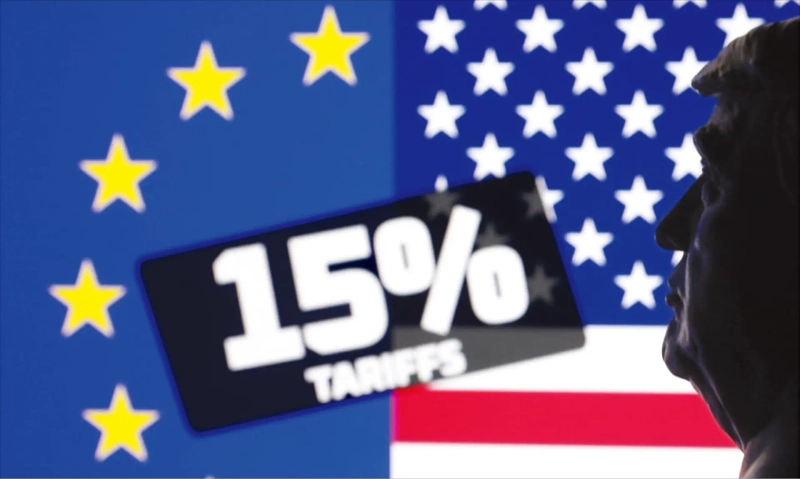
As the United States and the European Union (EU), the world's first and second largest economies by GDP, concluded their tariff negotiations just five days before the deadline, a significant portion of uncertainty in the global economy was alleviated. The EU pledged to purchase $1.35 trillion worth of U.S. energy and invest in the U.S., obtaining tariff reductions in return. However, differences in interpretation regarding tariffs on semiconductors and pharmaceuticals remain a potential source of conflict.
◇ EU promises massive investments in the U.S.
U.S. President Donald Trump and European Commission President Ursula von der Leyen finalized a trade agreement after meeting for about an hour on the 27th (local time) in Turnberry, Scotland, United Kingdom, which included imposing a 15% mutual tariff on U.S. imports of EU goods and automobiles. The EU initially proposed a complete mutual tariff exemption to the U.S., but President Trump firmly insisted, "It can't be below 15%," ultimately leading the EU to accept the 15% rate—similar to the deal obtained by Japan.
Automobiles will also be subject to a 15% tariff. Currently, EU-made cars exported to the U.S. face a preexisting 2.5% tariff plus an additional 25% item-specific tariff imposed by President Trump, totaling 27.5%. As a result of these negotiations, the tariff rate will be reduced to 15% beginning August 1.
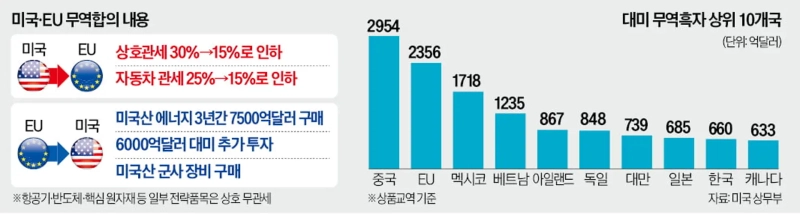
Tariff-free items were also agreed upon. President von der Leyen stated, "All aircraft and related parts, certain chemicals, specific generic drugs, semiconductor equipment, certain agricultural products, natural resources, and core raw materials will be subject to mutual tariff exemption."
In return for lowering mutual tariff rates from the original 30% proposed by President Trump to 15%, the EU promised large-scale purchases of U.S. energy and additional investments. Specifically, the EU will purchase $250 billion of U.S. energy annually for three years, totaling $750 billion. President von der Leyen explained that this amount aligns with the EU's plan to completely phase out Russian fossil fuels by 2028. Additionally, the EU will invest another $600 billion in the U.S. and, while not disclosing the amount, has agreed to purchase U.S.-made military equipment as well.
President von der Leyen also said, "U.S. AI semiconductors will power our AI gigafactories and help the U.S. maintain its technological edge." The U.S. tariffs of 50% on steel and aluminum remain unchanged.
◇ U.S.-EU all-out trade war averted
Following Japan's agreement, the EU's trade deal with the U.S. has eased market concerns. After news of the agreement, the euro rose as high as $1.1770 per euro, up more than 0.2 percentage points from the previous day. The EU is the U.S.'s largest trade partner and investment destination.
With major countries quickly finalizing trade negotiations, President Trump's political stature is also expected to rise. Tony Sycamore, a market analyst at global financial services firm IG, told Reuters, "The U.S. managing to strike deals with both Japan and the EU within a week shows significant progress" and that "the risk of a prolonged trade war has eased."
◇ The devil is in the details
Although the U.S. and EU agreed on a 15% mutual tariff in broad terms, they remained divided on key details such as semiconductors and pharmaceuticals. Before the meeting, President Trump drew a clear line by saying that pharmaceuticals would not be included in any agreement. After the talks, U.S. Secretary of Commerce Howard Lutnick stated that semiconductor tariffs, based on Section 232 of the Trade Expansion Act, "are expected to be announced in two weeks."
In contrast, President von der Leyen insisted that the 15% tariff would "apply to most categories, including automobiles, semiconductors, and pharmaceuticals," calling it "an explicit upper limit."
The vague timing of the EU's investment in the U.S. is also considered a risk. The BBC pointed out that the EU has not set forth exactly when or in which fields these U.S. investments will take place.
New York — Shin-Young Park, Correspondent, nyusos@hankyung.com

Korea Economic Daily
hankyung@bloomingbit.ioThe Korea Economic Daily Global is a digital media where latest news on Korean companies, industries, and financial markets.