

Persistent Employment Slump... 'Regressing' Throughout the First Half
Summary
- It was reported that, in June, the number of employees at domestic businesses turned to a decrease of 15,000 year-on-year.
- It was noted that there have been significant employee reductions in manufacturing and construction sectors.
- In some industries, such as healthcare and social welfare services, professional and scientific technical services, and real estate, the number of employees increased.
Decrease of 15,000 Employees in June
No Sign of Recovery in Manufacturing and Construction
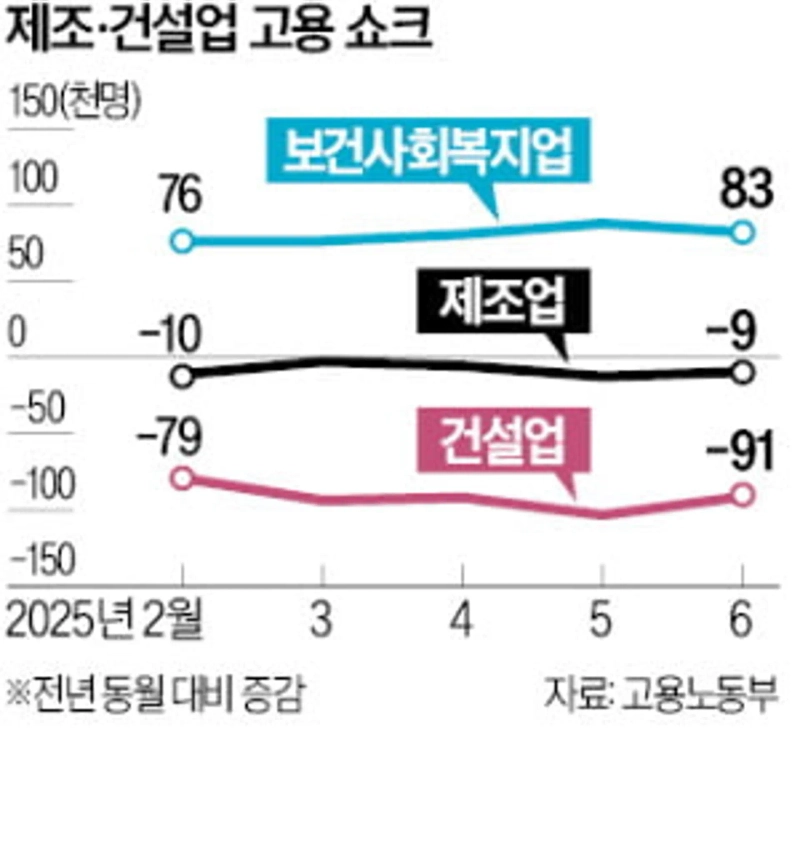
Last month, the number of employees at domestic businesses turned back to a decline after just one month. The employment market remains frozen and shows no sign of reviving.
According to the Ministry of Employment and Labor’s business workforce survey released on the 30th, as of the end of June, businesses with at least one employee had a total of 20,272,000 workers, down by 15,000 (0.1%) compared to the same month last year. The number of people employed by businesses had shown a continuous slowdown in increases since 2022 and turned to a decline in January, with a drop of 55,000 compared to the same period a year before. Since then, numbers continued to fall—by 8,000 in February, 26,000 in March, and 2,000 in April—for four consecutive months of decline. While May saw a standstill compared to last year, June has again shown a downward trend.
In particular, the manufacturing and construction sectors, which have a significant employment multiplier effect, continued to experience hiring shocks. Manufacturing saw a drop of 9,000 workers from the same month last year, marking 21 straight months of decline since October 2023. Construction also saw a decrease of 91,000 workers (6.2%). Wholesale and retail (down 26,000, 1.1%) and accommodation and food services (down 21,000, 1.7%) also decreased.
On the other hand, the healthcare and social welfare services sector (up 83,000, 3.4%), professional and scientific technical services (up 18,000, 1.4%), and real estate (up 14,000, 3.0%) saw an increase in jobs. By employment status, salaried workers increased by 15,000 (0.1%) year-on-year, while temporary and daily workers dropped by 8,000 (0.4%), and other workers decreased by 22,000 (1.7%).
As of May, the nominal total wage per employee at businesses with at least one regular employee was ₩3,916,000, an increase of ₩94,000 (2.5%) from the same month last year. Considering consumer price levels, real wages stood at ₩3,368,000, with a rise of 0.5%.
Ji-eun Ha, hazzys@hankyung.com

Korea Economic Daily
hankyung@bloomingbit.ioThe Korea Economic Daily Global is a digital media where latest news on Korean companies, industries, and financial markets.