

US applies 'Bring everything to the table' pressure… Heightened urgency for 'Team Korea'
Summary
- US Secretary of Commerce Howard Lutnick strongly demanded not only full market opening but also an increase in the total investment amount from the Korean negotiation team.
- The Korean government and business leaders proposed cooperation packages worth $10–20 billion in industries such as shipbuilding, semiconductors, and automobiles, but these reportedly fell short of US expectations.
- The anticipated US bottom line for total investment is about $30 billion, and if the negotiation falters, there may be growing pressure for either a tariff increase or further market opening concessions.
Korean negotiation team meets with Lutnick… US demands 'full market opening'
Chung Eui-sun also heads to Washington… Business leaders successively support the negotiations
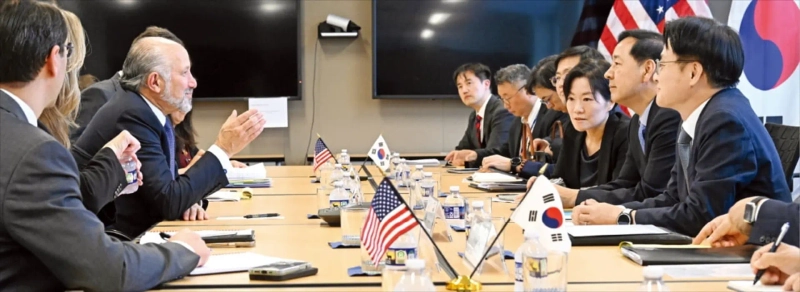
Howard Lutnick, US Secretary of Commerce, who is in tariff negotiations with Korea, reportedly said, 'If you want to persuade President Trump, you need to present the best and final trade agreement.' Observers suggest this indicates dissatisfaction with Korea's existing proposal, raising further pressure on the Korean team.
The Wall Street Journal (WSJ) reported on the 29th (local time) that Secretary Lutnick made this demand when he recently met Minister Kim Jung-kwan and Chief Negotiator Yeo Han-goo, who visited him in Scotland, UK. Lutnick, when presenting the final proposal to President Donald Trump, emphasized, 'You must bring everything,' and added, 'You need to convince President Trump why a new agreement with Korea is necessary when he has already concluded numerous trade deals with major partners such as Japan, the European Union (EU), and the United Kingdom.' He also said in a CNBC interview that day, 'The price of a deal with the US is now clear. Full market opening.'
President Trump, returning to the White House from Scotland that day, told reporters on Air Force One regarding the negotiations with Korea, 'Tariffs will not end tomorrow.' This implied that the mutual tariff talks (deadline: August 1) would not be easily concluded.
Korea is going all-in for the final showdown. Upon arrival in Washington, D.C., Deputy Prime Minister Koo Yun-chul immediately met Secretary Lutnick with Minister Kim and Chief Negotiator Yeo for about two hours.
On the 31st, Koo is scheduled to meet with Secretary of the Treasury Scott Besant. However, since Besant will return to the US on the 30th after finishing US-China talks, additional negotiations may occur before then. Foreign Minister Cho Hyun will also arrive in the US via Japan on the 30th and meet Secretary of State Marco Rubio on the 31st. Hyundai Motor Group Chairman Chung Eui-sun will join the negotiations in Washington, D.C., following Samsung Group Chairman Lee Jae-yong and Hanwha Group Vice Chairman Kim Dong-kwan. Not only economic, trade, and diplomatic ministers but also business leaders are providing all-out support and flanking assistance.
'Submit the final offer' — US ultimatum… In the end, what Trump wants is 'investment amount'
$10 billion+α vs. $40 billion… Lee instructs, 'Negotiating team, act with confidence'
Secretary Howard Lutnick's demand for the Korean team to "bring the best and final offer" is effectively seen as pressure to increase Korea's investment in the US. The proposed investment of '$10 billion+α' by the Korean team is considered insufficient by President Trump. While the 'Korea-US manufacturing cooperation' initiative is important, analysts believe what President Trump really wants is a clear number the American people can see.
The last piece of the negotiation puzzle is 'the numbers'
The Korean team is proposing a cooperation package focusing on 'MASGA' (Make American Shipbuilding Great Again) in sectors such as shipbuilding, semiconductors, and automobiles. Business leaders are directly presenting industrial investment plans and joint US-Korea initiatives. On the 30th, Presidential Policy Chief Kim Yong-beom stated, 'We are negotiating a package centered on areas where mutually beneficial outcomes can be achieved within a tolerable range for us,' and added, 'In addition to shipbuilding, semiconductors, secondary batteries, and biotechnology are also on the table.'
However, the US response remains cold. Secretary Lutnick publicly pressured the Korean negotiators to 'bring everything,' also highlighting the need to convince President Trump why a new deal with Korea is necessary. This suggests Korea's proposals fall short of US expectations.
Previously, Japan proposed a $55 billion investment plan, and the EU a $60 billion plan for the US, reducing mutual tariffs from 25–30% to 15%. These 'big deal' packages included market opening plus large-scale energy and defense purchases. In contrast, Korea's total proposed investment is reportedly in the $10–20 billion range.
Trade experts estimate the US bottom line, considering Korea's economic scale and trade surplus, is around $30 billion.
Heo Jeong, President of the International Trade Association, stated, 'What Secretary Lutnick wants are just two figures to put on the board for President Trump: total investment and tariff rate.' He added, 'Whatever number President Trump may instantly alter, it must first pass Secretary Lutnick's standards.' He went on, 'The US seems to prefer the order of proposing the total amount first, then discussing specifics. If the government has previously focused on explaining industry-specific plans, it is now time to shift toward proposing a convincing total figure.'
Fifth round of negotiations with Lutnick is essential
Within and outside the government, there is consensus that a fifth round of negotiations with Secretary Lutnick must be held before the scheduled meeting between Deputy Prime Minister Koo Yun-chul and Treasury Secretary Scott Besant on the 31st (local time). This is because Lutnick is the key player guiding substantive coordination and the tariff structure of the negotiations.
A diplomatic source said, 'If Koo goes into the Besant meeting with only the message that this is the best we can do, without a confirmed investment total, the US may consider the negotiations concluded and report as such to President Trump. In that case, a deal could be reached at a 20% tariff, not 15%.' There are also arguments that if raising the investment total is impossible, Korea must boldly consider opening its agro-livestock market, relaxing platform regulations, permitting Google Maps data transfers, and increasing US arms purchases.
Another scenario is to postpone the talks. Considering the lack of high-level coordination and top-level meetings compared to Japan and the EU, there are realistic opinions that rather than force a conclusion at this meeting, it's better to stage a presidential summit in August or September.
On this day, President Lee Jae-myung conveyed to the team through spokeswoman Kang Yoo-jung, 'I understand these talks are difficult, but as you are representing all 52 million citizens, please approach the negotiations with confidence.'
Washington = Lee Sang-eun, Park Shin-young (correspondent), Ha Ji-eun, Kim Ri-an (reporters) selee@hankyung.com

Korea Economic Daily
hankyung@bloomingbit.ioThe Korea Economic Daily Global is a digital media where latest news on Korean companies, industries, and financial markets.