

U.S.-China Tariff Truce Extended by 90 Days…Trump: "Will Meet Xi Jinping Within the Year"
Summary
- The United States and China reportedly reached a provisional agreement to extend the mutual suspension of high tariffs by 90 days as part of a 'second truce.'
- Final approval depends on President Trump, and it is suggested that a final settlement may be reached at the planned U.S.-China summit within the year.
- U.S. warnings indicate tariffs of up to 500% could be imposed if China continues to purchase Russian crude oil, signaling a need for caution by investors.
Provisional Agreement on High Tariff Suspension
Third Round of Talks Concluded in Stockholm
Besant: "Trump will make the final decision"
"500% Tariff on Chinese Purchases of Russian Crude Oil"
Final Settlement Expected at Summit
Speculation about Trump Visiting China Before APEC in Gyeongju
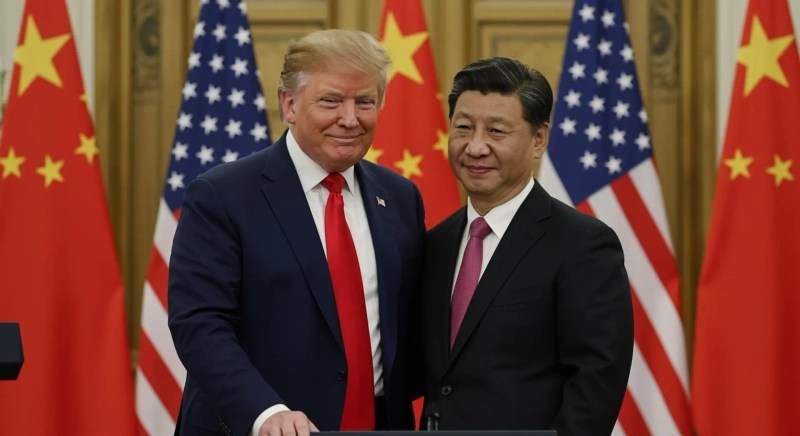
The United States and China have reached a provisional agreement on extending their mutual suspension of high tariffs by 90 days in a 'second truce.' It is reported that the final decision will be made by U.S. President Donald Trump. President Trump projected that a summit with President Xi Jinping of China could take place within the year.
Conclusion of the Third Round of Talks
Delegations representing the U.S. and China completed two days of negotiations in Stockholm, Sweden, on the 28th and 29th (local time), where the two nations reportedly reached a provisional agreement to extend the suspension of high tariffs by 90 days. Scott Besant, the U.S. Treasury Secretary who led the American delegation, said at a press conference on the 29th, "There are still a few technical details remaining," but added, "The talks were highly constructive."
However, he emphasized that the agreement will only take effect once President Trump gives his final approval. In a CNBC interview, he said that an extension of the tariff reduction was one of several options and reiterated, "President Trump will decide." He added that the two countries may hold additional talks within the next 90 days.
President Trump, speaking to reporters on a special flight returning from Scotland to the White House, said, "I just received a call from Secretary Besant, who said the meeting with China went very well," and added, "The delegation will brief me within 30 days, and I will either approve the agreement or not."
Li Chenggang, the Chinese Vice Minister of Commerce and International Trade Negotiator, who participated in the Chinese delegation, said at a press conference, "Based on the bilateral agreement, we will seek to continue the suspension of some U.S. tariffs and China's countermeasures." He Lifeng, leader of the Chinese delegation and Vice Premier, stated that "China's position on the economic and trade relationship between the two countries is consistent by nature and ultimately about mutual benefit and win-win," and added, "Cooperation brings gains for both nations, but confrontation hurts everyone."
This Stockholm meeting marked the third high-level gathering between the U.S. and China since the onset of the tariff war. At their first meeting this past May in Geneva, Switzerland, they agreed on a truce, with the U.S. lowering additional tariffs on Chinese goods from 145% to 30%, and China reducing tariffs on American goods from 125% to 10%. This suspension of high tariffs was to last for 90 days.
Subsequently, at the second meeting held in London, U.K., the two sides agreed to relax U.S. controls on exports of semiconductors and other high-tech products, and for China to lift restrictions on rare earth exports. The third talks in Stockholm came ahead of the expiration date of the tariff suspension (August 11).
"Thawing Mood" but Unresolved Risks Remain
With the Stockholm talks, the chances of the "thawing mood" between the U.S. and China continuing increased. However, some risk factors that could amplify tensions persist. Secretary Besant warned at the press conference that if China continues to purchase Russian crude oil, the U.S. could impose tariffs of up to 500%. Currently, the U.S. Congress is considering a bill to impose such tariffs on countries that buy Russian crude oil, as a way to help end the war in Ukraine—which could, if applied, affect China. Besant added, "U.S. allies will also be required to take similar measures to cut Russia's energy revenues." China is the largest purchaser of Russian crude oil, importing about 2 million barrels per day.
The U.S. also pointed to China's overproduction problem. Furthermore, the Wall Street Journal reported that although China requested the lifting of the 20% 'fentanyl (synthetic drug) tariff,' this was not accepted. The U.S. imposed additional tariffs on China, citing the inflow of Chinese fentanyl precursors into the country, among other reasons.
The potential U.S.-China summit is drawing significant attention. President Trump, aboard the plane returning to the U.S., told reporters that a meeting with President Xi is expected to occur "before the end of this year." The South China Morning Post previously reported that there was a possibility President Trump would visit China just before the Asia-Pacific Economic Cooperation (APEC) summit in South Korea at the end of October, or that he and President Xi would meet separately during the summit.
Beijing=Kim Eun-jeong, Correspondent kej@hankyung.com

Korea Economic Daily
hankyung@bloomingbit.ioThe Korea Economic Daily Global is a digital media where latest news on Korean companies, industries, and financial markets.