

Yeo Han-koo: "Protectionism is the new normal...Trade and industry must converge"
Summary
- Minister for Trade Yeo Han-koo stated that strengthened protectionism and economic security risks could be critical for the Korean economy.
- Korea's trade policy focuses on diversifying trade partners, convergence of trade and industrial policies, and establishing new trade norms for supply chains, AI, and other emerging issues.
- Professor Robinson evaluated that APEC can serve as an alternative to protectionism and a global cooperation platform, and that Korea has the potential to play a significant role in this process.
Professor Robinson: "APEC is the last bastion of multilateralism"
Seoul Pacific Economic Cooperation Council (PECC) General Meeting
The think tank that served as the foundation for APEC
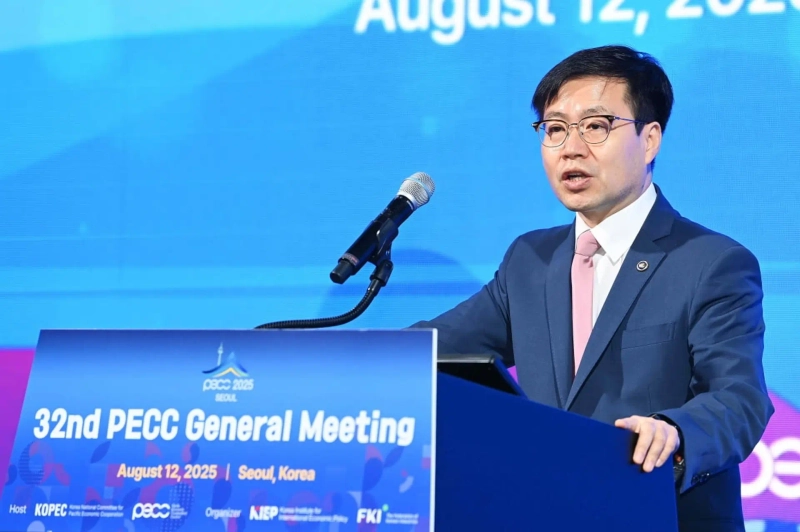
Yeo Han-koo, Minister for Trade at the Ministry of Trade, Industry and Energy, stated on the 12th that "protectionism and economic nationalism are emerging as the new normal," adding that "for Korea—which is highly open and mid-sized in scale—adapting to changes in the global trade environment is not optional, but a matter of survival."
At the keynote speech for the 32nd Pacific Economic Cooperation Council (PECC) General Meeting held at the Federation of Korean Industries (FKI) Conference Center in Yeouido, Seoul, Yeo said, "U.S. tariff impositions have triggered global tensions, and countries are scrambling for survival."
Yeo noted that "the global trade environment is undergoing structural transformation," pointing to three major trends: △ the securitization of economic issues, △ weaponization of interdependence, and △ acceleration of technological innovation in AI and digital technologies.
In particular, regarding the reciprocal tariffs during the Trump administration, he said, "Even among allies, tariffs have become a means of pressure," adding that "economic tools such as energy resources, critical minerals, and core technologies are now used as geopolitical instruments." The interconnected world is no longer a neutral space, but a stage for strategic competition.
The strengthening of protectionism in each country can be especially fatal for the Korean economy, which is heavily dependent on trade. Yeo pointed out Korea's high trade dependency ratio (over 90%) and manufacturing proportion (27%), stating, "These structural characteristics make the Korean economy more vulnerable to supply chain disruptions, intensifying geopolitical competition, and economic security risks."
Yeo emphasized that last month's dramatic resolution of the Korea-U.S. tariff negotiations was "the nation's top priority," explaining that "it was more than just a tariff reduction; it laid the groundwork for a strategic partnership for bilateral economic cooperation."
He outlined Korea's future trade policy direction as the diversification of trade partners to the Global South including ASEAN and India, the convergence of trade and industrial policy, and the establishment of new trade norms for issues such as climate change, supply chains, and artificial intelligence (AI).
He stated that "overreliance on a small group of countries amid escalating U.S.-China competition is unsustainable," adding, "ASEAN and India have become Korea's major emerging export markets, so Korea should expand trade by pursuing new agreements with developing and emerging economies."
Regarding convergence policies combining trade, industry, and security, he said, "Industrial policy and trade policy can no longer be pursued separately," but also emphasized "the need to focus on developing integrated industrial, trade, and security policies."
Regarding new trade norms, Yeo explained, "Climate change, supply chains, and AI have emerged as core issues in modern trade policy, yet the multilateral trade system centered around the World Trade Organization (WTO) has not responded adequately to these challenges," adding, "open plurilateralism among multiple countries is gaining attention as a pragmatic alternative."
He continued, "The Asia-Pacific Economic Cooperation (APEC) has long served as a consensus-based, non-binding forum and an incubator for new ideas in emerging cooperation areas," and said, "Now is the time for APEC to lead the discussion on next-generation trade norms, and Korea will play an active role throughout this process." PECC, established in 1980, is APEC's policy think tank, encompassing government, industry, and academia.

James A. Robinson: "APEC must become the alternative to protectionism"
James A. Robinson, University of Chicago professor and Nobel laureate in economics, also commented at the Asia-Pacific Economic Cooperation (APEC) summit on this day, saying, "It is an even more suitable multilateral platform than the European Union (EU)," and suggested that APEC could serve as an alternative to the protectionist trends triggered by the U.S.-China trade war.
At the PECC General Meeting, Robinson emphasized, "APEC's 'open regionalism' is based on principles of voluntariness, openness, non-binding agreements, and consensus-based cooperation."
Professor Robinson is a renowned institutional economist who, together with Professors Daron Acemoglu and Simon Johnson of the Massachusetts Institute of Technology (MIT), analyzed the relationship between institutions and economic growth. He was awarded the Nobel Prize in Economics last year for his contributions to research on the impact of social institutions on national prosperity.
Commenting on the current international situation, Robinson said, "There is a return to 'closed regionalism,' as we see the decline of multilateralism and the strengthening of protectionism," and analyzed that "the fundamental reason for the U.S. Trump administration's shift to protectionism is that existing institutions have not benefited all countries and peoples."
He pointed out that "despite the economic benefits of globalization, the United States has undergone structural changes that make it politically difficult to return to traditional free trade policies," and emphasized, "Other countries must now either rebuild a global free trade order without the U.S. or design new institutions compatible with U.S. policy directions."
In particular, he praised APEC's use of the concept of "economies" rather than "countries," saying, "In an era that requires a more flexible identity, APEC's approach can become a more suitable platform than the EU for conceiving a new global architecture (international system)."
Regarding Korea, he stated, "Not only mobile phones, ships, cars, but also K-Pop, Squid Game, and K-Beauty make it an economically and culturally astonishingly creative society," assessing that Korea has the potential to play a leading role in facilitating diverse dialogues and cooperation within APEC.
Addressing Korea's rising real estate prices and social polarization, Robinson remarked, "If the population decreases, real estate prices will naturally decline," and "Korea invested heavily in education during the 1960s and 1970s, so it has relatively less inequality compared to the United States and Western Europe."
Regarding the new government's fiscal expansion policy and moves such as raising corporate tax rates, he added, "Korea's private sector drives innovation and swiftly adapts to technological change," and "While I can't comment on the appropriate level of corporate tax rates, the government has a responsibility to ensure both distributive functions and incentives for companies and society."
By Kim Dae-hoon

Korea Economic Daily
hankyung@bloomingbit.ioThe Korea Economic Daily Global is a digital media where latest news on Korean companies, industries, and financial markets.