

"Take off the MAGA hat first"... Flood of criticism against the economist nominated by Trump [Washington Now by Lee Sang-eun]
Summary
- President Trump nominated E. J. Antoni as the next director of the Bureau of Labor Statistics (BLS) and announced support for suspending the monthly employment report.
- Markets and experts expressed concerns that a suspension of the BLS employment report could cause significant confusion among investors and key economic decision makers.
- President Trump is exerting pressure for personnel changes related to economic indicators and even at Goldman Sachs, which is expected to further increase market uncertainty.
Trump nominates economist E. J. Antoni as next head of the Bureau of Labor Statistics
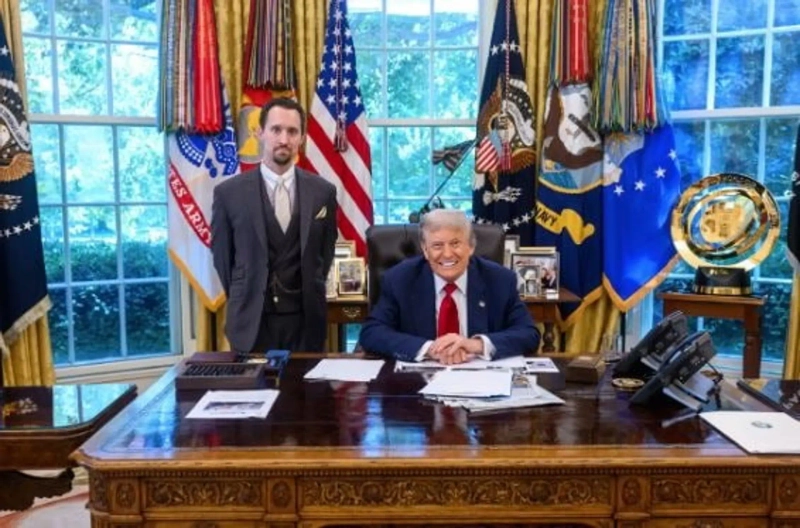
E. J. Antoni, the economist nominated by U.S. President Donald Trump as the next chief of the Bureau of Labor Statistics (BLS), argued that the publication of the BLS’s core data, the monthly employment report, should be temporarily suspended. He explained that the current report’s statistical methodology, modeling, and assumptions are fundamentally flawed. If the issuance of the employment report, which serves as the basic data for judging the health of the U.S. economy, is suspended, it is expected that the market will face considerable confusion.
○ Claims "Difficult to trust the data"
Antoni, chief economist at The Heritage Foundation, who is slated to succeed Erica McEntaffer—whom President Trump dismissed as BLS head via social media on the 1st—criticized in an interview on Fox News Digital on the 4th that "the monthly employment report’s data is hard to trust and is often overestimated." He further warned that such inaccurate data "misleads key economic decision makers from Washington to Wall Street."
In the interview, he said, "If we can’t be sure how many jobs are created or lost in the economy, how are companies supposed to make management plans, and how is the Federal Reserve (Fed) supposed to conduct monetary policy?" He emphasized that this is "a serious problem that must be resolved immediately." He continued, before resolving these issues, "the monthly employment report should be suspended, and instead, less timely but more accurate quarterly data should be released continuously." This interview was conducted a week before Trump nominated him as the next BLS director (on the 11th).
President Trump became furious and fired McEntaffer as BLS chief on the 1st after the BLS reported July's job growth, which fell short of market expectations, and sharply revised down job growth for May and June. On the 5th, he also summoned Stephen Moore, former chief economist at The Heritage Foundation, to the White House, arguing that BLS exaggerated job growth during Biden’s administration and played it down during his own presidency, saying the data was "intentionally rigged to make Republicans and me look bad." Citing unofficial BLS data, Moore claimed that the average household income of U.S. middle-class families increased by $1,174 between January and June this year, and income inequality had diminished, offering high praise for Trump.
Antoni and Moore, the BLS nominee and the former economist, share similar political views. They have regularly appeared on Fox News to positively evaluate Trump’s tariff and economic policies.
○ Criticism: "You need to take off the MAGA hat first"
The monthly employment report, published since 1915, is a key indicator—including new jobs and unemployment rates—used by industry, investors, policymakers, and even the Fed to gauge the health of the U.S. labor market.
Antoni’s nomination is not without justification—he advocates for improving data collection rates and introducing new technologies. The BLS gathers responses from 60,000 households and 120,000 businesses through phone and in-person interviews, a method maintained for decades. However, with survey response rates dropping from around 90% a decade ago to below 70%, the need for reform has been raised, and BLS has been looking to collect online responses as a long-term solution. Budget shortages also impact data quality. The BLS has decided to no longer produce about 300 subcategories of producer price data and is under pressure to reduce the survey population.
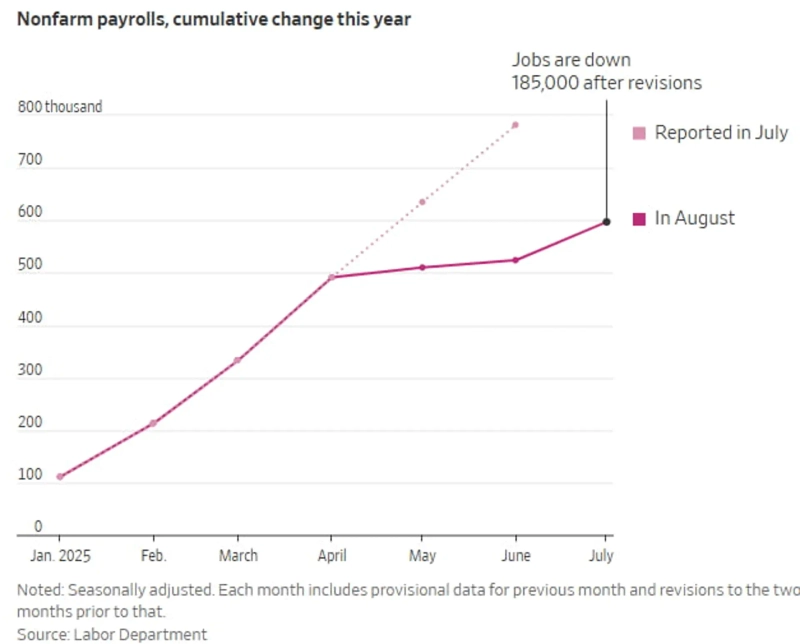
Recently, massive data revisions have occurred because delayed responses from businesses have slowed data collection, requiring later-received data to be reflected in subsequent updates, according to the Wall Street Journal (WSJ).
However, there are growing concerns in the market that Antoni’s nomination is not simply about data quality improvement. Stan Veuger, senior fellow at the American Enterprise Institute (AEI), a conservative think tank, told the Financial Times (FT), "There was hope that President Trump would choose someone reliable and not overly partisan, but Antoni is the exact opposite." He added, "Even those who support his economic policies think he is unqualified."
Jessica Riddle, senior fellow at the Manhattan Institute, told the FT, "If you publish accurate data that doesn't suit Trump, you could get fired; no trustworthy economist would want such a role." The WSJ said in its editorial, "If Antoni wants to earn public and market trust in BLS data, he’ll have to take off his MAGA (Make America Great Again) hat."
Michael McKee, a Bloomberg TV reporter, noted, "Though the indicator is sometimes delayed and revised, it's still the most reliable monthly data we have," and added that it’s uncertain whether the BLS head has the authority to suspend its publication.
Adriana Kugler, who announced her resignation on the 1st with about five months left in her term, is a labor economist who previously served as chief economist at the Department of Labor under the Obama administration and most recently as a Federal Reserve board member. As someone who played a key role in interpreting labor market indicators within the Fed, Kugler's departure—whether voluntary or pressured—was likely due to a mismatch with the Trump administration. President Trump has nominated Steve Myron, chairman of the Council of Economic Advisers (CEA), who authored a report including ideas from the "Mar-a-Lago Agreement," to take her spot. Both Antoni and Myron must be confirmed by the Senate.
○ Demands economist replacement at Goldman Sachs
U.S. President Donald Trump demanded that David Solomon, CEO of Goldman Sachs, replace the firm’s economist. On the 12th (local time), Trump emphasized the effectiveness of tariffs in a post on Truth Social, adding, "David Solomon and Goldman Sachs refuse to acknowledge what must be acknowledged."
He asserted, "The U.S. is collecting trillions of dollars through tariffs, and the results have been spectacular for our country, the stock market, and everything." He insisted that "tariffs have not caused inflation or any problems in the U.S. and have simply brought in huge cash inflows." He also argued, "It has been shown that, in most cases, it is not consumers but primarily companies and governments—many of them foreign—that bear these costs."
Trump further criticized Goldman Sachs: "They wrongly predicted the market impact and tariffs long ago, and their forecasts were wrong." He then said, "David should either find a new economist himself or stop stressing about managing a major financial firm and just focus on DJing."
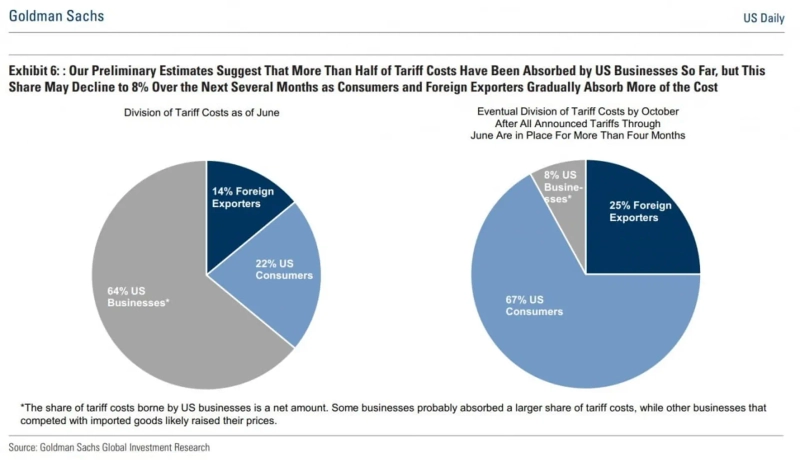
The economist mentioned by Trump is Jan Hatzius, chief economist at Goldman Sachs. Recently, the company analyzed that, as of June, American firms bore 64% of the tariff burden, U.S. consumers 22%, and foreign exporters 14%. By around October, it expected this to shift to U.S. consumers bearing 67%, foreign exporters 25%, and American companies 8%. While U.S. importers are currently absorbing the tariff shock, once inventories run out and rates stabilize, the burden is predicted to be passed on to consumers.
Recently, Trump has also been intervening in company management, ordering Coca-Cola to release cane-sugar-sweetened products and urging Liputan, CEO of Intel, to resign.
Washington—Sang-eun Lee, correspondent selee@hankyung.com

Korea Economic Daily
hankyung@bloomingbit.ioThe Korea Economic Daily Global is a digital media where latest news on Korean companies, industries, and financial markets.