

Silver rises 30% this year… Nearing $40 breakthrough
Summary
- International silver prices have risen over 30% this year, driven by supply shortages, increased industrial demand, and undervaluation compared to gold.
- Global IBs analyze that silver prices have entered a structurally rising phase and anticipate mid- to long-term growth, including the potential for a $40 breakthrough within the year.
- However, some forecast the average silver price next year may drop to $34 due to decreased demand from technological innovation in the solar industry and concerns over weaker demand in China.
Supply shortages coupled with industrial demand
Utilized as material for solar panels and electric vehicles
Supply instability from Mexico
Undervaluation compared to gold highlighted
Global IBs: "Prices will go higher"
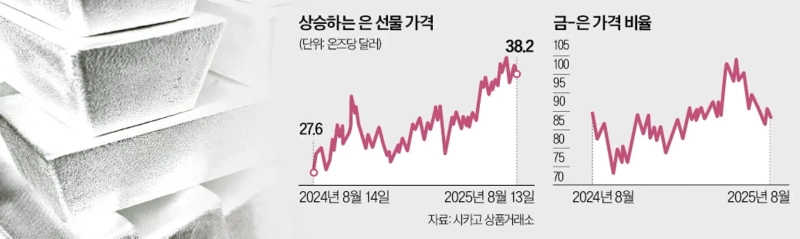
International silver prices have surged by over 30% so far this year, maintaining their upward trend. The rise is due to a combination of supply shortages and increased industrial demand. The widening gap caused by the soaring price of gold has also contributed to higher silver prices. Global investment banks (IBs) analyze that silver prices have entered a structurally rising phase.
According to the Chicago Mercantile Exchange (CME) on the 13th, the price of international silver futures stood at $38.2 per ounce, up 32.2% from $28.9 at the start of the year. After surpassing the $35 mark in June, prices have been fluctuating as they approach resistance at $40. Investors are closely watching to see if the $40 level will be breached.
The rise in silver prices has been driven by a combination of supply shortages and increased demand. According to market research firm The Silver Institute, last year’s silver demand exceeded production by 215 million ounces. The supply shortfall was at a record high, while inventories dropped to an all-time low.
The increased use of silver as an industrial material in solar power and electric vehicles had a significant impact. Silver is regarded as an irreplaceable essential industrial material due to its low resistance and high stability. Electric vehicles use 25–50g of silver per unit, which is more than double that of internal combustion engine vehicles. Silver also sees broad use in artificial intelligence (AI), 5th generation (5G) sensors, and more. Last year, 55% of silver supply was used as an industrial material, up 10 percentage points from 45% a decade ago.
Supply instability also pushed silver prices higher. This is because Mexico, which accounts for about a quarter of global silver production, has been engaged in a tariff dispute with the United States. While President Donald Trump of the United States said he would not impose tariffs on gold, he has made no such comments regarding silver.
Gold, which often moves closely in price correlation with silver, has also surged, further impacting silver’s relative valuation. When gold outpaces silver, silver’s relative undervaluation becomes highlighted. This can be seen through the gold-silver ratio (GSR), with a historical average in the 50–60 range. Currently, it is trading around 90, and at the beginning of the year it even exceeded 100. A high ratio means the price gap between gold and silver is large. When economic uncertainty grows, investors flock to gold and the GSR climbs; conversely, as uncertainty recedes, the GSR typically drops. Recently, as tariffs uncertainty from the United States has somewhat settled, the gold-silver price gap has also started to narrow.
Global IBs weigh in on the expectation that silver prices will continue rising mid- to long-term. Citigroup projected there is a possibility that the price could break through the $40 per ounce range within several months, and anticipated it could rise to the $43 range within a year. Bank of America and Saxo Bank also predict that silver may surpass the $40 mark as early as this year.
However, views are mixed concerning silver demand. The solar panel industry is reducing silver usage through technological innovation. There are also concerns about the weakening demand for solar power in China. HSBC, citing these reasons, predicts the average silver price next year to be around $34, which is lower than the current level and diverges from other IBs’ forecasts.
Yoon Sang Ko | kys@hankyung.com

Korea Economic Daily
hankyung@bloomingbit.ioThe Korea Economic Daily Global is a digital media where latest news on Korean companies, industries, and financial markets.