

PiCK
U.S. avoids tariff-driven inflation… "94% chance of a baby cut in September"
Summary
- The market reported that the probability of the U.S. Federal Reserve lowering the benchmark interest rate in September surged to 94.4%.
- Despite concerns over tariffs, the U.S. inflation rate remained moderate, and the probability of an additional rate cut by year-end has risen above 90%.
- Some Fed officials and market experts maintain a cautious stance on rate cuts, and companies are reportedly cautious about passing on costs to consumers due to fears of reduced spending.
Besant: "Should lower by 0.5%P next month"...Following Trump, presses Fed
Rate cut momentum after July CPI release
Stable U.S. inflation despite tariff concerns
4.25% probability next month up 40%P in a month
90% probability of additional cut in December
Cautious stance remains on Wall Street and within the Fed
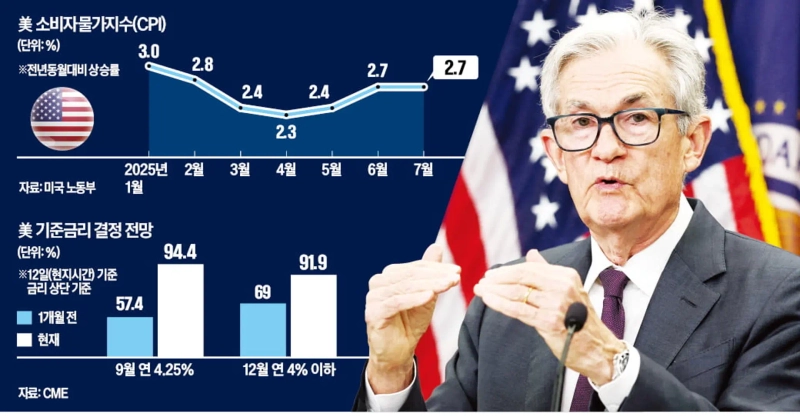
With the release of the July U.S. Consumer Price Index (CPI), the market is taking an interest rate cut by the Federal Reserve (Fed) at its September meeting as a foregone conclusion. The likelihood of an additional cut in December has also risen above 90%. Contrary to market concerns, the tariff policies of the Donald Trump administration resulted in only moderate price increases. Pro-Trump figures reiterated that "the impact of tariffs on prices is limited," increasing pressure for a rate cut.
◇ "94% chance of a rate cut in September"
The U.S. Department of Labor announced on the 12th (local time) that the July CPI rose 2.7% year-on-year—the same as the previous month—and increased by 0.2% from the month before. Core CPI, which excludes the more volatile energy and food sectors, rose 3.1% year-on-year and 0.3% from the previous month. The year-on-year increase in core CPI was the highest in five months. Still, price increases due to tariffs were more subdued than the market had feared.
In the market, expectations grew more certain that the Fed would lower the benchmark rate at the September Federal Open Market Committee (FOMC). According to the Chicago Mercantile Exchange (CME) FedWatch, after the CPI release, the futures market saw a 94.4% probability that the Fed would cut the upper bound of rates to 4.25% by lowering the key rate by 0.25% point at its September meeting. This is up 8% points from the previous day and about 40% points from a month ago.
Expectations for further rate cuts by year-end also strengthened. The probability that the upper bound of the benchmark rate would be set at 3.75% at the December FOMC was 50.7%, and 41.2% for 4%. The probability that the benchmark rate would be 4% or lower rose from 69% a month ago to 91.9% now. The Wall Street Journal (WSJ) explained, "A moderate rise in prices will remove obstacles to rate cuts."
◇ Treasury Secretary Besant calls for a 'big cut'
After the CPI announcement, President Trump increased pressure on Fed Chair Jerome Powell, saying he is considering a lawsuit regarding the interest rate cuts. He criticized via his social media, saying, "The always ‘too late’ Powell should lower rates immediately," and "The damage caused by Powell always acting too late is incalculable." He also mentioned that a "major lawsuit" was being considered over the cost of refurbishing the Fed building.
Scott Besant, U.S. Treasury Secretary, during a Fox Business interview on the same day, pushed for a "big cut" (a 0.5% point rate reduction), citing recent downward revisions to Department of Labor employment statistics for May and June. He emphasized, "If the correct figures had been available, the Fed would have cut rates in June or July," and, "What we really need to consider now is for the Fed to lower rates by 0.5% point in September to make up for the delay or data gaps."
Steven Miran, newly nominated National Economic Council Chair at the White House to succeed former Federal Reserve Board member Adriana Kugler, who resigned on the 1st, also backed the claim that "tariffs do not cause inflation." In a CNBC interview, Miran stated, "Predictions of disaster have not become reality, and they won’t in the future." James Bullard, former President of the Federal Reserve Bank of St. Louis and a candidate for the next Fed Chair, also described the price increases due to tariffs as "only temporary." He added, "Fed is likely to begin lowering rates in September and to cut the key rate by a total of 1% point over the next 12 months."
However, caution remains within the Fed. Jeffrey Schmid, President of the Federal Reserve Bank of Kansas City, commented, "Just because the impact of tariffs on inflation is currently minimal doesn’t mean it’s an opportunity for rate cuts," and, "Rather, it should be interpreted as a sign that monetary policy has been appropriately adjusted." Wall Street agreed. BMO Capital Markets noted, "Commodity prices in July were lower than expected, partly because many companies were cautious about passing tariffs onto consumers," adding, "They fear that with consumers being more cautious, sales could fall."
Reporter Hankyung Han hankyung@hankyung.com

Korea Economic Daily
hankyung@bloomingbit.ioThe Korea Economic Daily Global is a digital media where latest news on Korean companies, industries, and financial markets.