

Trump Secures Control Over Rare Earths and Steel... Now Aiming to Be 'Chip Commander-in-Chief'
Summary
- The Trump administration is reportedly pushing the acquisition of a stake in Intel, aiming to strengthen control over core strategic materials like semiconductors.
- Following the news of the acquisition, Intel's stock price surged by 7.38%, raising expectations for U.S. leadership in AI and advanced electronics through the strengthening of its foundry business.
- With the Trump administration expanding control from core industries such as steel and rare earths to semiconductors, The Wall Street Journal raised concerns about government intervention in corporate management.
Just one week after meeting the Intel CEO… Moves to acquire a stake
CEO Tan Successfully Persuades Trump
Actively addressed suspicions of ties with China
Sale proceeds to be invested in the foundry plant
On news of the acquisition, Intel shares surge 7.38%
U.S. counters China’s push into strategic industries
Transferring production facilities, supply chains, etc.
U.S. government gains decision-making authority
WSJ also criticizes: "Resembling China’s model"
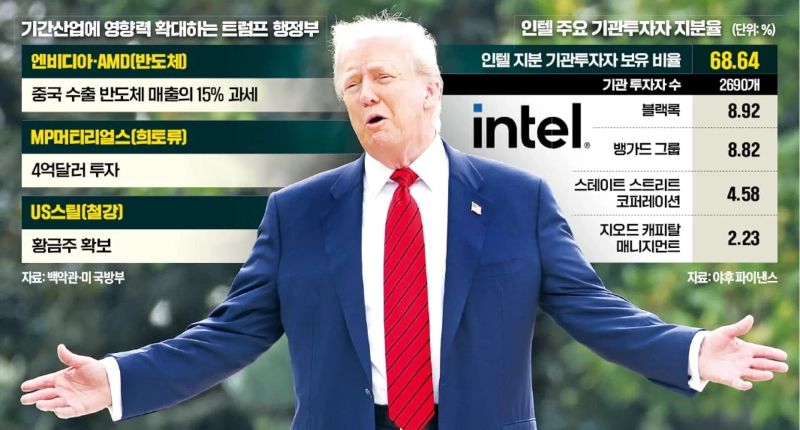
The Trump administration’s effort to acquire a stake in Intel is seen as a move to strengthen government influence over key strategic materials such as semiconductors. Following recent moves to secure control over core industries like steel and rare earths, this is interpreted as Trump seeking to gain a hold on the semiconductor sector as well. The New York Times has even dubbed him the "Chip Commander-in-Chief." This is largely a response to China’s own aggressive expansion of strategic industries through massive subsidies to its so-called private enterprises.
◇Tan in a Tight Spot—Was the Deal a Success?
According to the tech industry on the 14th (local time), the relationship between the Trump administration and Lip-Bu Tan, CEO of Intel, has changed dramatically in just a week. On the 7th, President Trump pressured Tan on his social media platform, Truth Social, stating, "CEO Tan must resign immediately." Trump raised concerns over Tan, a former venture capitalist, and his investment history, as many of his invested companies are suspected of links with the Chinese military.
Trump’s onslaught against CEO Tan softened after a White House meeting on the 11th. Following their meeting at the White House, Trump called it a "remarkable success story" and made a dramatic turnaround. He also hinted at a possible deal, stating, "CEO Tan and members of the administration will spend time together next week and bring me proposals."
In Washington, it is speculated that during the White House meeting, CEO Tan actively explained away the allegations of collusion and proposed additional deals to Trump. It’s believed that he succeeded in convincing President Trump, who views Intel’s foundry as a national interest issue.
Trump’s demand for Tan’s resignation stems from concerns that the head of Intel—receiving massive government support under policies like the CHIPS Act—could have close ties to China. However, the U.S. government also faces a dilemma, as Intel, which declared a foundry revival in 2022, cannot be left to abandon it again. This would mean having to rely entirely on allies like TSMC in Taiwan and Samsung Electronics in South Korea for key AI chip manufacturing facilities.
On the 6th, former Intel board members Charlene Barshefsky and others asserted in an editorial that “Intel withdrawing from the foundry business would hand America’s leadership in AI and advanced electronics to just two companies: TSMC and Samsung Electronics.” Reportedly, Trump, too, pressured not only U.S. companies like Nvidia but also TSMC to invest in Intel earlier this year to strengthen its foundry.
Tan himself, aiming to maintain the foundry business, is seen as having aligned interests with Trump. Frank D. Yeary, Chairman of Intel’s Board, has been pushing to sell Intel’s foundry division, which has faced deficits since 2022. In contrast, CEO Tan has publicly maintained the stance of “saving the foundry.” Should Trump lend support to Intel’s foundry business for geopolitical reasons, insiders anticipate Tan’s position against board pressure will be strengthened.
◇Trump Expands Influence Over ‘Core Industries’
The Trump administration is also broadening its influence in other key industries like steel and rare earths. In June, it approved Nippon Steel Corporation’s acquisition of U.S. Steel—on the condition that the U.S. government would retain a “golden share.” This gives the government decision-making powers on issues such as relocating company headquarters, production facilities, sourcing materials, and altering supply chains.
Last month, on the 10th, the Department of Defense invested $400 million (about ₩5500 billion) to acquire a 15% stake in MP Materials, the only rare earth mining company in the U.S. MP Materials has agreed to supply all rare earth magnets mined at the Mountain Pass Mine in California, to the Department of Defense for ten years, starting with the site's completion in 2028. The method of acquiring a stake in Intel is likely to follow the precedent set by MP Materials. With the administration’s blatant intent to intervene in corporate management, The Wall Street Journal (WSJ) even criticized the move, saying the U.S. is “becoming more like socialist China.”
Previously, U.S. government takeovers of management authority have typically followed bankruptcy procedures known as 'Chapter 11.' In 2009, during the global financial crisis, the Obama administration acquired shares in General Motors (GM) and Chrysler, which were in financial trouble, but later sold off all holdings by the following year and in 2011 respectively.
Silicon Valley—In-yeop Kim, correspondent inside@hankyung.com

Korea Economic Daily
hankyung@bloomingbit.ioThe Korea Economic Daily Global is a digital media where latest news on Korean companies, industries, and financial markets.