

The Rebellion of the No. 2 Crypto Asset...Ethereum Beats Bitcoin
Summary
- Ethereum recently surged over 50% in a month, surpassing 6 million KRW domestically, with net buying of ETFs by global institutional investors significantly increasing.
- US passage of the Genius Act and the Pectra Upgrade have strengthened Ethereum's technological capabilities and regulatory foundation, boosting its investment appeal.
- Experts pointed out that there are also concerns about profit-taking due to the rapid price surge and the potential for swift changes in investor sentiment.
Cover Story
The Charge of Ethereum
Surpassing 6 Million KRW Domestically for the First Time
Global Institutional Investors
Net Buying of Ethereum ETFs
Over 50% Surge in a Month
Bitcoin Remains Mostly Unchanged
Genius Act Passed in the US
Strengthened Technological Edge Also Attractive
US Public Companies Increasing Their Holdings
SC Bank: "$7,500 Possible"
Some Voices: "Concerns Over Profit-Taking"
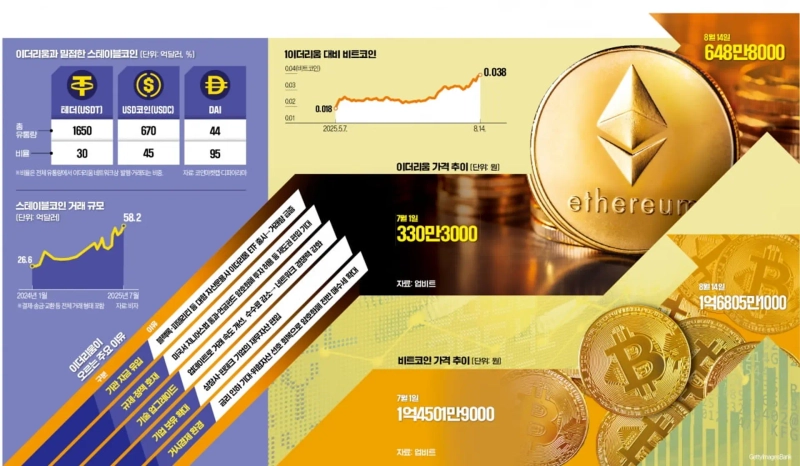
Ethereum surged more than 50% in the past month. It hit an all-time high, but its recent growth is modest compared to that of Bitcoin. Since Ethereum's price had long lagged behind Bitcoin's, its recent rise has been especially sharp. This is analyzed to be due to stablecoins being incorporated into the US regulatory framework and more companies holding it as an asset.
Ethereum Approaching All-Time High
According to the domestic crypto exchange Upbit, Ethereum soared 57.2% in the past month, well surpassing the 6 million KRW mark. This is the first time Ethereum has ever traded at the 6-million-KRW level in Korea. In the global market, Ethereum is trading around $4,700 and is approaching its all-time high of $4,891.70 recorded in November 2021. Although Ethereum is ranked second by market capitalization after Bitcoin, its recent rise has closed much of the gap. According to CoinMarketCap, Ethereum's market cap is $570.2 billion, about 25% that of Bitcoin’s market cap ($2.24 trillion). This is a significant difference even compared to just three months ago in May (11.7%). Ethereum’s value relative to Bitcoin has also increased. In April, 1 Ethereum was worth only 0.018 Bitcoin, but it has recently risen to about 0.038 Bitcoin. Ethereum’s rate of increase is overwhelming compared to the overall market’s rise (12.8%).
Ethereum’s price has risen sharply due to inflows from global institutional investors. Major asset management firms like BlackRock, Fidelity, and Grayscale have launched Ethereum spot Exchange-Traded Funds (ETFs), driving simultaneous buying by both institutions and individuals. Ethereum spot ETFs have recorded explosive trading volumes since their listing. According to Bloomberg, the cumulative trading volume of Ethereum spot ETFs had reached $123.5 billion (about 165 trillion KRW) by the end of last month.
Close Ties with Stablecoins
The recent passage of the Genius Act by the US Congress also backs Ethereum’s strength. The core of the Genius Act is to integrate stablecoins into the regulatory framework. Most major stablecoins are issued and traded on the Ethereum network. Tether (USDT), the world’s largest, sees 30% of its total circulation traded on Ethereum. For USDC, this figure is 45%. For Dai (DAI), it reaches 95%. As the Genius Act has clarified the legitimacy of Ethereum-based payments and remittances, interest in Ethereum is growing.
Enhanced technical competitiveness of Ethereum itself is also analyzed as a positive influence on investment sentiment. The Pectra Upgrade completed in May 2024 greatly improved the speed of the Ethereum network and lowered transaction fees. Previously, Ethereum’s network was hampered by slow transaction speeds and high fees, but this upgrade has significantly improved its performance. As technical convenience has increased, expectations are rising that the Ethereum ecosystem—including DeFi (blockchain-based financial services) and NFTs—will expand further.
An increasing number of US-listed public companies now hold Ethereum. This is referred to as a 'Digital Asset Treasury (DAT)'—a strategy of stockpiling coins. BitMine Immersion Technologies holds a total of 1,152,630 Ethereum tokens, worth approximately ₩7.361 trillion. Nasdaq-listed Sharplink Gaming also holds 598,800 Ethereum tokens. Nasdaq-listed 180 Life Sciences changed its name to Etherzilla and announced it would convert a portion of its financial assets to Ethereum.
Favorable Macro Environment
As inflation in the US has eased, expectations are rising that the Fed will soon cut its benchmark interest rate, which generally boosts the crypto market. A rate cut by the Fed usually weakens the dollar’s value and makes safe assets like deposits and bonds less attractive. As a result, investors turn their eyes to riskier assets such as stocks and cryptocurrencies in search of higher returns. Such macroeconomic changes are analyzed as a positive factor encouraging capital inflow into the crypto market overall.
Standard Chartered Bank (SC Bank) raised its year-end price target for Ethereum from $4,000 to $7,500, and further projected it could reach $25,000 by 2028. SC analyst Geoff Kendrick cited several reasons for the higher target: more than half of all stablecoins are issued based on Ethereum and already account for 40% of blockchain fees, as well as rapidly growing institutional demand, crypto-friendly regulations, and network upgrades.
However, as the price has risen sharply in a short time, a short-term correction is possible. Typically, after a surge, profit-taking leads to an increase in sell orders. Especially since the recent upward momentum has largely depended on events such as the ETF launch and regulatory news, there are concerns that investor sentiment could cool quickly.
Reporter Mihyun Cho, mwise@hankyung.com

Korea Economic Daily
hankyung@bloomingbit.ioThe Korea Economic Daily Global is a digital media where latest news on Korean companies, industries, and financial markets.