

"PBR 1.6x Approaching"...Nikkei Index Breaks New Ceilings
Summary
- Japan's Nikkei Index has continually broken all-time highs, with the PBR approaching 1.6x.
- The recent market rally has been driven by buying activity in various stocks, as investors look for relatively undervalued stocks.
- Nakamura, a market strategist at Mizuho Securities, analyzed that the key to sustaining market momentum will be whether Japan’s equity trading value remains at its current high levels.
'High-flying' Japanese Stock Market
Nikkei Index Sets Another All-time High
Up 0.77%, Reaches 43,714
Average PBR Nears 1.6x…"Further Upside Ahead"
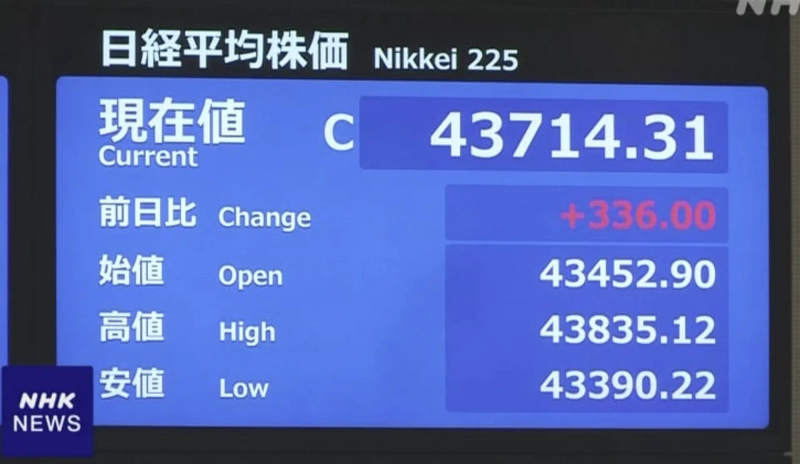
Japan's Nikkei Index reached another all-time high on the 18th. It broke records for the fourth time since the 12th. With the average price-to-book ratio (PBR) of Nikkei constituents nearing 1.6x, forecasts suggest the stock market will continue its upward momentum.
On this day at the Tokyo stock exchange, the Nikkei Index closed at 43,714.31, up 0.77% from the previous trading day (the 15th). For two consecutive trading sessions since the 15th, new all-time highs were set.
Since the index broke records three times last week alone, there were many predictions that the rally would slow this week. Sawada Ryotaro, senior analyst at Tokai Tokyo Intelligence Lab, said, "Despite a lack of notable catalysts across the market, there’s an unusually strong buying energy."
The stocks leading the market rise were different from usual. Tokyo Electron and Sony Group each fell 2.13% and 2.53% respectively, showing weakness among core Japanese stocks in semiconductors and electrical machinery. Bank stocks, which had surged last week on expectations for a Bank of Japan interest rate hike, also faced notable declines.
Meanwhile, various stocks such as J. Front Retailing and Isetan Mitsukoshi in retail, which hit their highest prices in a decade, and Suzuki in automobiles, were bought, supporting the entire market.
The surge in Japanese stocks accelerated after the US-Japan tariff talks concluded in late July. Many investors saw the 'Obon' holiday period, when trading volume typically drops, as a buying opportunity. Regarding continued all-time highs during Obon, Shimada Kazuaki, chief strategist at Iwai Cosmo Securities, analyzed, "Investors who were unable to secure enough shares are looking for relatively undervalued stocks."
There are no obvious signs of slowdown in the US economy either, and the US stock market continues to hit new record highs. Ueno Hiroyuki, chief strategist at Mitsui Sumitomo Trust Asset Management, pointed out, "With inflation settling in Japan, strong earnings expectations have also become justified." Waiting to buy has now become a risk, he explained.
With the sharp surge in stock prices, valuations have surpassed last year's peaks. The average PBR for Nikkei constituents now stands at 1.58x, above the peaks of 1.57x recorded in March and July last year. Nakamura Katsuhiko, market strategist at Mizuho Securities, reported, "Investor activity in seeking lagging stocks is spreading into every corner of Japan's equity market."
The key is trading volume. Nakamura, the market strategist, analyzed, "The main issue is whether Japan's equity trading volume can stay at these elevated levels." Currently, the average daily trading value of the Prime Market over the past 20 days has increased to ¥5.2 trillion, but there are concerns that if trading value decreases due to foreign investors withdrawing, market momentum may decline.
Tokyo=Kim Il-kyu, Special Correspondent

Korea Economic Daily
hankyung@bloomingbit.ioThe Korea Economic Daily Global is a digital media where latest news on Korean companies, industries, and financial markets.