PiCK
BIS’s Hyun Song Shin Says Won Stablecoin Wouldn’t Curb Demand for Dollar Tokens
Summary
- Shin said 63% of cryptocurrency crime is facilitated by stablecoins.
- Shin said a won stablecoin would not curb demand for dollar stablecoins and could become a channel for capital outflows.
- Shin and other participants said public-sector digital currencies such as CBDCs and Project Hangang are the alternative.
Forecast Trend Report by Period


Hyun Song Shin, BIS Economic Adviser and Head of Research
Speech at a Session on Central Bank Digital Currencies
Local-Currency Stablecoins
Could Become a Channel for Capital Outflows
CBDCs Presented as the Alternative
BOK’s Project Hangang Should Continue
63% of Crypto-Related Crime
Is Tied to Stablecoins
“Stablecoins are involved in 63% of cryptocurrency crime. One way to prevent that is to restrict coin conversion for wallets linked to illicit transactions.”
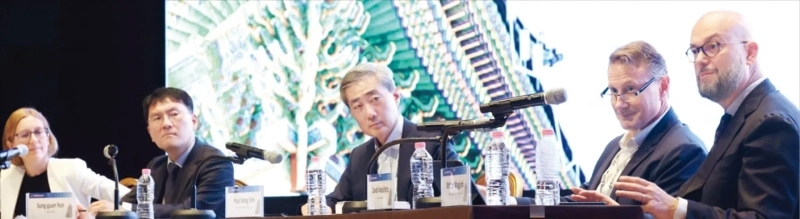
Hyun Song Shin, economic adviser and head of research at the Bank for International Settlements, made the remarks on Aug. 21 during a session on the state of central bank digital currencies at the World Congress of Economists held at Coex in Seoul. Shin, one of the BIS’s top officials, said stablecoins are widely used in financial crime and to circumvent controls on capital inflows and outflows. He added that even in countries with legal safeguards such as foreign-exchange transaction laws, it is difficult to block illegal stablecoin trading.
‘Stablecoin Crime Must Be Stopped’
Shin proposed regulating stablecoins by tracing the history of wallets through which they have passed and assigning them a “lawful use score.” Under that approach, coins that moved through wallets linked to illegal transactions would be identified and scored, and banks would refuse conversion if the score fell below a certain threshold. Tokens that are difficult to exchange at banks because of low scores would trade at a discount to other coins, creating an incentive to avoid illicit transactions. International coordination would be desirable, but individual countries could adopt the system immediately, he said.
He also offered a bleak view of won-denominated stablecoins. Demand for dollar stablecoins would persist even if countries introduced stablecoins denominated in their own currencies, including the won, he said. Local-currency stablecoins could instead facilitate swaps into dollar-denominated crypto assets and become a channel for capital outflows. The remarks directly challenged the argument that a won stablecoin would protect monetary sovereignty from encroachment by dollar stablecoins. Dollar-denominated tokens currently account for 99% of stablecoins in circulation worldwide.
Shin presented a digital currency platform centered on tokenized central bank money and commercial bank money as the alternative to stablecoins. He said the Bank of Korea’s Project Hangang and the BIS’s Project Agorá could serve that role. Project Hangang, in particular, should continue without interruption, he added.
CBDC Adoption Would Improve Transparency
Yoon Sung-kwan, head of the Digital Currency Research Lab at the Bank of Korea, outlined the progress of Project Hangang. More than 80,000 people participated over three months, successfully testing fast, fee-free payments and programmable smart voucher functions, he said. Yoon called CBDCs an important turning point toward a more transparent and efficient financial ecosystem. He said a CBDC platform could also help governments manage public finances more transparently by tracking the flow of public funds such as subsidies.
Most economists at the session also favored CBDCs over stablecoins. Matteo Maggiori, a professor at Stanford Graduate School of Business, said stable digital money grounded in the public sector is needed rather than leaving everything to private players. Silvana Tenreyro, an economics professor at the London School of Economics and former member of the Bank of England’s Monetary Policy Committee, said funding costs in South Korea would rise if Korean deposits were converted into dollar stablecoins.
Kim Young-sik, a professor of economics at Seoul National University, said 19% of 3,561 adults surveyed chose CBDCs as their most preferred payment method. A general-purpose CBDC could gain broad use if introduced, he added.
Cho Sung-hoon, a professor of economics at Yonsei University, said the rapid spread of stablecoins is increasing financial instability and the risk of a coin run. That is strengthening the case for introducing a CBDC.
Kang Jin-kyu and Lim Da-yeon, Korea Economic Daily reporters josep@hankyung.com

Korea Economic Daily
hankyung@bloomingbit.ioThe Korea Economic Daily Global is a digital media where latest news on Korean companies, industries, and financial markets.