

Despite surging stock prices, the won's value plunges…"Won·dollar could exceed 1440 won"
Summary
- "The won–dollar exchange rate" rose to its highest level in 5 months, highlighting the decline in the won's value.
- Experts forecast a high possibility that the won–dollar exchange rate will further increase above 1440 won.
- Korea–U.S. summit negotiations and investment to the U.S. could act as important variables for the exchange rate's rise.
Exchange rate at highest in 5 months
Weak yen and euro spur a strong dollar
The rule 'exchange rate up, stocks down' is broken
Resolution of Korea-U.S. trade talks is the biggest variable
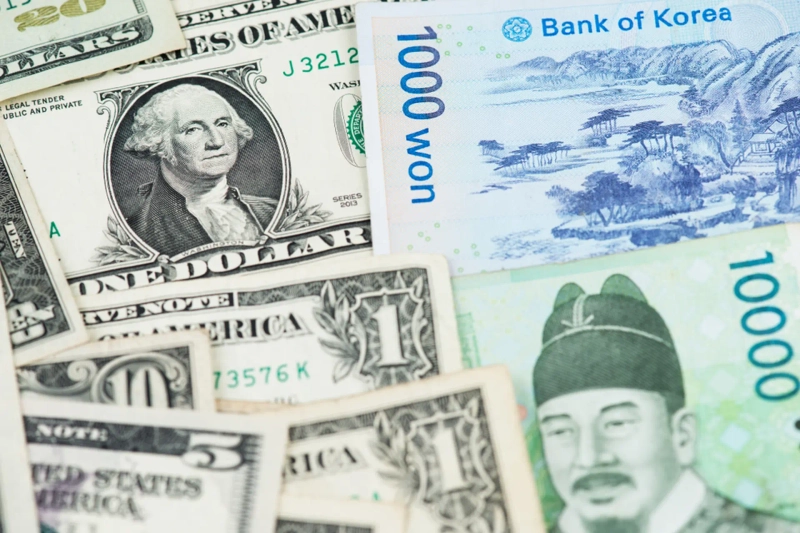
Although the stock index once again hit an all-time high, the won–dollar exchange rate rose to its highest level in 5 months (the won's value fell). With trade talks with the United States stalled, the dollar strengthened amid weakness in the Japanese yen and the euro, which had an impact. Experts predicted the won–dollar exchange rate could rise above 1440 won.
On the 10th at the Seoul foreign exchange market, the won–dollar rate closed the week's trading at 1421 won, up 21 won from the previous trading day. It was the highest in about five months since April 29 (1437 won 30 jeon). The increase (21 won) was the largest since April 7 when it rose 33 won 70 jeon.
That day, the rate continued the trend of surging to the mid-1420 won range in offshore trading during the holiday. As the currencies of advanced economies such as Japan and Europe fell during this period, the dollar strengthened and the won was relatively devalued. In Japan, Sanae Takaichi, the LDP leader and a likely next prime minister, was expected to carry on Abenomics and launch 'Sanae-nomics', sending the yen down by nearly 4%. In Europe, the euro weakened after French Prime Minister Sébastien Lecornu resigned 27 days after his appointment following conflicts over the budget bill.
That day the KOSPI index surpassed 3600, but it was insufficient to pull the exchange rate down. Generally, when stock prices rise, the won–dollar rate tends to fall. One reason this rule has not held recently is continued overseas investment by domestic investors. Min Kyung-won, an economist at Woori Bank, explained, "Domestic residents' overseas stock investments, chasing the U.S. stock market's record-high rally, are exerting upward pressure on the exchange rate." The unresolved pressure for the U.S. government's US$350 billion cash investment is also cited as a factor sustaining the high exchange rate.
Experts see a high likelihood that the exchange rate will rise further for the time being. Park Sang-hyun, a researcher at iM Securities, said, "For the time being, the won–dollar rate's movement depends on the yen," and added, "Next week, the rate is expected to move between 1400 and 1440 won." Economist Min Kyung-won predicted, "If 1420 won is quickly breached, a consensus could form that the upper bound has opened up to just short of 1470 won."
Korea Investment & Securities adjusted its Q4 won–dollar rate forecast range from the previous 1320~1430 won to 1350~1440 won. Moon Da-un, a researcher at Korea Investment & Securities, said, "Whether a Korea–U.S. summit will result in negotiations favorable to the won is a variable," and added, "If investment to the U.S. is executed in a short period, foreign currency outflows could rapidly expand and raise the exchange rate level by more than 100 won."
Kang Jin-kyu reporter josep@hankyung.com

Korea Economic Daily
hankyung@bloomingbit.ioThe Korea Economic Daily Global is a digital media where latest news on Korean companies, industries, and financial markets.