

Won–dollar exchange rate breaks through 1430 won amid U.S.-China tensions… highest in 5 months
Summary
- The article reported that, due to U.S.-China trade war risks, the won–dollar exchange rate topped 1430 won in early trading, marking the highest level in 5 months.
- Min Kyung-won, an economist at Woori Bank, said that the trade conflict and a contraction in risk appetite are likely to increase the pressure of won weakness.
- However, he warned that ample supply from exporters' dollar nego (selling) volumes around the 1430 won level could cap the upside.
Currently slipped back into the 1420 won range
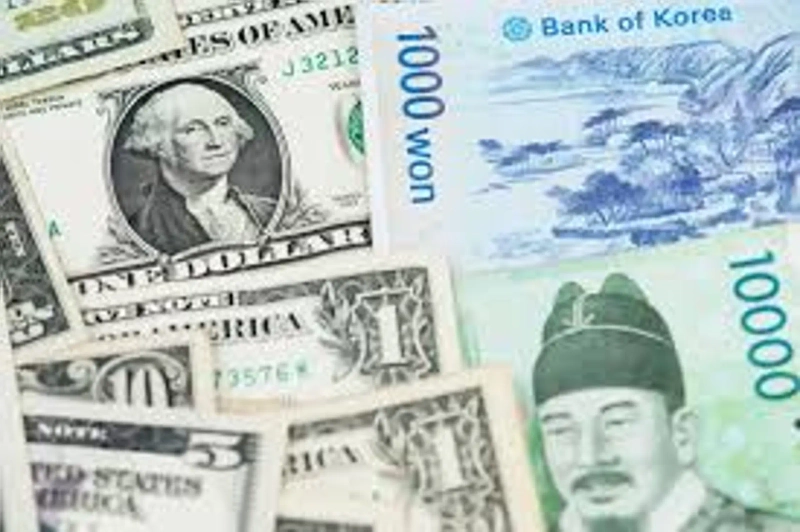
As U.S.-China trade war risks resurfaced, the won–dollar exchange rate topped 1430 won in early trading.
On the 13th at the Seoul foreign exchange market, the won–dollar exchange rate opened at 1430 won, up 9 won from the previous session. Based on intraday highs, it marked the highest level in about 5 months since May 2 (1440 won).
Immediately after the opening, the rate rose to 1434 won. As of 9:21 a.m., it was trading at 1426.8 won, showing high volatility.
It is analyzed that the won weakened due to the impact of the trade conflict. Earlier, China announced it would impose a 'special port service fee' of 400 yuan per net ton on U.S.-related vessels. It also halted imports of U.S. soybeans and announced plans to tighten controls on exports of rare earth alloys.
In response, on the 10th (local time) the U.S. added 100% to the existing average 55% tariff rate on China and took measures to restrict exports of key software. However, as major U.S. indices plunged due to the tariff war, President Trump said, "The United States is not trying to hurt China but to help it," and moderated the level of pressure on China.
In a pre-opening report, Min Kyung-won, an economist at Woori Bank, said, "With U.S. President Donald Trump announcing plans for steep tariff increases, Asian stocks and currencies are highly likely to fall together," adding, "Over the weekend President Trump said he was willing to resolve the matter through talks with China, but it is questionable whether already damaged investor sentiment can successfully rebound."
He went on to say, "In the case of the won, given its sensitivity to trade wars and reduced risk appetite, we judge that downside pressure will increase."
He said export firms' nego (dollar selling) volumes would limit the upside. Economist Min diagnosed, "The foreign currency held by domestic companies is about 93 billion dollars (as of the end of August), and considering that end-of-Q3 negotiating was not as strong as expected and export performance was favorable, dollars that could be supplied above 1430 won are more than abundant."
Jin Young-gi, Hankyung.com reporter young71@hankyung.com

Korea Economic Daily
hankyung@bloomingbit.ioThe Korea Economic Daily Global is a digital media where latest news on Korean companies, industries, and financial markets.